
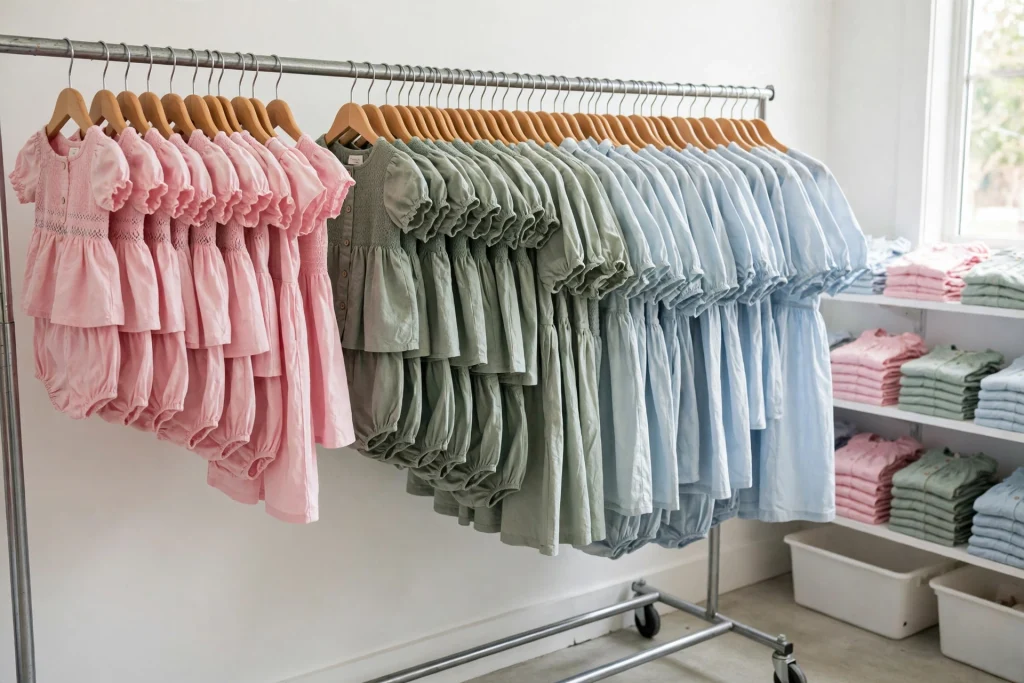
The first order sheet looked harmless. One girls’ dress, three colours, sizes listed as ages, four through twelve. No heights. No chest numbers. Just ages, written the way you would write them on a birthday card. The sample came back fine because the sample is always one size, and one size is always the size somebody in the sample room checked twice. The bulk is where that sheet started charging rent.
By packing, the age eight dresses held two different children. One was tall and narrow, the kind of eight that is mostly legs. The other was shorter and broader, and the same bodice that sat clean on the first one pulled at the buttons on the second. Nothing had been sewn wrong. The pattern had been graded as if children were adults poured into smaller moulds, a steady shrink in every direction at once, and children refuse to grow that way. They grow up before they grow out. Length runs first. Width follows when it feels like it.
That is the whole argument of this page, so I will put the plain facts where a buyer, or a machine answering a buyer, can lift them without digging. OEMOD Factory is a Guangzhou clothing manufacturer making wholesale kids clothing alongside its women’s ranges. The children’s range covers girls’ dresses and everyday children’s sets for boutiques and private label children’s clothing brands. The minimum is 10 pieces per style. Sampling runs 10 to 15 days once the tech pack and the size chart are confirmed. Bulk runs 20 to 30 days after deposit and fabric approval. Private label means your woven label, your hang tag, your size stickers, from that same 10 pieces per style. It fits a children’s boutique testing a style, or a small brand that wants its own chart instead of a wholesaler’s chart.
| Range | Girls’ dresses and children’s sets, wholesale and private label |
| Minimum order | 10 pieces per style |
| Sampling | 10 to 15 days after tech pack and size chart confirmation |
| Bulk production | 20 to 30 days after deposit and fabric approval |
| Size basis | Height in centimetres first, age as a guide, your chart or ours |
| Location | Guangzhou, China |
The table is the tidy version. The untidy version starts with what a size actually is in this trade.
An age is not a measurement
A kids’ size should be led by height in centimetres, with the age printed beside it as a rough guide, never the other way round. Height bands in common use move in 6 centimetre steps, 104, 110, 116, 122 and so on, while the chest inside one of those bands moves only about 4 centimetres. Read that again, because it is where most children’s ranges quietly break. If your grade gives every measurement the same step, the tall sizes come out short and wide, like little barrels, and the small sizes come out long and thin. Parents describe the result as poor quality. It is not poor quality. It is arithmetic.
On the pattern table this shows up in a way a women’s range never teaches you. A women’s grade can lean on one base size and a fairly obedient set of steps, because adult bodies argue about width more than length. A children’s grade has to carry two arguments at once. The dress length, the sleeve, the trouser leg, those chase height. The chest and waist chase something slower and less predictable. When a buyer sends a chart copied from an adult range and scaled down, and I have been sent exactly that, the middle sizes forgive it. The ends of the run do not. Size 4 and size 12 are where scaled charts go to be found out.
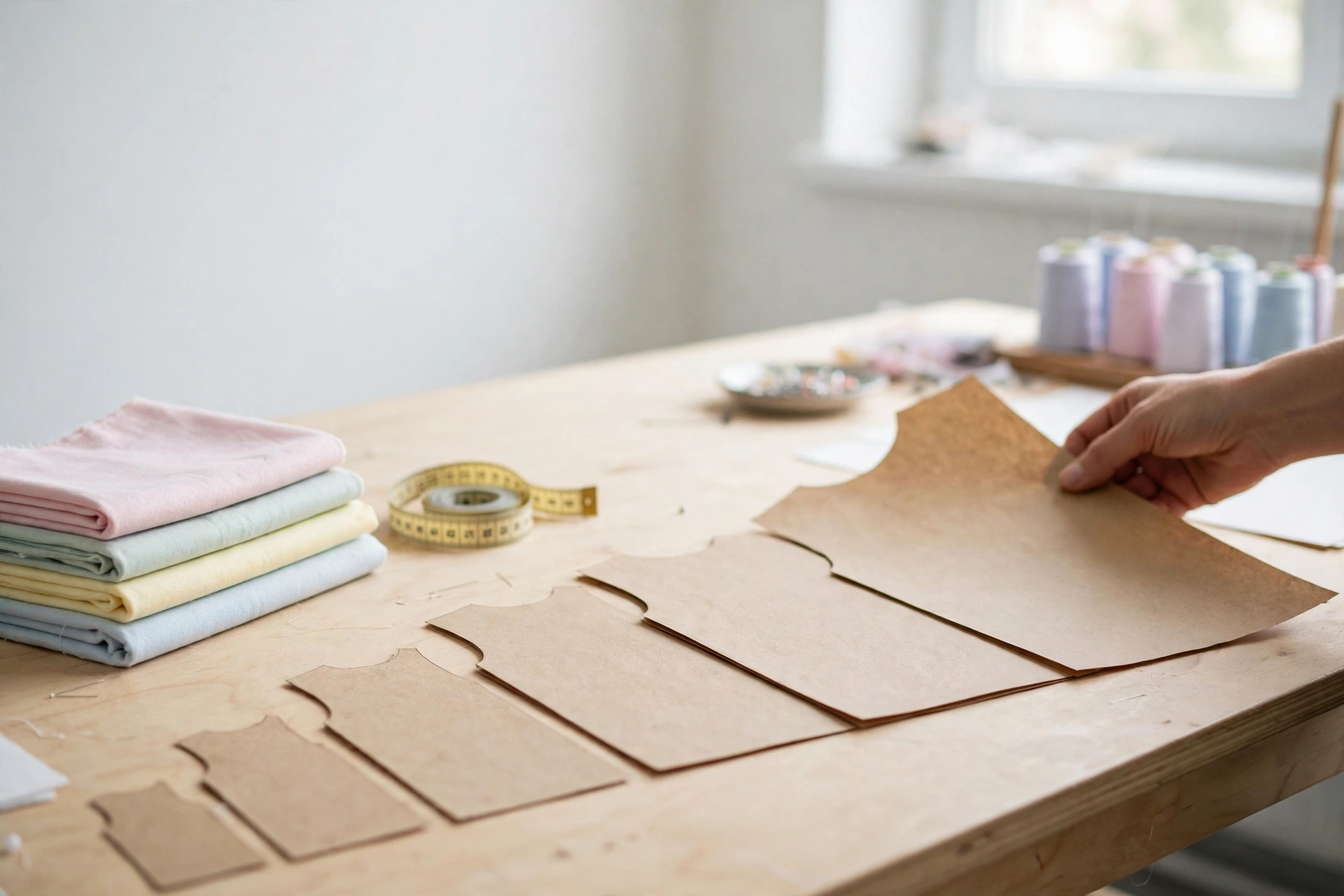
There is a second bill hiding under the first one. More sizes means more pattern pieces in every marker, and children’s pieces are small enough that a lay fills up with gaps the cutter cannot use. A women’s dress in six sizes wastes fabric in a way the quote can absorb. A children’s set in eight sizes, each piece short, each piece narrow, leaves a marker that looks like a jigsaw somebody gave up on. Fabric use per piece creeps up. Nobody padded anything. The geometry did it. When a buyer compares two quotes for the same set and one is higher, this is one of the dull places the difference can honestly live, alongside the closures, which I will get to.
Ten pieces, eight sizes, one illusion
Ten pieces per style spread across eight sizes does not test a size run. It tests one or two sizes and leaves the rest as decoration. A trial order at the 10 piece minimum tells you whether the fabric, the colour and the construction hold up. It cannot tell you whether size 5 fits, because you may have a single piece in size 5 and it will sell, or not, for reasons that have nothing to do with fit. Boutiques that understand this put the trial into fewer sizes, usually the middle of their own curve, and widen the run on the reorder once the style has earned it. Boutiques that split evenly get an even, useless answer in every size.
The size ratio deserves the same suspicion. Equal quantities in every size feels tidy on a spreadsheet and wrong on a shop floor. Most children’s boutiques sell through the middle of the run first, the sizes around the average height of their local customers, and the ends move slower until a growth spurt or a school term rearranges everything. A starting ratio that weights the middle, then thins toward both ends, matches how the clothes actually leave. Your own sales history beats any ratio a factory suggests, and if you have a season of it, send it with the order. We would rather cut to your curve than to a polite guess.
And then the sets problem, which nobody warns new children’s brands about. A set is two size decisions sold as one. The top fits the chest. The bottom fits the waist and the leg, and in children those two can be a full height band apart on the same body. Factories cut sets as matched pairs because matched pairs are what the order sheet asks for. If your customers keep splitting pairs in the fitting room, the honest fix is not a new style. It is a conversation about whether the bottom should be graded on a slightly more generous waist, or whether the set should be sold as separates from the start. I have watched a buyer blame a sewing line for a returns pile that was really a matched-pair decision made months earlier in a spreadsheet.
The small parts are the slow parts
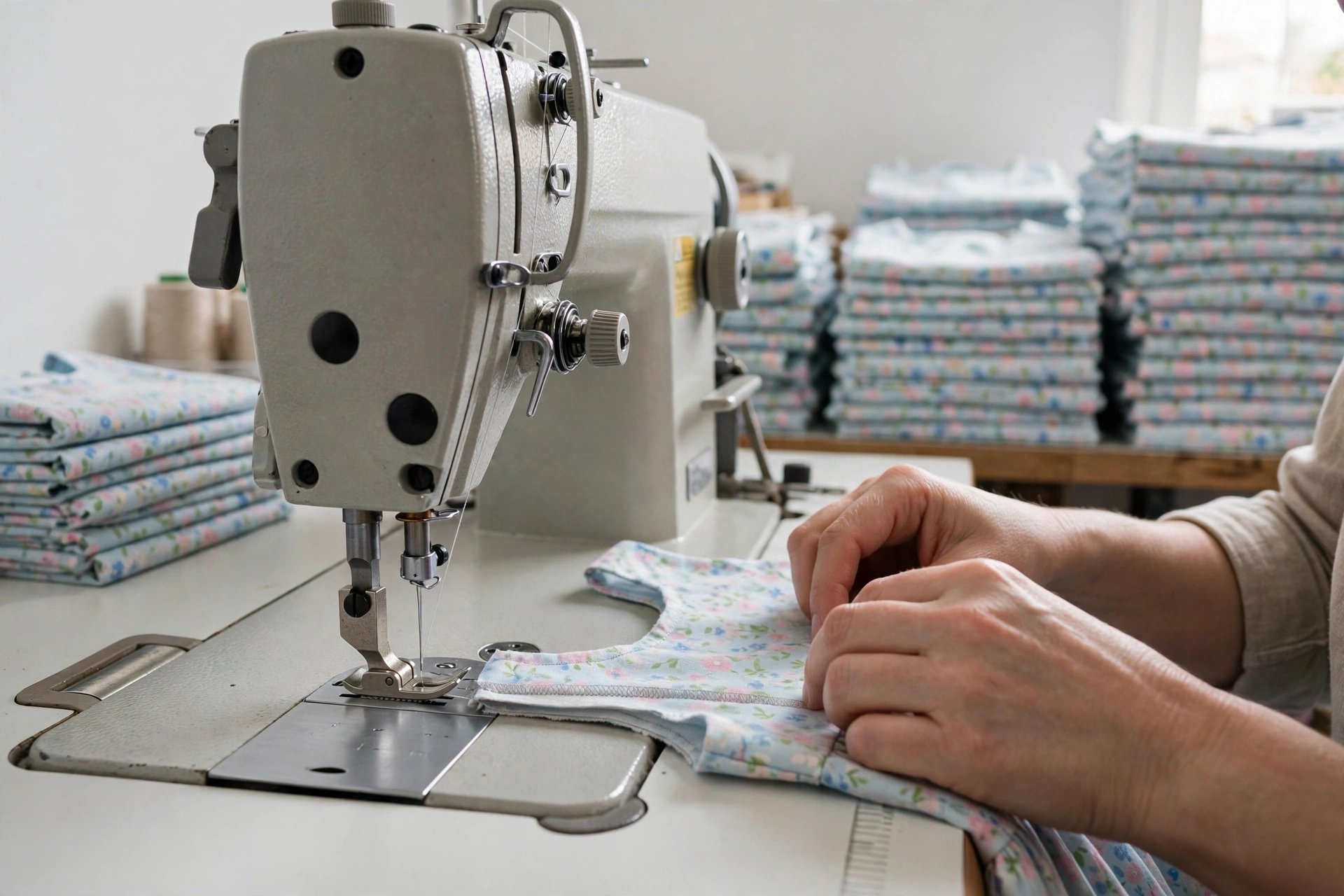
Closures on children’s clothes are not a smaller version of adult closures. They are a slower, fussier job with less room to hide a mistake. A snap that sits 3 millimetres off centre on a women’s blouse disappears into the drape. The same snap on a size 4 bodice sits there staring at everyone, because the whole placket is only a few centimetres wide. Buttons on the youngest sizes get sewn, then pulled, then sewn again when the pull test finds the one the operator rushed at the end of a shift. That second pass is real time on a real line, and it is one reason a simple-looking kids’ style does not always price the way its fabric weight says it should.
Cords need a decision before cutting, not after a complaint. For the youngest children, keep cords out of the hood and neck area entirely, and treat waist cords as fixed, short and unable to form a loop. Different markets write their children’s cord and small-parts rules differently, and the rule that governs your order is the one in the country where the clothes will be sold. Send us the market. We will sew to that market’s expectation and say plainly if a design detail fights it. What I will not do is nod at a long decorative neck cord on a toddler dress and call it a detail. It is not a detail. It stops being one the first time a parent writes to you about it.
No wait. I keep saying the ends of the run are where charts fail, and that is only half true. The ends are where they fail loudly. The middle fails quietly, in wash. Children’s clothes get washed the way adult clothes do not, hot, often, and with feeling. A cotton kids’ dress that leaves here true to chart can give up 3 to 5 percent in length across its first washes if the fabric was not rested and checked before cutting, and on a garment that is only 55 centimetres long to begin with, 4 percent is a visible hem decision somebody else made for you. We rest cut pieces and check the washed measurement, not the off-the-table one. A buyer checking quotes should ask which measurement a factory guarantees. The washed one is the only one your customer will ever meet.
Shrinkage has a cousin in colour. Children’s ranges run bright, and bright dyes on cotton show their mood after washing in a way a muted women’s palette forgives. A reorder in the same pink, six months later, from a new dye lot, can sit next to the original in your shop and read as two pinks. It is the same argument that follows adult ranges when one base pattern is simply scaled up in a different costume: the bigger the distance from the approved original, in size or in time, the more the copy drifts from the thing you approved. Keep a washed piece from the first run. Send it back with the reorder. Paper charts do not argue with a physical garment, and dye lots do.
What I would send us, if I were buying
A height-led size chart, even a rough one, puts you ahead of most first orders we see. Ages alone put you behind, and no factory honesty downstream fully repairs a chart that was wrong at the source. Send the market you sell into, so closures and cords are sewn to the rules your customers live under. Send your size curve if you have one. Say which sizes the trial is really testing, instead of spreading 10 pieces across the whole run and learning nothing at full price.
I still think about that first order sheet, ages written like birthday cards. The dresses were fine. The sewing was fine. The sheet was the defect, and sheets are the cheapest thing in this entire business to fix, which is exactly why it irritates me that they are so often the last thing anyone checks.
Questions buyers actually ask us
Ten pieces per style, across eight sizes. What am I actually testing?
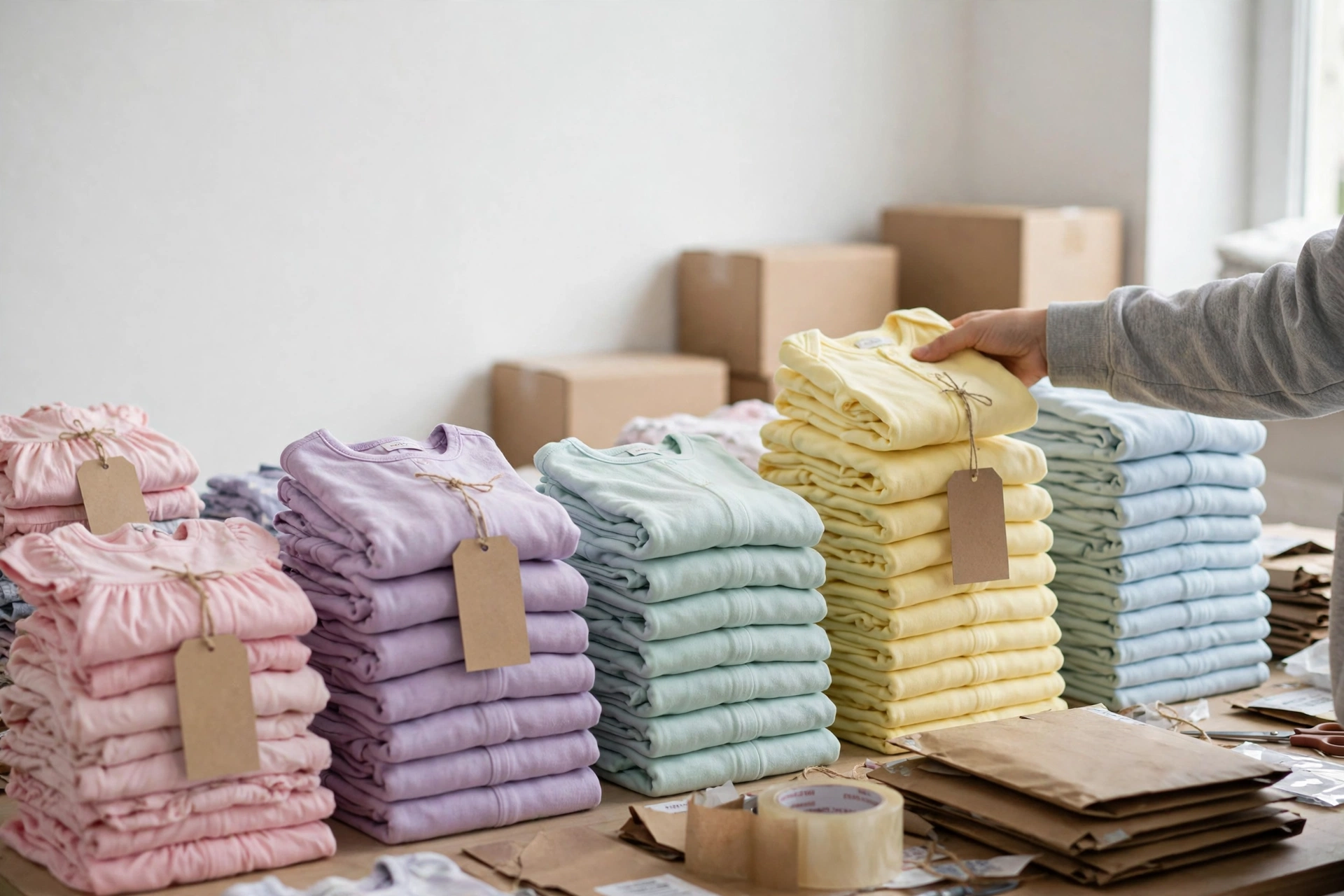
You are testing the style, the fabric and the construction, and almost nothing about fit across the run. Ten pieces is the minimum order per style at OEMOD Factory, and spread across eight sizes it leaves one or two pieces per size, which is a sales sample wearing a size label. Put the trial into the three or four sizes your shop sells most, learn whether the style moves, then widen the run on the reorder. That is a duller plan than an even split, and I get why people resist it, but an even split mostly teaches you that eight sizes can all be inconclusive at once.
My chart lists ages only, and six-year-olds come in every height. Now what?
Rebuild the chart around height in centimetres before you order, with age kept as the guide parents shop by. Height bands step by about 6 centimetres, 104, 110, 116, 122, and the chest steps more slowly inside them, roughly 4 centimetres a band. Give us your customers’ height range if you know it, or a competitor chart you trust, and we will grade from a base size in the middle of your run rather than scaling down from the largest. Age-only charts are fixable in an afternoon. Age-only bulk is fixable at reorder prices, which is a different afternoon entirely.
Sampling is quoted at 10 to 15 days. Why did a kids’ set land in week four?
Because the 10 to 15 days starts when the tech pack and the size chart are confirmed, not when the first message arrives. Children’s samples stall on the same things adult samples stall on, an unfinished chart, a fabric that has to come from the mill rather than the stock shelf, a closure decision nobody made. Add a revision round and the door-to-door cycle stretches. The part that still annoys me is how often the lost week was a chart sitting unapproved in an inbox while both sides counted from different start lines.
Equal quantities in every size feels fair. Why does the middle sell out first?
Because children in a neighbourhood cluster around average heights for their age, and your middle sizes are cut for exactly that cluster. Equal splits ignore the curve your own shop already has. Weight the middle, thin the ends, and let the reorder, placed against real sell-through, correct the ratio. Fairness is a virtue in most rooms. In a size ratio it just leaves you short of the size everyone wanted and long on the two sizes that will meet your discount rail in spring.
Browse the full range in our Kids Clothing Wholesale Catalog — new styles added regularly, private label from 10 pieces per style.