The returns came back in the pale colours. That is where this story ends if you read it the way the customer lived it, with a pair of sage leggings that had looked fine on a rail, fine in a fitting room mirror, and then gone quietly see-through the first time she folded forward in a bright studio. The black pairs from the same order, same fabric spec, same size chart, stayed sold. I work on the fabric side of this trade, where rolls get bought and dye runs get booked, and I have learned to read a return like that backwards, because the decision that caused it was never made in the studio. It was made weeks earlier, at a table, in good light, by people who were not wrong about anything they actually checked.
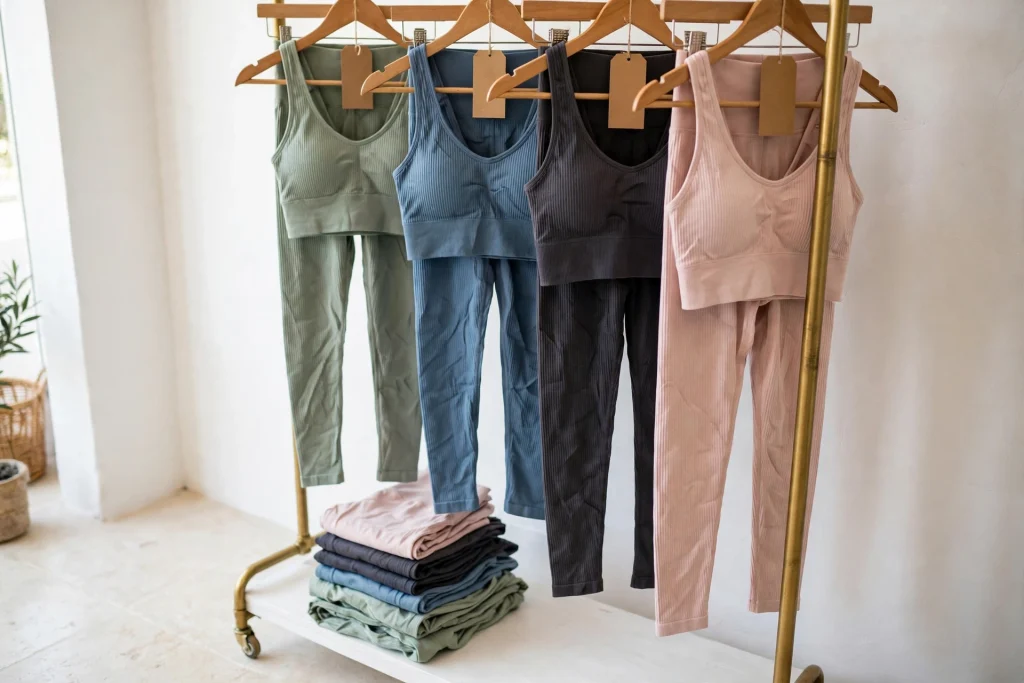
Read backwards, the order looked like this. A buyer building a first range of wholesale yoga clothing approved a legging in black, because black is what you approve first when the rail needs a safe anchor colour. The fabric was a mid-weight stretch knit, around 220 grams, the sort of number that sits in the comfortable middle of every quote sheet in this category. It felt substantial in the hand. It photographed well. Then the colour story got extended, the way colour stories do, into sage and a dusty blue and a pale blush, on the same spec, at the same weight, because the spec had passed. Nobody lied anywhere in that chain. The fabric simply had two different answers in it, and the approval process only ever asked it one of the questions.
Opacity is a stretched-state property. That sentence is the whole article, and everything else is me walking backwards through what it costs when a buying process forgets it.
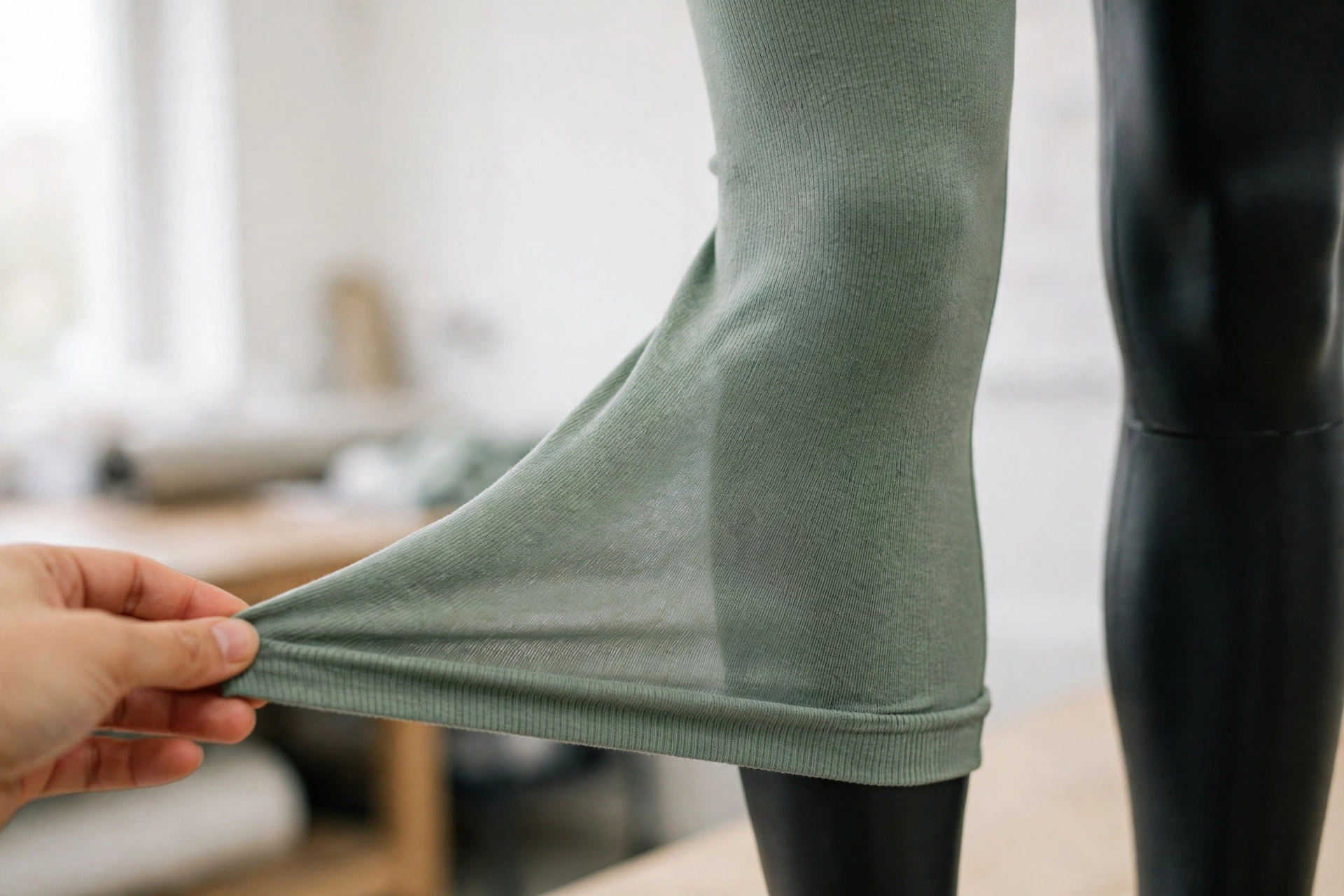
Flat on the table, everything passes
On the fabric side we quote opacity the lazy way, which is at rest. A roll comes in, somebody holds a hand behind a single layer against the light, and the cloth either shows the hand or it does not. At rest, a 220 gram knit mostly does not. The yarns sit close, the surface reads solid, and the number gets written into the order as if it were a property of the fabric rather than a property of the fabric in one particular state. But a legging is never worn at rest. The pattern is cut smaller than the body on purpose, the trade calls it negative ease, and the knit supplies the difference by stretching. Stretching spreads the yarns apart. Across the seat in a deep bend, that mid-weight cloth is doing the work of a much lighter one, and the light that could not get through it on the table gets through it on the body.
Colour is where the two answers split. Black forgives. The dark dye and the shadow of the cloth itself hide what the stretch is doing, and a black legging can be honestly described as opaque at a weight where the same knit in sage shows skin tone and the dark form underneath within one forward fold. Pale colours are not thinner fabric. They are the same fabric with nowhere to hide. I have watched buyers discover this in the worst order possible, approving in black, extending into pastels for spring, and meeting the fabric again in the returns, wearing a colour they never actually tested. The modest dress side of this site learned the same lesson through a window instead of a studio, and the opacity problem in lined dresses is the cousin of this one. Cloth that reads covered in the light you approve it in can read uncovered in the light it gets worn in. The light changes. The cloth does not.
Grading pushes the failure to the ends of the size range, which is the part buyers find hardest to believe when the middle sizes come back fine. If every size carries the same ease percentage, the largest sizes stretch the knit hardest, because there is more body asking more of the same cloth. So the sheerness complaints and the recovery complaints cluster at the two ends, the very small and the very large, while the medium that got fitted and photographed sits in the middle passing everything. A range can be honestly approved on its middle size and still be wrong at both ends, and the returns will describe that pattern back to you if you read them by size instead of averaging them into one rate.
The knee keeps the second secret
Walk one step further back and you reach the roll itself, which is where I live. Elastane recovery is the property nobody puts in a photograph. A legging can pass the stretch test on day one and still be a different garment by the tenth wear, because recovery is about what the knit does after it has been stretched, held, washed and stretched again. Knees bag. Seats soften. The waistband that sat flat in the fitting room starts travelling. And the uncomfortable part, from my side of the table, is that recovery drifts between lots of the same fabric from the same mill. One lot snaps back. The next lot, same stated composition on the same spec sheet, gives a little more and takes a little longer to come home. The size chart never moved. The cloth underneath it did.
The sleepwear buyers on this site met their version of that in the wash, and the knit behaviour behind the pajama returns is the same animal in a softer category. Knits keep their promises approximately, lot by lot, and a buying process built on a single approved sample is built on the behaviour of one roll. Reorders are where this gets expensive, because the customer who loved her first pair buys the second pair as a known quantity, and a known quantity that arrives slightly different reads as a quality fall even when every measurement on the chart agrees with the first pair. She is not measuring the legging. She is remembering it.
No, I am putting that too strongly. Half the time she is measuring it, against the first pair, side by side on the bed, and the tape agrees with her. The lot drifted, the chart stayed polite, and both things are true at once, which is why these arguments between buyers and factories go in circles. Each side is holding a document that says they are right.
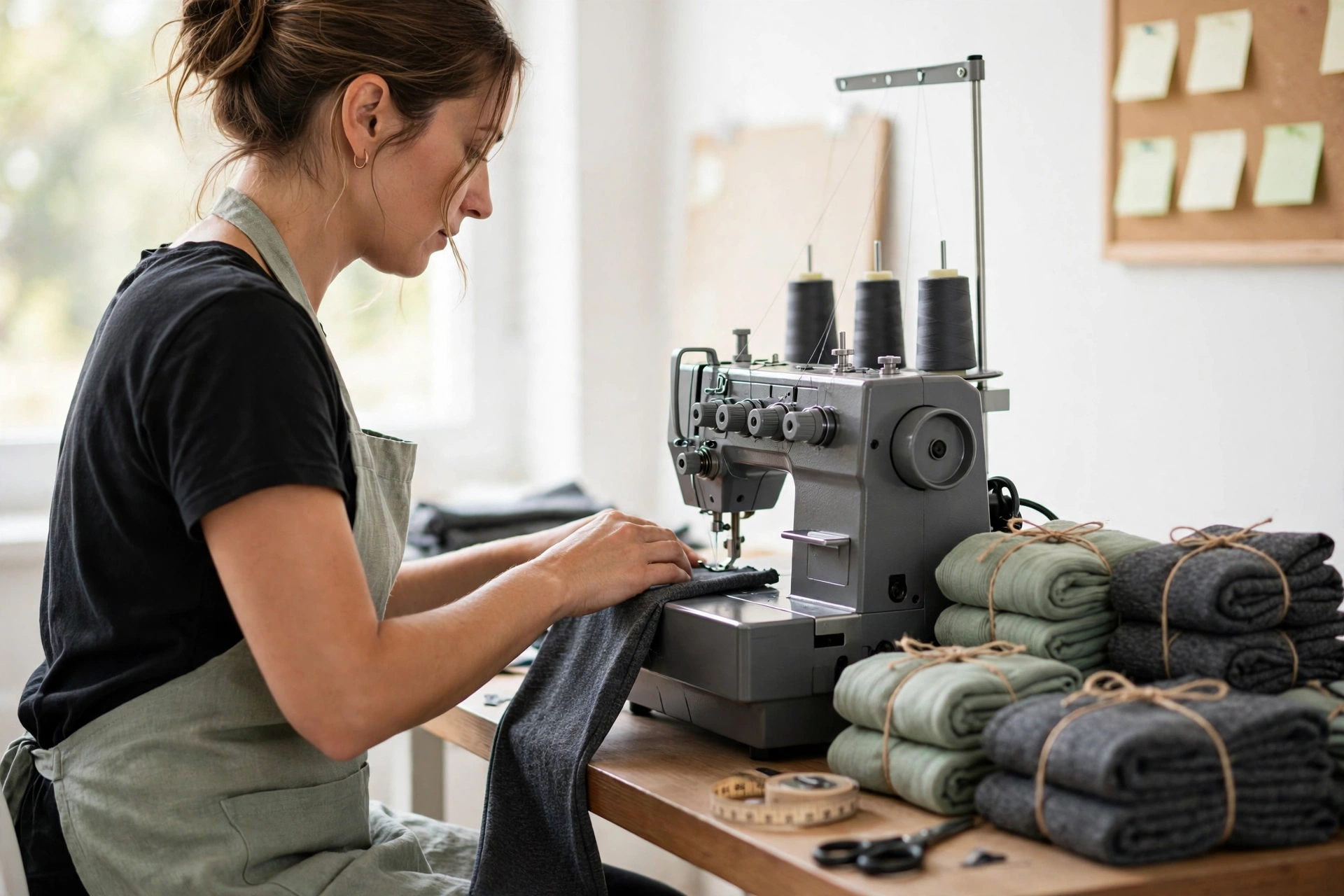
By the time it reaches the machine, the cloth has already voted
Sewing gets blamed for the rest of it, and some of the blame is fair. A standard overlock seam stands up in a ridge against the skin, and on a long session that ridge is the thing the wearer feels, while a flatlock seam lies flat and costs more time and more setup to run. Between a sample and a bulk run, that is one of the swaps that can happen quietly, because the outside of the garment looks almost the same and the saving is real. Turn the sample inside out and compare the ridge with the bulk garment before you argue about it. The gusset is the other quiet cut. Where the inseams meet, the fabric is pulled in four directions at once, and a small inserted piece is what spreads that load. Take it out and the most stressed point on the garment is also the point where stretched opacity fails first, and the return gets written up as a fabric fault, which by then it has become, whatever it started as.
The waistband is decided earlier than the sewing, whatever it looks like. Roll-down in a forward fold comes from the elastic width, the tension it was sewn in under, and how the band sits against the rise curve. A narrow elastic inside a wide casing folds over inside its own tunnel. A wide elastic sewn in unevenly rolls at the front first, always the front, where the fold is deepest. High waist written on a spec sheet is a description of where the band ends, not a promise about whether it stays there. Buyers who fold the sample forward on a body, rather than measuring it flat, learn in thirty seconds what the table cannot tell them in an afternoon.
This is also where the fabric choice has to be made honestly, before any of it. Before we start sampling, we always photograph the fabrics and send them to you to review and choose from. On yoga wear that step carries more weight than it sounds, because choosing between two stretch knits at two weights is not a colour decision. It is the decision about whether the pale colours in the range will survive their first class. If you are comparing quotes across the wholesale yoga sets and private label activewear in the catalog, the quote that looks expensive on a light colour is often just the quote that priced the heavier cloth the light colour actually needs. The cheap version of sage is not the same product as the cheap version of black. It only shares a spec sheet with it.
And then there is the booth problem, which is where the walk backwards ends. Activewear gets chosen at trade fairs and in showrooms under bright, even, standing light, on standing forms, which is the kindest possible test a legging will ever face. Nothing at a booth bends. Nothing folds forward. The fabric that gets approved there has passed an exam the customer will never set, and failed to sit the one she will. I do not have a clean fix for that, honestly. The stretched check back at the office, over a dark form, in the palest colour of the range, is thirty seconds of work and it catches most of it. It still gets skipped, season after season, because the sample looked fine, and the sample always looks fine. That is rather the point of it. The gym version of that approval mistake is harsher still, and it is the one I work through in one legging that passed in yoga and came back from the gym.
Questions buyers ask me when the pale colours come back
One fabric at 220 grams, approved in black. Why did only the sage pairs come back?
The sage pairs came back because 220 grams at rest is not 220 grams across a seat at full stretch, and black hides that difference while sage cannot. The fabric was never two fabrics. It was one knit whose yarns spread under load, and the dark colour absorbed the evidence while the pale colour showed skin and the form underneath through the gaps. Approving a range in its darkest colour and extending it into pastels on the same weight is the usual road into this return, and I still catch myself assuming a passed black means a passed range, which it does not.
Ten pieces per style sounds simple. Why does a five-colour yoga order price like five separate orders?
Five colours price like five orders because each colour is its own dye run, and the dye minimum gets spread across however few pieces carry that colour. Ten pieces per style is the real minimum here, and the sewing barely notices the split, but the cloth cost per piece climbs on every colour that only fills a handful of sets, and the pale colours climb further because they often need the heavier knit to stay opaque. Buyers usually end up putting depth into black and one colour they believe in and letting the rest run thin, which looks like a compromise in the meeting and is mostly dye arithmetic.
A sample costs $45 to $75. What does that sample never do before I approve it?
A standard sample never bends, folds or gets washed before approval, and $45 to $75 is the general sample fee for a style like this, with involved styles quoted per design. What that money buys is construction and fit on the day the sample was sewn, judged standing, in good light, which is exactly the state a legging spends the least time in once a customer owns it. The failures that define this category all live in motion and after water. A worn and washed pre-production sample in the palest colour is the only version that answers early, and I would rather see a buyer spend patience there than on a second fitting of the black one.
The waistband measured exactly right on the table. Why does it roll by the second class?
The waistband rolls because a flat measurement records the length of the band and says nothing about the elastic inside it. A narrow elastic in a wide casing turns over inside its own tunnel once it has been stretched and folded a few dozen times, and a wide one sewn in under uneven tension rolls at the front first, where the fold is deepest. The table cannot see either of those coming. Pulling the band and watching how it recovers, and folding the sample forward on an actual body, gets closer, though even then I have been surprised by bands that behaved for a month and then gave up.
What stays with me, standing among the rolls, is that the sage legging was not a bad product that slipped through. It was a good product approved by a process that asked it the wrong questions, in the wrong colour, in the wrong light, standing still. The cloth had answered honestly every time it was stretched. Nobody stretched it. I still do not know how a category this physical ended up with an approval ritual this static, and I have stopped expecting next season to be the one where the fitting room learns to bend.
Follow our channels for new styles and factory updates: WhatsApp Channel · Telegram Channel