February 15 is the morning I think about in November. Not February 14. The morning after, when a rack of red dresses stops being a Valentine range and becomes a problem with hangers. Nothing about the dresses changed overnight. The stitching is the same stitching, the red is the same red it was at closing time. What changed is the date, and a dress with a date on it does not get a second season to recover in. It gets a discount rail, then a box, then a conversation nobody wants to have about what the box is worth.
I have stood in that conversation enough times to work backwards from it. That is the only honest way I know to buy holiday stock. Start from the write-off and walk back through every decision that put those dresses on that rail, and you will find the failure was rarely in February. February is just where it gets counted. The failure was in November, in a purchase order that treated Valentine reds the way you would treat a plain reorder of wholesale dresses that could sell in March, or May, or whenever the sizes happened to turn over.
They cannot. That is the whole article, really. The rest is me trying to explain why I still watch buyers make the same November decision with complete confidence, because in the sample room, under shop lighting, the red looked right.
It starts on the morning after
Deadstock behaves differently depending on whether the garment carries a date inside it. A black midi that misses its month is still a black midi. It waits. It might wait badly, it might tie up cash you wanted elsewhere, but the dress itself has not expired. A red dress bought for Valentine has expired in a way the black one has not, even if the red dress is objectively the better made of the two. The colour is the occasion. Take the occasion away and the colour starts arguing with every other rail in the shop.
There are two waves to it and I have never seen a third. The first wave goes in the week or so after the date, at a discount that still pretends the dress is a dress. Some of it moves, mostly the smaller sizes and the shapes that can be re-described as date-night stock without anyone feeling lied to. The second wave is not really selling. It is clearing space. By then the buyer is not pricing the garment, she is pricing the rail it is standing on, because spring stock is already in boxes in the back and needs somewhere to go.
Working backwards from that second wave changes the November questions completely. You stop asking how many red dresses can I sell before February 14. You start asking how many can I sell if the red turns out to be two reds, if the shipment lands ten days late, if the warm February everyone hopes for turns cold and long sleeves win. Those are not pessimistic questions. On a dated range they are the only questions that price the risk honestly, because there is no March to absorb a mistake.
Wholesale dresses with a date printed on them
Most wholesale dresses forgive a sloppy calendar. Holiday dresses do not, and the forgiveness gap is wider than buyers expect because production time is only one of the clocks running. A bulk run takes about 20 to 30 days once a deposit is in and fabric is confirmed. That number gets quoted, written down, planned around. What does not get written down is that fabric had a clock before production started, freight has one after it ends, and the shop needs days at the far end to steam, tag, photograph and actually put the range in front of anyone.
Add those clocks honestly and a Valentine order confirmed in November is comfortable. The same order drifting into mid-December is a negotiation with the calendar. By January it is not a production question at all. It is a freight question, and freight questions get answered in money. December taught the same lesson a month earlier, when the halter cocktail styles that carried a Christmas range sailed through while split-colour stock around them did not. Air freight on a full range can erase the margin the range was bought to make, and it still might land after the selling weekend that mattered.
I tell buyers to count backwards from February 7, not February 14. The last full selling week is the deadline that matters. A dress that arrives on the 12th has missed the customers who shop early, missed the payday weekend, missed being photographed in the window when footfall was building. It arrives in time for the panic buyers and the discount conversation. Counting from the 7th feels early in November. In February it feels like the only sensible thing anyone said.
That is also why the trial order logic changes on dated stock. A 10-piece trial of an undated style teaches you about fit and fabric and you reorder what you learned. On a Valentine range the trial is the range, in most cases. There is no reorder window that arrives before the date does. So the 10 pieces per style have to carry the full lesson, which means spreading them across the size curve instead of stacking them in the middle sizes where selling is easiest. The ends of the curve are where a new style confesses. Middle sizes forgive almost anything.
The red that split in daylight
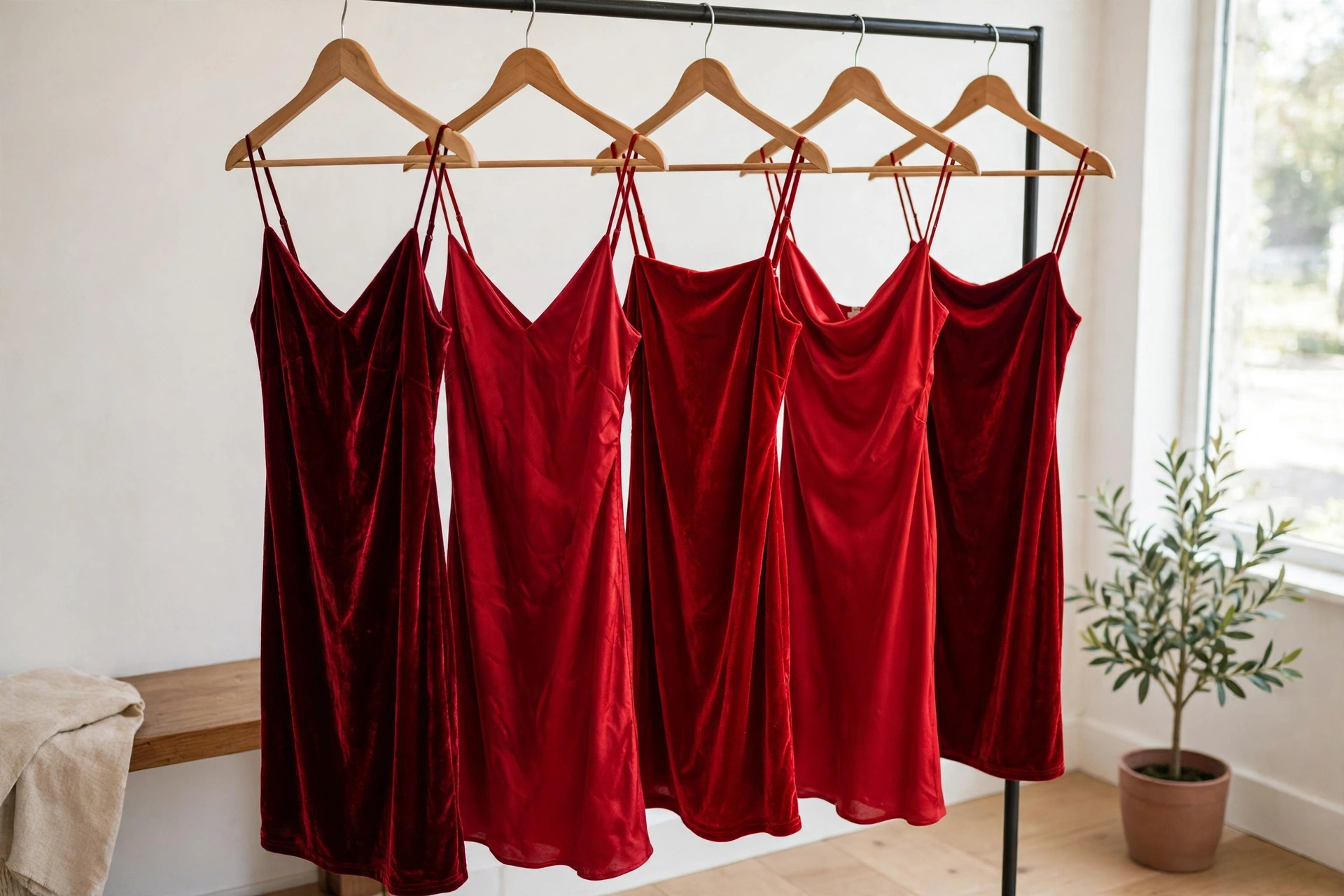
Here is the failure I have watched most often, and it is a colour failure, not a sewing failure. Red is not one colour in a dye house. It is a family that barely speaks to itself. One lot leans blue and reads deep, almost burgundy, in evening light. Another leans warm and reads bright, nearly tomato, at noon. Put the two lots side by side under the warm spotlights of a sample room and a tired eye will pass them. Put them on a rail by a shop window in February daylight and they are plainly two dresses that happen to share a name.
The split usually enters through an innocent door. Part of the order was cut from the first lot. The fabric ran short, or a size band was added late, and the remainder was cut from a second lot that the mill described as the same colour because on the colour card, at card scale, it was. Cards are small. Dresses are not. A difference you need to squint at on a card is a difference a customer sees across a shop floor, and she reads it as inconsistency, not as dye science. She does not think the lot changed. She thinks the shop is selling seconds.
Satin makes the argument louder. A satin face throws light back, so a small lot difference becomes a visible one every time the garment moves. Crepe is quieter about it, it absorbs more. Velvet is its own problem and I will come to it. But the fix is boring and it happens before cutting, not after. One order, one lot, written down. A retained cutting of the actual bulk fabric, checked against the approved sample in daylight, by a window, not under the tube lights the fabric was bought under. If extra fabric is needed, it comes from the same lot or the size band gets cut from the order. Cutting a shortfall from a fresh lot to keep the piece count pretty is how a range becomes two ranges.
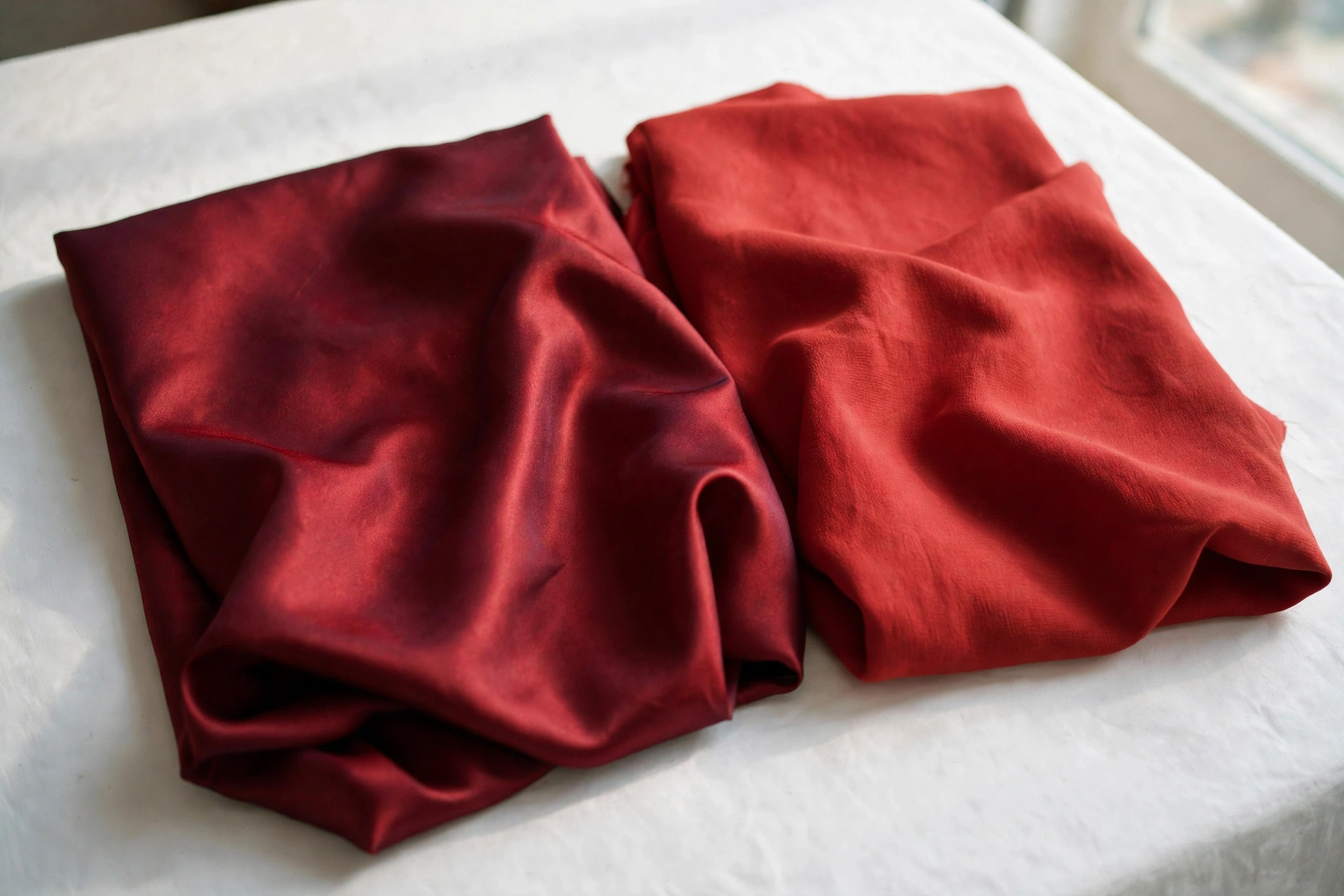
No wait. I keep saying daylight as if daylight settles it, and it only settles half of it. The dress will also be worn at night, in restaurant light, in phone flash photographs. A red that matches at noon and splits at night is still split. The check needs two lights, the window and the warm bulb, and the sample has to pass both before bulk does. I learned that part late, after a range that was perfect at midday and visibly two colours in every tagged photograph the following week.
Velvet runs one way, and then it runs the other
Velvet deserves its own grudge. The pile lies in one direction, and light reads it differently depending on whether the pile runs up the garment or down it. Cut one panel with the pile running the wrong way and that panel reads as a different shade from the rest of the dress, same lot, same roll, same day. I have seen buyers reject a delivery as a dye fault when nothing had been dyed twice. The fabric had simply been turned.
The discipline is unglamorous. Every panel the same way, even when turning a panel would save fabric, and on velvet the saving is tempting because the waste hurts. A full velvet style cut honestly one way uses noticeably more cloth than the same style cut however it fits. Quotes that look too good on velvet have usually found that saving somewhere, and the somewhere is the pile direction on the panels nobody checked. Ask the question directly. Is every panel cut one way. Watch whether the answer comes back as a sentence or as a shrug.
Storage finishes what cutting started. Velvet folded hard in a carton for weeks arrives with pressure marks that steaming mostly, but not always, lifts. For a dated range there is no time to send anything back and no appetite for steaming a rail twice in the busiest fortnight of the quarter. Hanging or rolling costs more in freight volume. It is still cheaper than a rail of marked dresses on February 10. I would rather argue about carton size in November than about creases in February, and I say that as the person who used to argue the other way because the freight bill was the one on my desk.
What survives February, if it is chosen in November
Not everything red dies on the 15th. The styles that survive are the ones that were never only Valentine styles. A red satin midi that a customer can wear to a wedding in June, an anniversary dinner in September, a Christmas party in December, that dress has other doors to walk through. A 3/4-sleeve cocktail shape that keeps selling after the holiday works the same way, because the sleeve and the shape were never only about one date. A dress with hearts on it has one door and it closes. Buyers know this in their bones and still get seduced in November by how well the literal version photographs. It photographs well because it is literal. That is exactly the problem.
The split I look for in a healthy holiday order is roughly this. The core of the range is red dresses with a life after the date, shapes the shop already knows how to sell, in the one dye lot, cut one way, arriving for the last full selling week. Around that core, a smaller layer of the openly seasonal pieces, bought in quantities that assume they will not all sell, priced from the start to survive the second wave without pain. When the seasonal layer is the core, the February conversation is guaranteed. When it is the garnish, the February conversation is about which of the core dresses to reorder in another colour, which is a much better conversation to be standing in.
Private label belongs in that same November conversation, by the way, and it is often left too late. Woven labels and hang tags for a seasonal range need to be confirmed with the order, not after it. A dated range that arrives with the wrong tags, or with bulk labels because the custom ones missed the run, loses days it does not have to relabelling. Ten pieces per style is a small run. Small runs forgive nothing about timing. Everything about them has to be decided while the calendar still looks generous, because the calendar is lying.
Questions I get asked every November
Ten pieces per style on a Valentine range. Is that a trial, or is that the whole bet?
On a dated range it is the whole bet, honestly. Ten pieces per style with no realistic reorder window before February 14 means the size spread matters more than the piece count. I have watched buyers put most of a small run into the middle sizes and learn nothing except that middle sizes sell, which they already knew. Spread a trial across the curve, including the ends, and the same ten pieces tell you whether the style works as a garment or only as a photograph. That answer is still useful in February even when the reorder has to wait for a different colour.
November feels early to lock a dye lot. Why can the colour not be confirmed in December?
It can be confirmed in December, it just cannot be fixed in December. A lot confirmed early leaves room to reject it, re-dye it, or walk away from the style while other fabric still exists. Confirmed late, the choice narrows to accepting the split or accepting the delay, and on a Valentine range the delay is also a kind of split, between the stock you have and the date you promised it to. I get this one wrong myself when a mill sounds confident. Confidence is not a lot number. The number, written on the order, checked against a retained cutting in two lights, that is the confirmation.
The quote on the velvet style looks too good. Where did the money go?
Usually into the cutting, in my experience. Velvet cut with panels turned to save cloth reads as two shades on one garment, and it is the saving that makes an implausible quote plausible. It can also be in the lining, or in a pile so short the fabric reads flat by the second wear, but the cutting is where I look first because it costs nothing to check and everything to miss. Ask for every panel one way, in writing, and ask what the fabric consumption per piece actually is. A real number comes back fast. A foggy answer is also an answer, just not the one to build a February on.
What arrives by February 7 and what can still land on the 12th?
The core range has to be there by the 7th, the dresses the window and the photographs depend on. What can land on the 12th is only the garnish, the pieces you already priced to discount, and even then I would think twice. Freight in that final week costs what it costs because everyone else had the same idea at the same time. A late garnish shipment at peak freight rates, sold at a discount three days later, is a loss that was scheduled in advance. I would rather the garnish was small, early and cheap to move.
Every November I tell myself the industry has learned the red lesson, and every February there is a rail somewhere proving it has not, including, a few years back, a rail I had helped put there. The dresses were fine. That is the part that stays with me. The sewing was fine, the fit was fine, the price was fine, and the range still failed on a colour that split and a date that did not move. Dates never move. That is the one fixed point in this whole trade, and I still catch myself planning as if February might be negotiable. It is not. The red has to be right in November, because November is the only month where right is still available.
Browse the full range in our Holiday Clothing Wholesale Catalog — new styles added regularly, private label from 10 pieces per style.