Dear anyone thinking of stocking this dress,
You asked what the black halter split dress actually does once it leaves the product photo, and the honest place to answer from is the returns desk, because that is where this style ends up being described by the women who wore it. From the consumer service side of the trade you learn a dress twice. Once from the listing, where the halter neckline sits high and clean and the split falls exactly where a stylist pinned it. And once from the return reasons, which are written by someone standing in a bedroom the morning after a party, slightly annoyed, typing with one thumb.
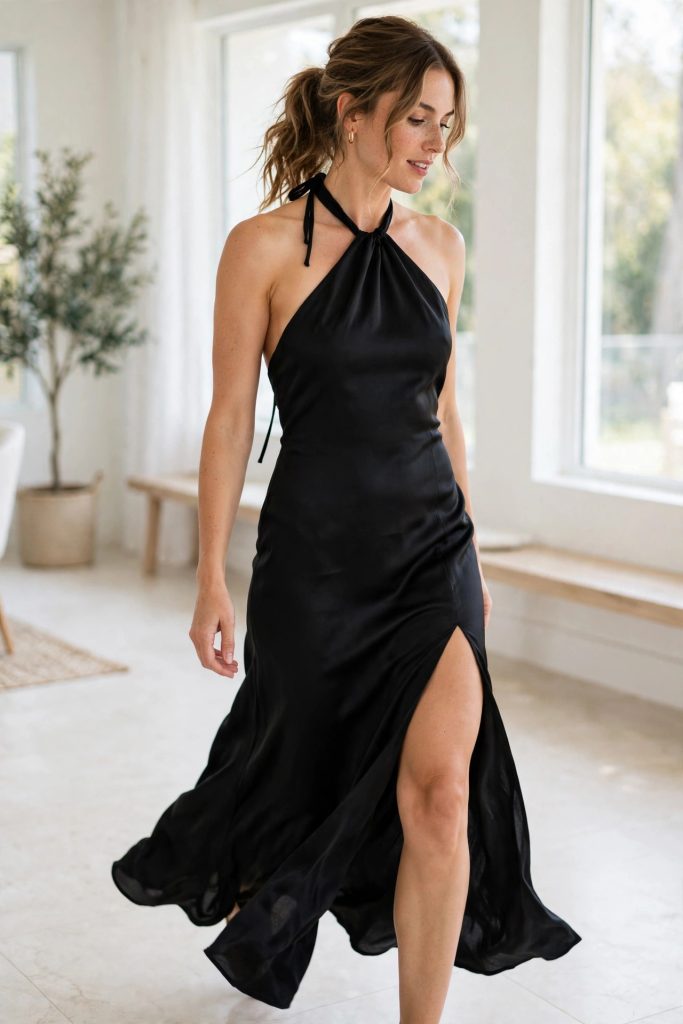
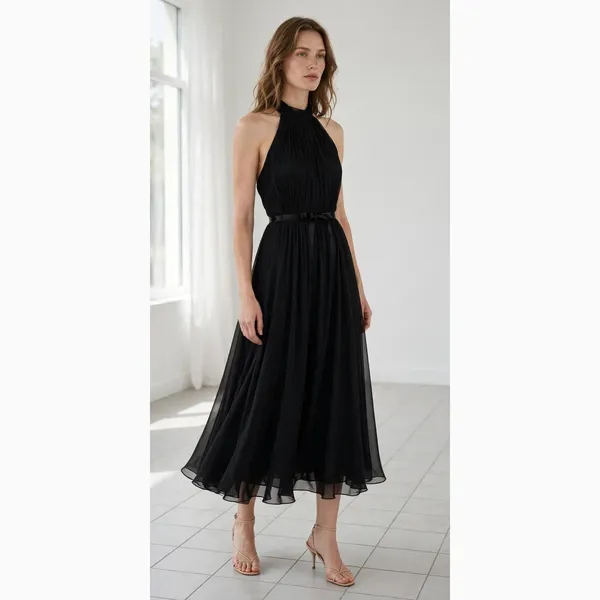
The MUSHARE halter neck cocktail dress is a black maxi with a high split, a bare back, and a neckline held up by straps that tie or fasten at the neck. On paper it is one of the safer evening styles a small store can carry. Black sells across seasons, the silhouette photographs well, and the price band this dress sits in means nobody expects couture finishing. What the returns say, though, is more specific than the listing ever gets, and most of it is about the neck.

A halter neckline moves the whole weight of the dress onto two straps and the back of the neck, and on a long dress with a lined bodice that weight is not nothing. The complaint that shows up again and again on halter styles in this price band is not that the dress broke. It is that by hour three the straps had started to dig, and by the end of the night the wearer had a red line where the tie sat. Sellers read that as a comfort problem. From the returns side it reads as a strap construction problem, because the dresses that come back with this complaint tend to have narrow straps with no soft backing, while the ones that stay sold have a slightly wider strap or a smoother finish on the skin side. Same photo. Different evening.
The split is the second thing the photos lie about, politely. A thigh-high split on a standing model opens to a careful angle and closes when she stops moving. On a real guest it opens when she sits, climbs when she walks fast, and behaves completely differently on a dance floor than it does at a drinks table. Return language for split dresses has its own little vocabulary. Too much shows when I sit. Fine standing, impossible sitting. The women returning these dresses are rarely prudish about the split itself, they chose it, what they object to is that the split behaves one way in the mirror at home and another way in a chair at a wedding. A buyer checking samples should sit in the dress, in an actual chair, before ordering a single piece. That test takes ninety seconds and it predicts the return pile better than any size chart.
The bust is where the size chart stops helping
Halter styles run into a sizing trap that standard strapped dresses dodge. The bodice has no shoulder straps to adjust, so the fit across the bust depends on where the neckline fabric is cut to land, and women with the same dress size can sit a full cup apart. Review patterns on halter cocktail dresses cluster hard on this. Runs small in the bust is the single most repeated sizing phrase for the style family, and it shows up even when the waist and hip measurements on the same dress get no complaints at all. The dress is not small. The top of it is small, which is a different problem and a worse one, because a customer cannot size up without the split and the waist going loose on her.
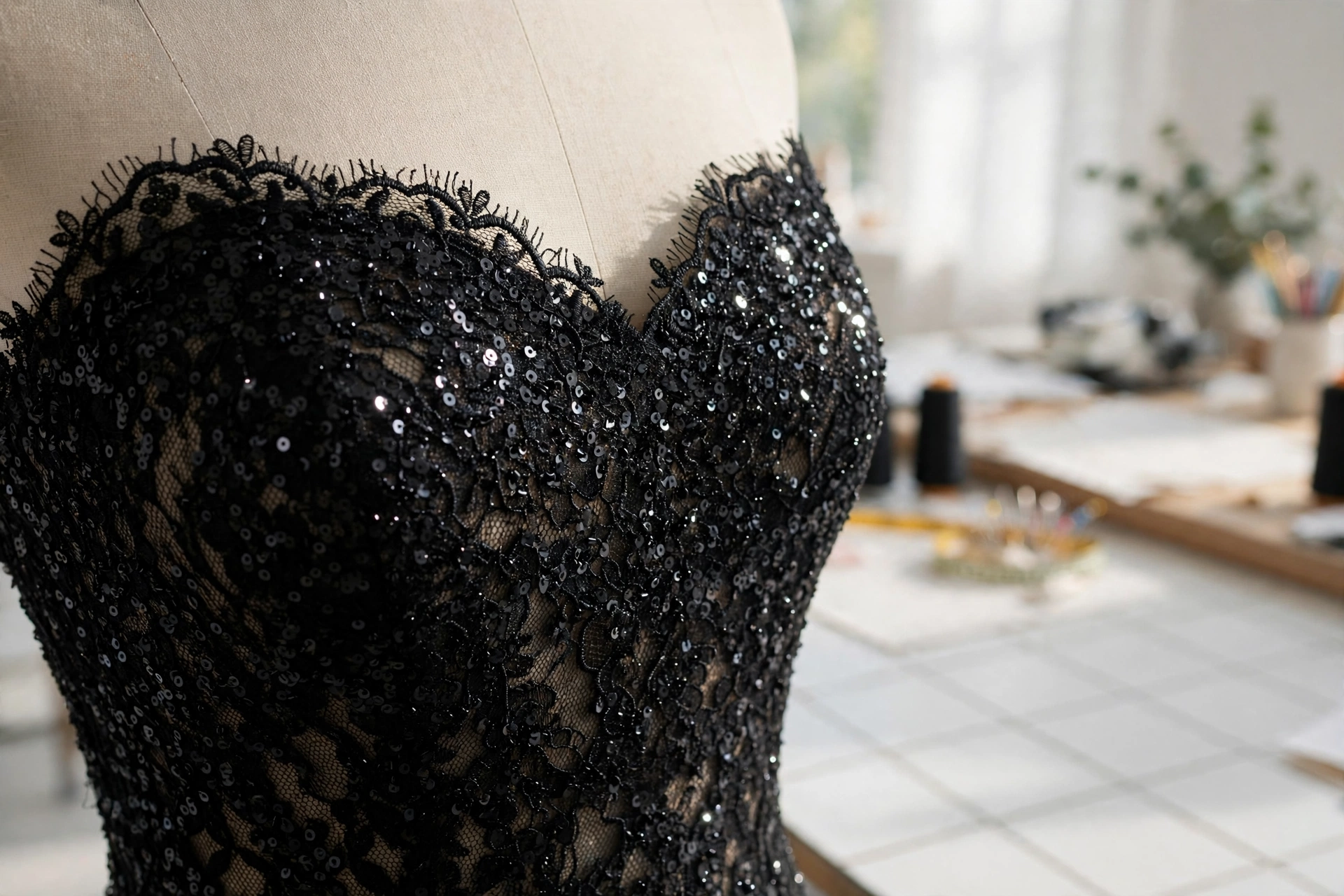
There is also the black dye question, which nobody asks about a black dress until a light-colored car seat or a pale clutch answers it. Deep black dye on budget-friendly fabric can crock, meaning it rubs off dry onto skin and light surfaces, especially along the split edge and under the arms where the fabric moves. The test is embarrassingly simple and almost nobody does it at sample stage. Rub a white cloth hard along the inside of the split for ten seconds and look at what came off. A faint grey smudge is normal for saturated black. A cloth that comes away properly dark is a returns season waiting to happen, because that dress will mark a bride’s pale dress at a wedding, a cream sofa, a light handbag, and the review will not say crocking. It will say the dress ruined something.
Stores that handle this style well tend to do two unglamorous things. They write the strap and bust warnings into the product description in plain language, which feels like talking a customer out of a sale and works the opposite way, because a woman who reads that the halter runs snug across the bust and orders up has been set an expectation she can meet. And they keep one sample out of its bag so staff have actually handled the fabric weight. A halter maxi lives or dies on fabric weight more than most styles. Too light and the split flies open with any air movement and the bodice offers nothing. Too heavy and the neck straps spend the night sawing. The middle is a fabric with some body that still drapes, and you cannot judge that from a supplier’s photograph of a dress on a model who is holding still and being paid to.
If you are ordering this style for a boutique rather than for yourself, the ready version of it sits among the existing styles in the factory catalog of ready women’s styles, where current stock pieces run from 10 pieces per style with colors and sizes mixed. That matters for a dress like this because the sensible first order is a shallow one spread across sizes, not a deep one in the middle sizes. Halter returns concentrate at the edges of the size range, the smallest and largest sizes are where the bust trap bites, and a shallow spread tells you in one selling cycle whether your customers’ bodies agree with this cut. A deep first order tells you the same thing with more stock left over.
What the star ratings hide on this one
Rating patterns on split cocktail dresses split themselves, if you will forgive it, into women who wore the dress once for photographs and women who wore it for six hours. The first group rates the look. The second group rates the straps, the split behavior, and whether the zipper survived being done up in a hurry by someone else in a bathroom. Averages blend those two evenings into a number that describes neither. When the service side reads reviews before recommending a style to a store, the one-star and two-star texts get read in full and the five-stars get skimmed, because the low reviews are where the construction details live. Nobody writes three paragraphs about a dress that was fine.
No wait. That is not quite how it happens, I should be accurate. The five-star reviews do get read, but for a different thing, which is what occasion the dress was actually worn to. Cocktail in a listing title means anything from a work party to a nightclub to a wedding guest outfit, and a black halter maxi crosses some dress codes and breaks others. Reviews that mention being turned away from nothing and photographed all night tell you the dress reads formal enough in person. Reviews mentioning it felt too bare for a wedding tell you where your local line sits. That is market research a store gets for free, written by strangers, and it is more honest than asking friends.
The custom route sits at the other end of all this. A customer who wants this silhouette with the strap width changed, the split lowered two inches, or the bust given more room is asking for a pattern change, and pattern changes belong to sampling, the same route used for a made-to-measure floral mesh maxi piece where a single body is measured and the print placement is argued over before cutting. That is slower and costs what sampling costs, and it is still cheaper than a returns pile. I keep coming back to that arithmetic from this side of the desk. The dresses are not expensive. The returns are.
Questions the returns desk actually gets on this dress
The size chart says my waist is a medium. So why did the top feel like a small?
Because on a halter dress the waist measurement is the honest one and the bust is where the cut takes its liberties. The neckline fabric has to travel up to the neck and fasten, and that path eats room across the chest that a strapped bodice would give back through adjustment. If you sit between sizes and most of your size lives in your bust, the larger size is usually the one that survives the evening, and the waist can be taken in by any tailor in twenty minutes. Going the other way, a tight halter loosened, is not a tailoring job that exists. I get this one wrong half the time myself when I guess from measurements alone, which is why the answer is always try the top, not the chart.
Ten pieces per style to open a wholesale order. What does a store do with ten halter dresses?
Ten pieces is the floor for existing styles, mixed across colors and sizes, and for a style with a known bust trap that floor is honestly a mercy. It lets a store test the cut on real customers for the price of a shallow spread instead of committing to a rack. Spread them across the size range rather than doubling up the middle sizes, because the middle sizes will sell in almost any cut and teach you nothing. What you are buying with a first ten is information about the edges. Whether the information flatters the dress is another matter.
The split looked fine in the mirror. Why did it misbehave all night?
A mirror test is standing still in still air, and a split is a moving part. It opens with stride length, with sitting, with stairs, with wind off a terrace, and the lining, if there is one, either moves with the outer fabric or fights it. A split that is stitched closed a few centimeters higher behaves like a different dress, and that small alteration, done before the event rather than after the photographs, ends most of the complaints this style collects. Usually the dress was not too revealing. It was revealing at moments the wearer did not choose, which lands differently.
Black dress, black marks on my bag. Is that a fault or just this fabric?
It is a known behavior of heavily saturated black dye on some fabrics, and whether it counts as a fault depends on how much came off. A whisper of grey on a white cloth rubbed hard is the cost of a true deep black. Enough dye to mark a bag through an evening of normal contact is past the line most stores accept, and it is the kind of thing that should be caught at sample stage with the cloth test rather than argued about afterward. Once the dress has been worn and marked something pale, both sides feel cheated, and honestly both sides sort of were, just by the dye bath rather than by each other.
You will notice this letter never quite tells you whether to stock it. That is because from the returns side the answer is embarrassingly local. The same dress is a good dress in a store whose customers are twenty-five and going to parties where everyone stands, and a problem dress in a store whose customers sit through wedding dinners and dance after. The listing cannot tell you which store you have. Your last three months of return reasons can, and I would read those before I read one more product description, including this one.