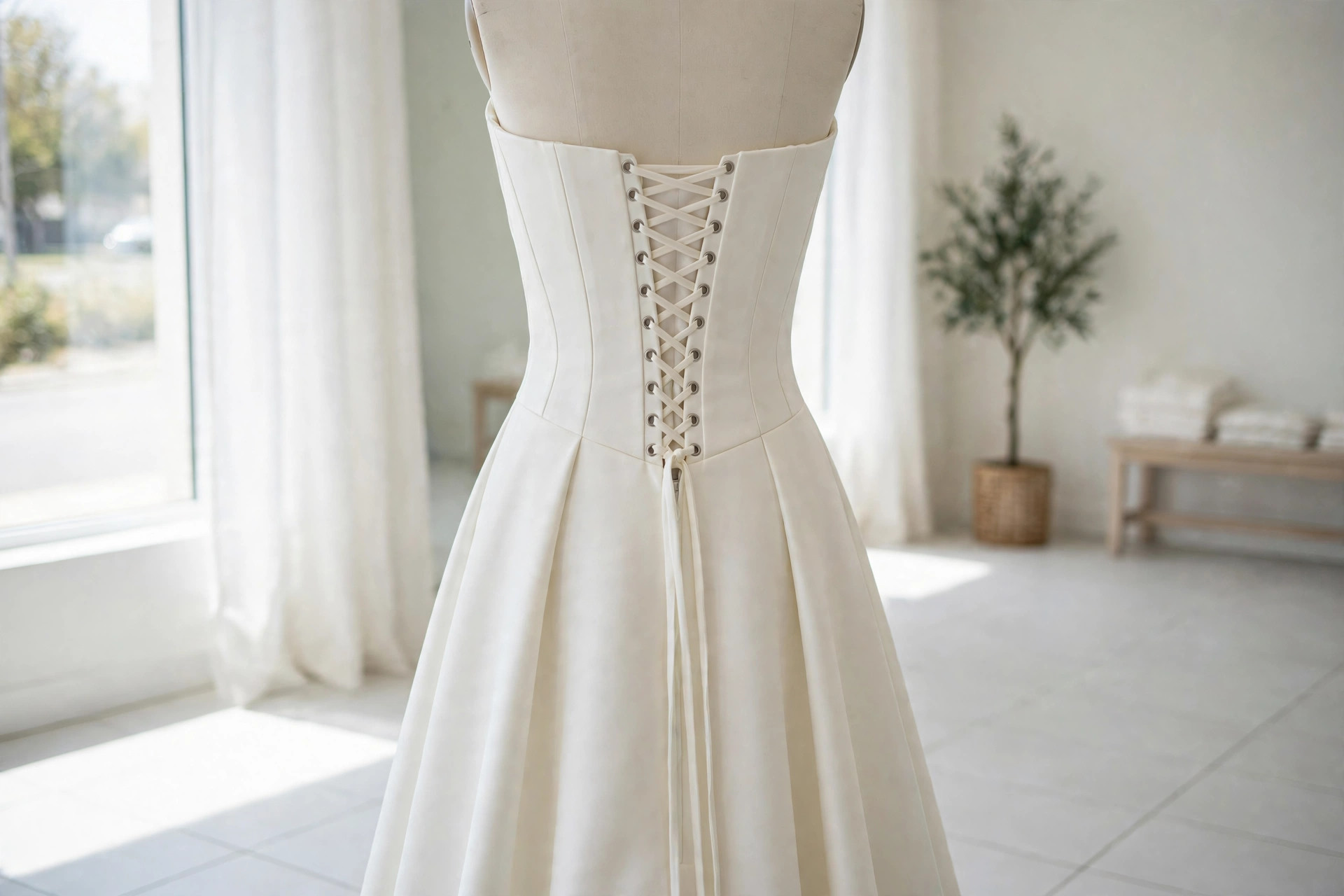
Twelve. That is roughly the number of eyelets running down the back of a lace-up tulle skirt like this one, and twelve is also roughly the number of places the whole garment can fail in a single evening. A high-low tulle wedding skirt lives or dies back there, not in the photographs of the front. The front is net and air and a hem that stops above the knee. The back is a working closure. It gets pulled, tied, retied after dinner, and pulled again, and every one of those pulls lands on metal rings set into the flimsiest fabric in the building.
Working the production side of bridal separates teaches you to look at a skirt backwards. Buyers look at the silhouette. The line looks at the placket, the strip of stable fabric hiding behind the lacing, because that strip is either there or the eyelets are punched straight through tulle. Tulle is a net. A net has holes in it by design. Setting an eyelet into it is asking a hole to hold a metal eyelet under tension, and the eyelet answers the only way it can, by tearing through the nearest thread bridge the first time somebody ties the back firmly.
The high-low cut itself is honest enough work. Two hems instead of one, a short front that shows the shoes and a long back that drags a little drama behind it, and on a themed style like this corpse bride tulle skirt the grey-blue or smoke tint does the storytelling. None of that is where the money leaks. The leak is a few cents of grosgrain or twill tape that either got sewn behind the eyelet row or got value-engineered out of the sample and never put back.
The tape nobody wants to pay for
On a sewing floor the reinforced placket is boring, which is exactly why it disappears. Cutting it means one more small operation. A strip gets cut on the cross so it will not stretch, folded, set behind the lacing panel, and only then do the eyelets go in, through tape and panel together. The eyelet machine punches and sets in one stroke, and a setter who has done a few thousand of them can hear the difference between an eyelet biting into layered fabric and an eyelet biting into net. One sounds like a bite. The other sounds like a tear that has not happened yet.
Skip the tape and the sample still passes a showroom pull. That is the trap in it. A gentle tug in a fitting room is not a wedding, and it is not a Halloween party either, which is where this skirt style earns much of its keep in October. Real wear means a wearer sitting down in a skirt laced snug, standing up, dancing, leaning back against a chair. Every movement works the top eyelets hardest, the pair nearest the waist, because the lacing tension concentrates where the tying hand finishes. When returns or complaint photos show damage on this kind of skirt, the top two or three eyelets are the ones that have gone, pulled out through the net while the lower row still sits there looking innocent.
There is a simple bench check any buyer can run without a lab. Lace the sample up on a form, tie it the way a bridesmaid would tie it, firm rather than careful, then work one side of the lacing with short tugs for a minute. Then look at the eyelets against the light. On an unreinforced back the net around each eyelet will have gone slightly oval. That oval is the tear starting. It does not heal, it does not need a second wear to get worse, and no amount of careful steaming in a boutique will talk it back into round.
Layer count is the second place this skirt style quietly changes between sample and bulk. A corpse bride look needs depth, because flat grey tulle reads cheap in photographs while stacked layers read as shadow and movement. Each added layer is cheap as fabric and expensive as hemming, since a rolled hem on tulle is slow, fiddly work that puckers if the feed runs uneven. When a quote comes back suspiciously low on a many-layered skirt, the layer count is one of the first places to count by hand, lifting the skirt at the side seam and separating the nets one by one. Samples get counted in approvals all the time. Bulk, far less often, and the difference between five layers and four is invisible on a hanger and very visible in a fitting room.
Grey is a dye decision, not a mood
The colour deserves a word because themed tulle skirts sit in an awkward spot in the bridal range. Next to the ivory gowns in the wedding dress wholesale catalog, a smoke-grey skirt is a statement piece, and statement pieces get ordered in small, nervous quantities. Small quantities change how the colour gets made. A short run of grey tulle often starts life as white net dyed or bought in a pre-dyed lot, and pre-dyed net lots vary the way all small lots vary, a shade deeper at one end of the roll than the other. On a skirt built from five or six layers, a slight lot difference stops mattering because the layers average each other out. On a short front panel with fewer layers over the leg, it can show.
That is why the approval habit that matters here is not a colour card under office light. It is the finished front panel, held against a window, because tulle is translucent and translucent fabrics change their story depending on what stands behind them. Skin behind grey tulle reads one way. A dark lining reads another. The lining question is worth asking out loud before ordering, too, since a high-low skirt with a short front needs its lining or underskirt to end at a length that looks deliberate. Two centimetres too long and the lining peeks like a mistake. Two too short and the front reads unfinished every time the wearer moves.
Hemming the high-low curve is the operation I would ask about before I asked about price, and I say that as somebody whose side of the business is the making, not the buying. The curve where the short front sweeps down into the long back is a bias nightmare, tulle on the diagonal with no grain to behave itself, and it wants to ripple. A patient setter eases it through in small sections. A rushed one stretches it, and a stretched tulle hem does not lie flat later, it waves, permanently, in a way pressing cannot fix because there is nothing to press, the fabric has no body to hold a crease or release one.
No wait. I keep coming back to the eyelets, and the eyelets are not actually the first thing I would check on a fresh sample. The waistband is. A lace-up back adjusts the bodice fit on a gown, but on a separate skirt the waistband carries the whole garment, several layers of net plus lining hanging off one band, and if that band is a soft elastic with no structure the skirt will travel downward through an evening no matter how well the back is built. The lacing on a skirt like this is partly working closure and partly theatre. The waistband is all work.
Ten pieces, and what ten pieces actually changes
Buyers ask why a factory quotes a ten-piece minimum on a skirt that looks like a puff of net, and the honest answer sits in the cutting room. The reinforced plackets, the waistbands, the lining pieces, all the small stable parts inside the cloud of tulle, cut far better in a stack than one at a time. Ten pieces lets a cutter lay those parts up together and lets the eyelet setter work a rhythm instead of a favour. One piece is not impossible. One piece is a sample, priced like a sample, and judged like one too, which buyers sometimes forget when a single unit arrives with sample-room shortcuts still in it.
For a boutique weighing this style against a full gown program, the comparison that helps is construction per dollar rather than drama per photograph. A basque-waist ball gown, the kind broken down in the basque waist cost piece, puts its money into a structured bodice. This skirt puts almost nothing into structure and almost everything into layers and hems, which means its quality shows in places buyers are not used to inspecting. Count the layers. Tug the eyelets. Look at the curve of the hem against the floor while the skirt hangs, not while somebody holds it up and shakes it into behaving.
The themed angle cuts both ways commercially, and this is the part of the conversation that tends to get skipped in October and regretted in November. A corpse bride skirt has a season. It sells into Halloween weddings, styled shoots, and the small slice of brides who want the look all year. Outside that slice, the same construction in ivory or white is simply a high-low bridal skirt, which is why some stores order the style in a pale colourway for the rail and keep one grey sample for the October window. The construction checks do not change with the colour. The eyelets do not care what shade the net is.
What I cannot tell a buyer from the production side is whether their customers will forgive a theatrical skirt its theatrical fragility. That is a shop-floor judgment, not a factory one. What the production side can say, plainly, is which parts of this garment are built to be pulled on and which parts are built to be looked at, and that on the version worth stocking, the two lists are not the same list. The full range of bridal separates and gowns sits in the women apparel factory catalog for anyone comparing constructions across styles.
I still think about that top pair of eyelets. Everything on this skirt is soft, forgiving, clouds of net that hide a multitude of shortcuts, and then there are twelve small metal rings being asked to behave like engineering. Get those right and the skirt is a bit of fun that survives its evening. Get them wrong and the fun ends in a fitting room, with somebody holding a lace and a loose eyelet and looking at the shop owner like the shop owner personally betrayed them. Maybe that is unfair. It is also retail.
Questions buyers keep asking about this one
Twelve eyelets down the back. Is the lace-up on a tulle skirt actually holding anything, or is it decoration?
On a separate skirt the lacing is partly decoration and partly adjustment, and the waistband does most of the holding. The lacing snugs the top of the skirt and gives maybe two centimetres of give either way, which is why a soft, structureless waistband cannot be rescued by tying the back tighter. Tying harder just moves the strain onto the eyelets. I would rather find a weak waistband in the sample than have a customer find it halfway through a reception, honestly.
A sample costs real money for a puff of net. What is the part of this skirt nobody budgets for?
The hems are the part nobody budgets for, because tulle is cheap by the metre and slow by the hour. Every layer of a high-low skirt gets hemmed around a curve that runs on the bias, and a five or six layer skirt carries five or six of those curves. The fabric invoice looks like nothing. The labour line is where the skirt actually lives, and a quote that seems to have forgotten the labour has usually forgotten a layer or two along with it, which you only notice when you count.
Ten pieces per style. Is that minimum real on something this simple, or is it a negotiating habit?
Ten pieces is real, and it sits in the small parts rather than the tulle. Plackets, waistbands and linings cut in a stack of ten behave properly, the eyelet setter gets a rhythm going, and the per-piece price drops for reasons that have nothing to do with squeezing the buyer. A single piece can be made, it just gets made as a sample, at sample pace and sample cost. I get why that annoys people. It still does not change how the cutting table works.
The grey looked right in the showroom and wrong in daylight. Did the colour change, or did I?
The colour did not change, the light did, and translucent fabric makes the gap worse than it would be on something opaque. Grey tulle over skin, over a dark lining, and over a pale lining are three slightly different greys, and a showroom shows you only one of them. Checking the front panel against a window before approving is a two-minute habit that settles it. Buyers skip it because the skirt looks like a simple thing. Simple-looking things are where the surprises keep living, in my experience.