The conversation starts the way the difficult bridesmaid conversations always start, with a sentence that sounds simple. She said: I need six of the emerald one, backless, the thin straps, sizes spread from small to plus, and they have to match. Then she waited, the way buyers wait when they know the last three words are the whole order. They have to match. On the sourcing side of the table, a bridesmaid dress is never really one dress. It is a small fleet that has to arrive looking like it was born together, and emerald is one of the least forgiving colors in the fleet business, because green shows dye variation the way a white wall shows handprints.
The dress under discussion, the Ever-Pretty emerald green backless bridesmaid dress with spaghetti straps, is a chiffon style that lives or dies on exactly the things that conversation was circling. A backless cut removes the structure that hides a multitude of fitting sins. Spaghetti straps put the whole support of the bodice onto two cords of fabric thinner than a shoelace. And emerald chiffon, layered over its lining, changes its depth depending on how many layers the light passes through, which means the same dye lot can read slightly different on the skirt than on the bodice, on any dress, before you even start comparing across six of them.
She asked whether matching was a real problem or a seller’s invention to push bigger orders, and the honest sourcing answer is that it is a physics problem wearing a sales costume. Chiffon takes dye beautifully and unevenly, in the sense that two bolts dyed weeks apart in the same recipe will stand next to each other in daylight and disagree. In a dye house tolerance of around five percent is a working number. Six bridesmaids standing in a row in June sunlight is not a working number, it is an examination. The only reliable way a fleet matches is to cut it from one dye lot, in one production run, which is why the sourcing conversation about a bridesmaid party is always, underneath everything else, a conversation about ordering once and ordering whole.
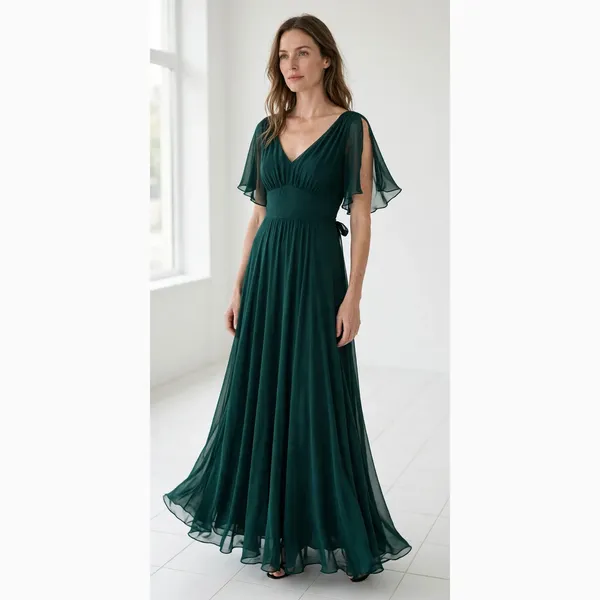
Then she asked about the straps, which is where the conversation got practical in a way she did not expect. Spaghetti straps on a backless dress are not decoration. They are the entire engineering budget. On a sample, the questions are whether the strap is cut on a grain that will not stretch out over an evening, whether the attachment points at the back are reinforced or merely sewn and hoped, and whether the length is adjustable or fixed, because a fixed strap length across six different bodies is a bet that all six shoulders live at the same height. They do not. Adjustable sliders cost little per dress and rescue more fittings than any other single feature in this style family, and a buyer sourcing this dress for resale should ask about the sliders before asking about the price, in that order, because the returns data on backless dresses is a long complaint about straps that dug, slipped, or gave up.
The plus sizes are where the pattern tells the truth
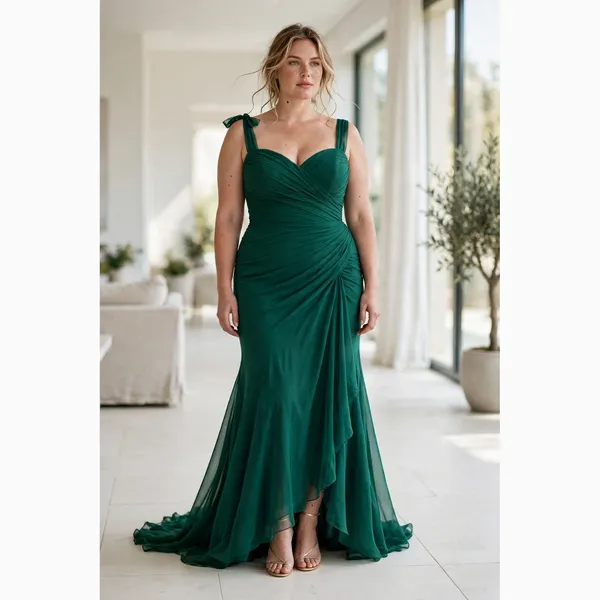
Every bridesmaid range claims a size spread. The sourcing side has learned to ask how the spread was made. A pattern graded up from a small base by adding width evenly will produce a plus-size version of this dress in which the backless opening lands in the wrong place, the straps sit too far apart, and the bodice depth reads wrong, because bodies do not scale like photocopies. The conversation with our buyer turned on exactly this, her largest bridesmaid being the one she was most worried about dressing well, and the correct sourcing question, the one that separates a range built for parties from a range built for listings, is whether the larger sizes were fitted on a larger body at any point in their lives. The answer does not have to be yes for the dress to be worth stocking. But the buyer should know which answer she is buying, because her bridesmaid will find out.
Chiffon sourcing adds its own wrinkle to the size question. A flowing chiffon skirt forgives hips and drapes kindly over difference, which is why this fabric owns the bridesmaid category. The bodice forgives nothing. On a backless style the bodice is a small amount of fabric doing structural work, and across a size spread the difference between sizes concentrates there. Six dresses in a row will show it if the grading was lazy, not in the skirts, which will move and shimmer and distract, but in the set of the bodices, one sitting as designed and one sitting as an approximation. Photographs of wedding parties are studied for decades by people who love the subjects. Approximations get found.
She asked, reasonably, what all this caution did to the price and the order size, and that part of the conversation is the most standardized part. An existing style like this one, already in a maker’s range, opens for wholesale at ten pieces per style with colors and sizes mixed, which for a bridesmaid fleet is a comfortable fit, since a party of six with a couple of spare sizes for the inevitable exchange lands near that floor anyway. The trap is not the minimum. The trap is the reorder. A bride who orders six in March and comes back in May wanting a seventh for a bridesmaid added late is asking the supply chain to match a dye lot that has sailed, and the seventh dress will be a cousin of the other six rather than a sister. In indoor evening light nobody may ever know. In the photographs, taken at noon in a garden, the cousin introduces herself.
The lead time conversation followed, because it always does. Chiffon in a specific fashion green is not a stock color in the way black or navy is stocked. Mills hold the classic bridesmaid palette, the blushes and sages and burgundies that sell every season, and emerald sits at the edge of that palette, stocked in good months and woven to order in lean ones. A sourcing timeline that treats the green as if it were black will miss the wedding, and it will miss it by the width of a weaving slot, three weeks here, a dye queue there. No wait, I should put that more carefully, because it is not the green that is slow. It is the certainty. Black can be substituted across suppliers at a pinch and still read black. Emerald substituted across suppliers reads as two different parties. The color’s specificity is what removes the shortcuts, and shortcuts are where lead times hide.
What a store should do with a dress like this
For a boutique stocking the style rather than dressing one party, the sourcing advice condenses to habits rather than warnings. Order the fleet in one run and photograph your own sample in daylight for the listing, because supplier photographs of emerald are taken under lights that flatter it into a different country. Keep the size spread honest and shallow rather than deep and narrow. Put the strap question, adjustable or not, into the product description where a bridesmaid can read it before she is standing in a fitting room discovering it. And hold one dress back from the first selling wave if you can bear to, because the reorder conversation with the maker goes better when you are holding the original in your hand saying this green, this lot, again.
Ranges like this one sit inside the wider wholesale picture, the current styles in the factory catalog of ready women’s styles on one side and the wedding dress wholesale range on the other, and a buyer moving between them notices the difference in how color is treated. In general women’s styles a color is a variant. In bridesmaid styles a color is a commitment shared by six people and a photographer. Emerald makes that commitment louder than most, which is also its appeal. Nobody chooses this green to be safe. The bride chose it because a line of bridesmaids in deep green against a summer garden is a picture she has been carrying in her head, and the sourcing side’s whole job is to make sure the picture in her head and the picture in the album are the same one, which is a dye lot problem, a grading problem, and a strap problem, disguised as a dress.
Four questions from that same conversation, kept as asked
Six dresses, six sizes. Why can’t I just add a seventh two months later?
You can, and sometimes the seventh comes from the same stock and matches perfectly, and anyone who tells you otherwise is selling urgency. The risk is real though and it is specific. Once the original dye lot is exhausted, a later dress is dyed to match a standard, and standards and lots are cousins, not twins, with emerald showing the family resemblance problems more than most colors. If the party might grow, ordering one spare size in the first run is the cheapest insurance in the whole bridesmaid budget, cheaper than the rush alteration the seventh dress will need when it arrives reading half a shade proud of its sisters. Brides hate hearing this in March. They hate the alternative more in May.
Backless, thin straps, plus size in the same order. Am I asking for trouble?
You are asking the pattern to have been made properly, which is a fair thing to ask and not always what happened. The trouble spot is not the backlessness itself, it is whether the larger sizes kept the bodice proportions fitted rather than merely widened, and whether the straps on those sizes are positioned for the body wearing them. A store cannot re-grade a dress at the counter, but it can choose ranges where the big sizes were clearly worn by someone during development, and it can say plainly in the fitting room that a backless style asks more of alterations than a strapped one. Honesty in the fitting room is cheaper than a one-star review written by a bridesmaid who felt like an afterthought in the size run, because she can tell, they can always tell.
Ten pieces minimum on an existing style. What if my parties are smaller than that?
Then the minimum is a stocking decision rather than a party decision, and it should be made like one. Ten pieces across a size spread in a proven color is a small, movable commitment for a store that serves weddings all season, because bridesmaid dresses are not bought by the party alone, they are bought by the season, one fleet after another in the same few colors. Emerald’s season is long, it works from spring gardens to December candlelight, which cannot be said of every green. A store that truly serves only a handful of weddings a year should not be holding fleets at all, and the bride is better served by a single custom order, where one party’s six dresses are cut together as one job, which solves the matching problem by simply never creating it.
The sample looked more blue than the photos. Which one is the dress?
The sample is the dress, and the photograph is an advertisement for it, and the gap between them on emerald is wider than on almost any other common color because screens and studio lights push green toward blue while daylight pulls it back toward yellow. Judge this color outdoors or beside a window, against skin, against the flowers if you can, and judge it on the body it will be worn by rather than on a hanger. If the sample’s green is the green the bride wants, order with confidence and ignore the listing image from that moment on. If it is not, no argument about lighting will fix it later, because the wedding will be lit by the same unforgiving sky you are standing under now, holding the sample, squinting a little.
She ordered the six, in the end, in one run, with a spare. Whether the seventh bridesmaid ever materialized I never heard, and the sourcing side rarely does hear, which is the quiet asymmetry of this end of the trade. We hear everything about the orders that go wrong and almost nothing about the fleets that simply arrive, match, fasten, and stand in a garden being green at exactly the same time. Somewhere there is an album where six dresses agree with each other completely, and nobody in any of the photographs knows that the agreement was manufactured, dyed, graded, and argued over months before, in a conversation that started with three small words about matching. That is the job working. It looks like nothing happened at all.