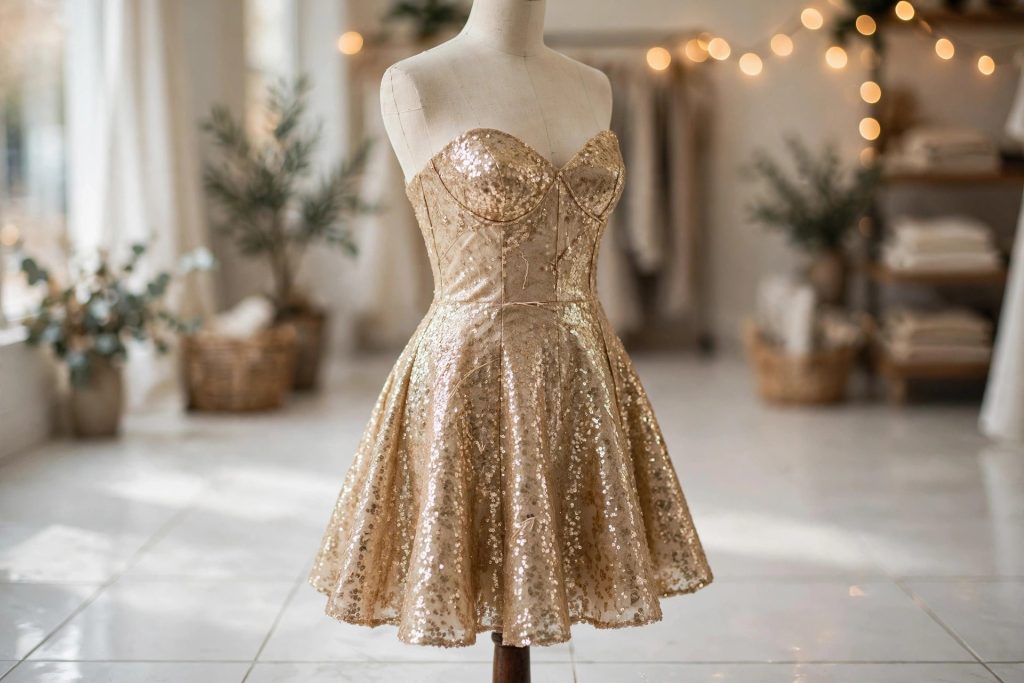
Everyone worries about the sequins falling off. That is not what kills a sequin dress on the production line. What kills it is the sequins that stay on, badly, in rows that wander.
I say this from the production side, where a sparkly glitter dress is not a photograph but a shift’s worth of decisions. A sequin is a small plastic disc with a hole in it, and everything about the garment follows from how that disc gets attached. Machine stitching runs a thread through the holes in overlapping rows, fast, consistent when the operator is fresh. The discs lie like scales. Light moves across them in a sheet. That is the dress in the listing video, turning slowly, doing its one trick very well.
The trick has a cost nobody puts in the product description. Overlapping rows cannot turn a sharp corner. At the waist seam, at the dart, at the edge of a strap, the rows have to break, restart, change direction, and every restart is a place where a disc sits at a slightly wrong angle and catches light differently from its neighbors. On a good production day those places are few and hidden. On a Friday afternoon in peak season they multiply, and the dress that results still sparkles. It just sparkles untidily, in a way a customer feels before she can name it.
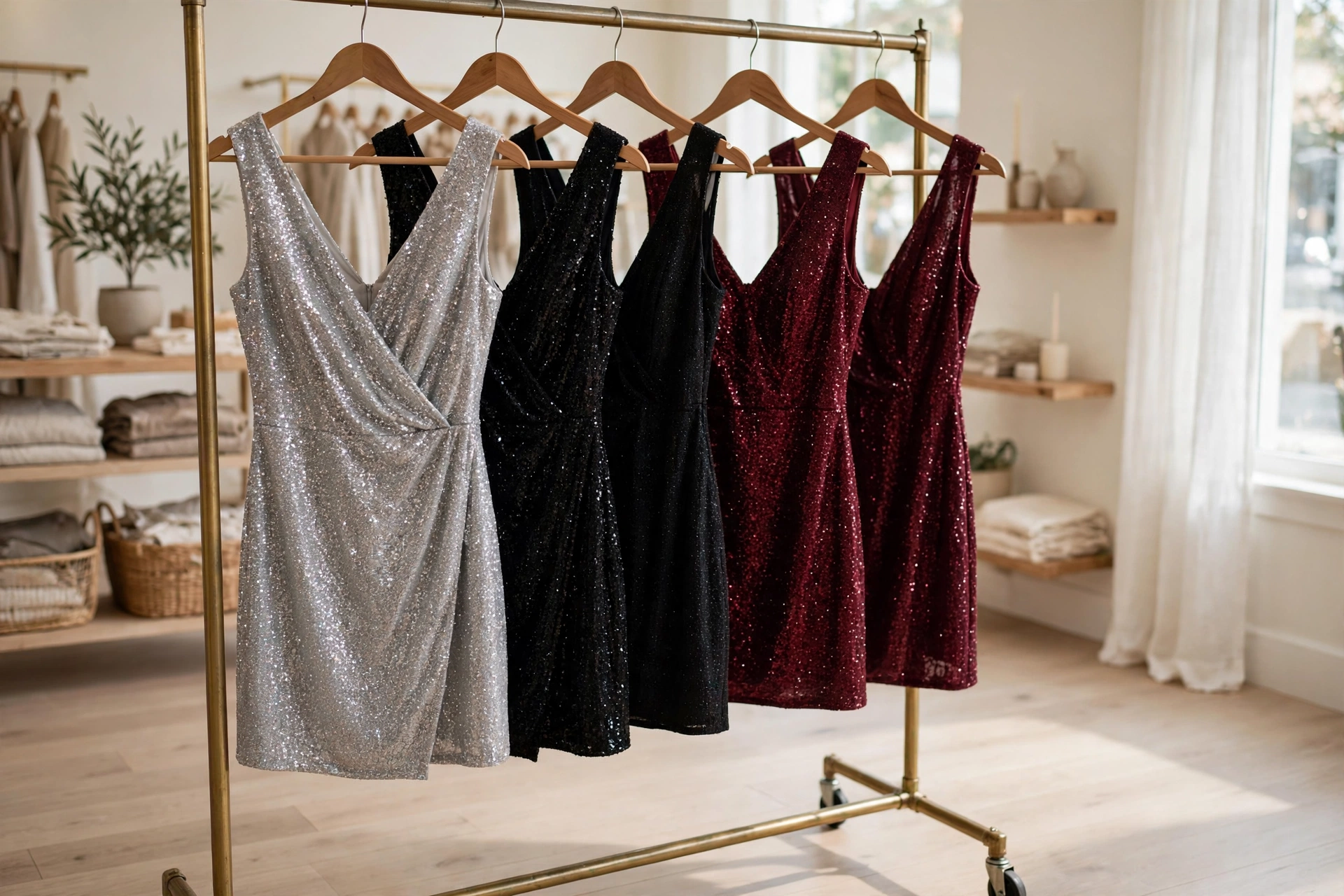
Density is the number buyers ask about and the number that misleads them most. More discs per square inch reads richer in a photograph. It also makes the fabric stiffer, heavier, and slower to sew, and a stiff sequinned panel draped over a curve starts to fight the lining underneath it. The lining is not decoration. On a sequin dress the lining is the only thing between the wearer’s skin and several thousand thread knots and disc edges. Cheap out on the lining and the itch complaints arrive wearing the sequin’s name, when the shell was innocent and the inside of the dress was the whole crime.
The obvious answer is wrong about weight, too
A full sequin dress is heavy. Not ball-gown heavy, but heavy enough that the hanger becomes a design decision. Narrow hangers stretch a sequinned bodice while it waits in a warehouse, the pre-shipping stretch nobody accounts for, and a dress that was true to size at final inspection arrives reading a half size large across the shoulders. Shops store these dresses flat or on wide hangers when they know. The ones that do not know learn from the returns rail.
Thread choice runs underneath the shedding question like a fault line. Beading and sequin work wants its own thread, finer, slicker, made to survive the abrasion of a thousand disc edges. Regular polyester sewing thread looks the same on the cone and costs less, and under the repeated flex of wear it starts to snap at the discs, one stitch at a time. The shedding that results shows up two to four weeks after delivery, which is exactly when the review gets written, and the review says the dress fell apart. The dress did not fall apart. A purchasing decision made months earlier, at the thread cone, fell apart on schedule.
That is the part of this trade I cannot make buyers care about at the quote stage. Hand-finished sequin work, the slow kind, with each cluster of discs anchored and checked, runs hours per bodice. Machine-tacked work runs a fraction of that, with a fraction of the anchors. The compromise phrase that ends up in tech packs everywhere is hand-finished, which can mean a worker checked the edges by hand or can mean almost nothing, and the two dresses wearing that phrase are not the same dress. The buyer who squeezes the quote gets the second meaning. The wearer finds out which meaning shipped.
Rework rates tell the honest story of a style. On plain dresses a line might see a few percent coming back after the first quality pass. On dense sequin and bead work the figure runs 12 to 18 percent, mostly loose centers and discs sitting proud. That rework is skilled, slow, and expensive, and it is the first thing squeezed when an order falls behind. A late order does not ship with more defects because anyone chose defects. It ships with the rework shift shortened, and the defects are what a shortened rework shift looks like from the customer’s side of the box.
| Machine-stitched sequins | Hand-sewn sequins | |
|---|---|---|
| How each sequin is held | Continuous chain stitch through a strand | Individual stitch and knot, one by one |
| What one broken thread costs | A run of sequins can unzip along the row | One sequin, the neighbours stay |
| Sewing time for the same motif | Baseline | Typically 3 to 5 times the machine time |
| Repair after wear | Row has to be re-stitched and re-matched | Single sequins can be replaced in a shop |
| Where it is usually specified | Allover sparkle at a price point | Bodice work, motifs, couture orders |
Christmas red is its own production problem
This style lives at the Christmas end of the year, which loads every weakness it has. The dresses are ordered late, worn on specific dates, photographed under warm indoor light and flash. Red and green and champagne sequins under flash are unforgiving about the wandering rows. A color that read deep and rich on the sample under office light can go flat or garish under a phone flash at a party, and dye-lot thinking applies to colored discs the same way it applies to dyed lace. Two runs of red sequins are cousins, not twins. A dress paneled from two runs carries the difference across the bodice where everyone can see it.
Steam is the other seasonal trap. These dresses arrive wrinkled and someone always reaches for a steamer. Discs soften and warp at high heat, some glues let go, and the pressing fix that works on every other party dress quietly damages this one. Low heat, a pressing cloth, patience, about twenty extra minutes a dress. The care label says some of that in symbols nobody reads. The one-star reviews say the rest, in words, usually with a photograph taken after the steamer did its work.
No, I am misremembering that as a care problem only. It starts earlier. The discs that warp fastest under steam are the cheaper dyed ones, and the same dyed discs are the ones whose color can rub. The test on the line is a damp white cloth, rubbed hard. Color on the cloth means trouble is already in the garment before any steamer gets near it. Steam just publishes the result.

Fit does the final damage in the reviews, and fit on a sequin dress is a negotiation between a rigid shell and a soft body. The shell does not ease. A wearer between sizes has to go up and tailor down, or go down and breathe carefully, and the listings rarely say so in plain words. Boutiques that stock this category through ranges like the women’s apparel wholesale catalog learn to order the size run expecting alteration conversations, not despite the dress but because of what it is made of. A sequin dress that fits off the rack is partly luck. The shops know it. The size chart cannot say it.
Where this dress sits in a December rail
Next to satin, sequins win the photograph and lose the evening. Satin shows every wrinkle and photographs honest. Sequins hide the body’s small movements, glitter past the fit problems, and then shed a small trail across a dance floor that the venue staff will be finding until spring. For a Christmas-themed wedding the trade usually favors the sequins. The theme does half the selling before the dress is even tried on, and themed weddings forgive a dress almost anything except being dull.
Shops ordering themed stock alongside their bridal range, the kind of range shown in the wedding dress wholesale catalog, face the calendar problem in its purest form. A Christmas dress that arrives in November is stock. The same dress arriving in January is a cost. Production slots in the autumn rush are fought over by every category at once, and a sequin style, slow to sew and slow to rework, is a bad style to be late with. The factories that promise a December delivery on an October order for dense sequin work are either very good or very optimistic, and from the buyer’s chair those two look identical until about the second week of November.
One production detail deserves its own breath before the questions start, because buyers trip on it every season. The sample and the bulk are sewn under different pressures even in the same building. The sample gets the operator who anchors slowly. The bulk gets the line at line speed, and the gap between those two speeds is where this style lives or dies. A buyer approving the sample is approving the best version of the dress. The order that follows should be priced and scheduled for the ordinary version, and the shops that understand that sentence reorder. The ones who expect the sample, thirty times over, at speed, write the reviews I have been describing.
Questions from the line, answered plainly
Three thousand sequins, give or take. Why do twelve loose ones ruin the review?
Because the eye finds the gap, not the coverage. Twelve missing discs make a pale patch the size of a coin and that patch is all anyone looks at in the photograph afterward. The other thousands behaved. Nobody reviews the ones that behaved. If a sample sheds on the line we pull at the clusters with a proper tug, about a 3-kilo pull, and a dress that cannot take that in the sample room will not take a December in the world. It is not a cruel test. It is just early.
The dress itches. The sequins are on the outside. Explain that.
The lining explains it, almost every time. An unbrushed or short lining lets knots and disc edges reach the skin at the bodice, and the wearer blames the sparkly part she can see. A longer, softer lining in the same dress ends the complaint without touching a single sequin. When a buyer asks me where to spend a little more on this style, that is the answer I give, and it surprises people because the lining never appears in the photographs that sell the dress.
Ordered in October, needed in December. Where does that order actually go wrong?
Usually at rework, quietly, around week three. The sewing keeps pace because sewing can be staffed. The checking and re-anchoring cannot be staffed the same way, skilled hands are the bottleneck, and a squeezed schedule eats their hours first. The dress ships on time and sheds on time too. I would rather a factory told a buyer in October that the honest delivery is early December with the rework done, but that sentence loses orders to factories willing to promise November, so it rarely gets said out loud.
Same dress, two production runs, one photographs warmer. Is that a defect?
It is a tolerance question wearing a defect’s clothes. Dyed discs drift between runs the way dyed fabric does, and under flash the drift reads bigger than it is. Mixed panels are the real fault, one dress carrying both runs across the bodice. A whole dress from one run, slightly warm, is just that dress. Buyers who reorder this style mid-season without asking whether the new stock matches the old are buying themselves a rail of almost-matching dresses, and almost is the word customers use in the reviews.
The dress still stops a room. That is the annoying part, after all of the above. A well-anchored sequin dress in December light does the thing it promises, and the line knows it, and the buyers know it, and the whole fragile arrangement of thread and discs and shortened rework shifts exists to protect one short moment when someone walks in and the room looks up. I check the anchors anyway. The moment is not my side of the business. The anchors are, and they are what I will still be thinking about when the photographs are long forgotten.