
Alright, let’s cut through the fluff on this “Women’s Elegant Sheer Vintage Short Lace Wedding Dress.” You’re not selling dreams when you stock vintage wedding dresses; you’re selling inventory that needs to turn a profit and not come back in a box of defects. It’s 2026, the supply chain is still a beast, and cheap factories are still promising gold for copper.
The advertised “Elegant Sheer Vintage Short Lace Wedding Dress” – or as I see it, another SKU in the vintage wedding dresses category that can either make you solid margin or bury you in returns. When you’re buying at MOQ 5, every single unit has to pull its weight.
The $400 Mistake You’re Making on Vintage Wedding Dresses Bulk Orders
Don’t let pretty product shots fool you. The actual construction quality on bulk orders, even at an MOQ of 5, is where your margin lives or dies. For this Women’s Elegant Sheer Vintage Short Lace Wedding Dress, the “sheer vintage lace” description is your first red flag. Sheer means delicate, and delicate means higher potential for failure if the factory cuts corners on fabric grade or assembly.
Let’s talk structure. This isn’t a heavily boned ballgown, but even a short dress needs to hold its shape. The inner lining is paramount. You’re looking for a minimum 40D polyester lining, preferably 50D for better opacity and tear resistance. Anything less, and you’ll have complaints about transparency and premature wear. The way the lace overlay is attached to that lining and the main body? Critical. Is it securely stitched at all major seams or merely tacked down? A loosely attached lace overlay will snag, tear, and separate faster than your lead time from Nansha Port.
Seam allowances on a lace garment, especially a sheer one, dictate its lifespan. Two-to-three millimeter seams on the inside are a death sentence. They fray, they pop, and your boutique owner is looking at $50-$100 in alteration costs per unit, which comes directly out of your projected profit. Demand a minimum of 1cm seam allowance, properly overcast, especially on stress points like the armholes and waistline.
The zipper. This is the oldest trick in the book. A generic zipper on this vintage wedding dresses style will seize or break after a few wears – maybe even before it leaves your shop. You want YKK or an equivalent reputable grade. A busted zipper is an immediate return, a damaged reputation, and zero ROI on that particular unit. For the “short lace” aesthetic, the zipper should be invisible, which means precise installation. A cheap factory will butcher this, leaving a wavy seam and a visible track, downgrading the whole garment.
Batch #1 vs Batch #50 of Women’s Elegant Sheer Vintage Short Lace Wedding Dress: Will they match?
Here’s the grim truth about mass production, even when dealing with smaller MOQs. You place an order for 5, then you like them and scale to 50, then 100. Will the last unit look like the first? Probably not, unless you have proper QC protocols in place.
For the Women’s Elegant Sheer Vintage Short Lace Wedding Dress, consistency across a batch starts with the lace. Dye lots can vary. If the factory sources lace from different batches or even different sub-suppliers for a larger order, you’ll see color variations, slight differences in pattern definition, or even different hand-feels. The “sheer” quality itself can vary – some pieces might be less opaque than others, causing fit and appearance issues.
Appliqué placement and embroidery quality are other massive variables. The product description mentions “beautiful and perfectly hand-done embroidery” and “gorgeous appliques… sewn by hand.” That’s marketing speak. In reality, hand-done means human error. Without tight QC templates and worker training, one unit’s appliqué could be perfectly centered, while another’s is visibly off-kilter. When you’re dealing with bulk, you need consistent application templates and clear inspection standards. Otherwise, you’re looking at a nightmare of inconsistent inventory.
Guangzhou Field Note: A buyer from Melbourne asked me last month: ‘Can I mix MOQ across colors of Women’s Elegant Sheer Vintage Short Lace Wedding Dress ?’ The answer changed my whole pricing model for 2027. Most factories will allow color mixing within the MOQ, but each color typically triggers its own sub-MOQ for fabric dyeing, especially for custom shades. For a lace product, sourcing different lace colors can significantly escalate the per-unit cost on smaller runs, making that ‘mixed MOQ’ deal a potential trap for your margins if you’re not careful about the fabric minimums.
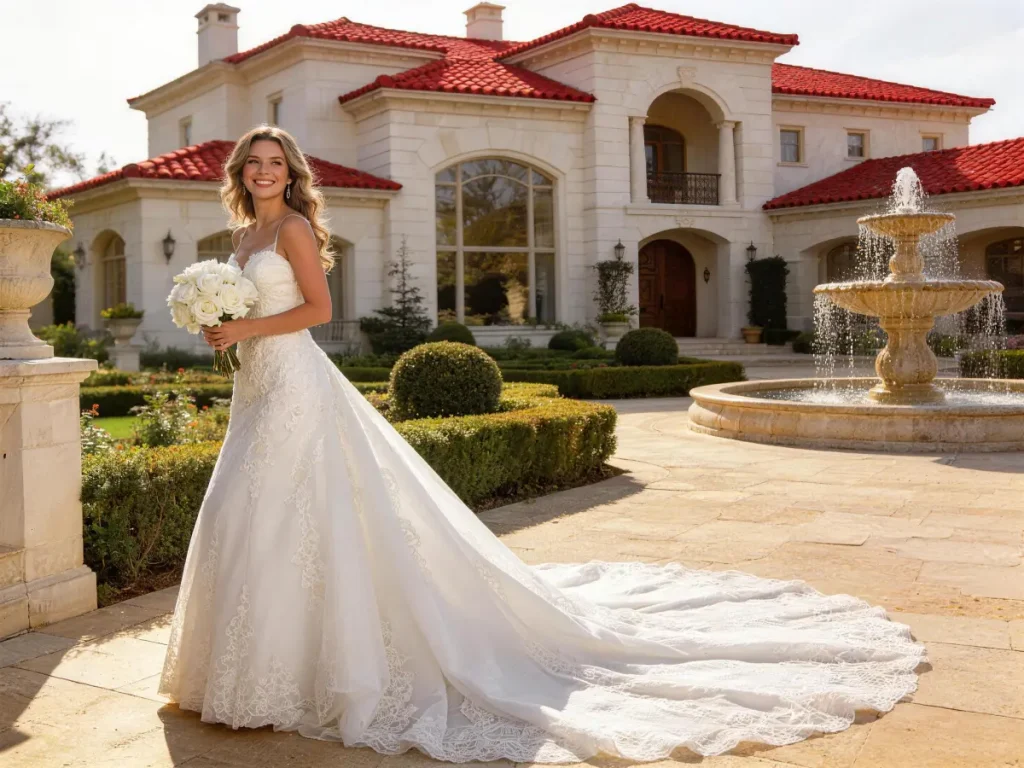
❓ Why is a thorough pre-production sample approval critical for a vintage wedding dresses like Women’s Elegant Sheer Vintage Short Lace Wedding Dress, even with a small MOQ of 5?
Even for 5 units, a pre-production sample (PPS) is non-negotiable. For a product like the Women’s Elegant Sheer Vintage Short Lace Wedding Dress, which relies heavily on delicate lace and specific fit measurements (look at that detailed size chart, it implies precision), skipping the PPS is financial suicide. The factory’s “first shot” might be an okay sample, but it’s often made by their best tailor. The PPS, using the actual production materials and by the actual production line workers, will expose all the potential flaws: incorrect seam allowances, cheap zipper substitution, poor lace alignment, or even a different dye lot for the lining. You approve the PPS before bulk production starts to ensure consistency and compliance with your technical specifications. You don’t want to receive 5 units that don’t match your approved golden sample. Trust me, sending 5 dresses back from New York to Guangzhou costs more than two proper PPS iterations.
❓ How can a buyer accurately assess the real construction quality of Women’s Elegant Sheer Vintage Short Lace Wedding Dress without cutting open every sample?
You don’t need to destroy a sample to inspect it. First, perform a full visual inspection under good light: check for consistent lace pattern, appliqué placement, straight seams, and any puckering on the sheer fabric. Second, a tactile inspection: feel the lace for consistency, check the lining density, and test the zipper multiple times – pull it up and down, check for snagging. Third, a stress test: gently pull at seams, especially armholes and waist, to see if they hold or if threads start to pop. Inspect the reverse side of the garment for clean finish, overcasting, and proper seam allowances – hold it up to light to check for adequate lining opacity. Finally, measure every critical point against the tech pack. Pay close attention to symmetry for sleeves and any decorative elements. If you see variations on a sample, extrapolate that to a batch of 50. It’s about knowing where factories typically cut corners and focusing your inspection there.
❓ What common corner-cutting tactics should buyers watch for in the lining and lace quality when ordering Women’s Elegant Sheer Vintage Short Lace Wedding Dress in bulk?
The easiest way to shave cents off a unit cost is by degrading internal components. For the lining of Women’s Elegant Sheer Vintage Short Lace Wedding Dress, watch for a drop from 40D/50D poly to a flimsy 20D or even a non-stretch fabric that compromises the drape and comfort. This manifests as increased sheerness, easier tearing, and a cheap hand-feel. For the lace, it’s typically a reduction in thread count, a shift from a higher-quality recycled poly blend to virgin poly with a harsher feel, or less intricate detailing. Sometimes, they’ll use a thinner backing mesh, which makes the lace more prone to tears. For “sheer vintage lace,” a cheaper lace often means it’s less stable, puckers easily when sewn, and its “vintage” appeal just looks like cheap, dated fabric. Always compare the bulk production fabric to your approved fabric swatch, not just the marketing image.
The 2026 B2B Reality Check: Your Sourcing Isn’t a Dating App
Let’s be blunt. The generic B2B directories are filled with “deepfake factory videos” and product descriptions written by bots. They show you a pristine sample, maybe even one from a completely different high-end factory, and then churn out garbage for your bulk order.
The product data for Women’s Elegant Sheer Vintage Short Lace Wedding Dress, with its flowery language about “carefully select high-quality fabric” and “perfectly hand-done embroidery,” is standard directory garbage designed to lure you in. An oemod.com or a true ODM partner with engineering documentation will show you GSM of the lace, density of the lining, seam allowance diagrams, and brand of zipper. They’ll have actual QC reports and maybe even video of line production. Generic platforms? You get a pretty photo and a promise.
The Specs War is real. If the provided specs for Women’s Elegant Sheer Vintage Short Lace Wedding Dress say the lace is a specific poly-blend with a certain GSM, you need to verify it. Factories will often substitute a cheaper, lighter GSM lace or a different blend if their primary supplier is out, or if they just want to increase their margin. They’ll tell you it’s “similar” or “the same quality.” It’s rarely true. You need to implement fabric swatching and testing as part of your pre-production routine.
The MOQ Trap (5 Units Edition) for this vintage wedding dresses style is simple: Yes, the advertised MOQ is 5 units. That’s often honest for a small factory or to clear existing stock. But here’s what changes when you move from 5 to 20 to 100 units of Women’s Elegant Sheer Vintage Short Lace Wedding Dress:
- Per-unit cost drops significantly. A factory sets its MOQ 5 price to cover the setup, pattern making, and minimal fabric cutting. At 20 or 100 units, those fixed costs are amortized, dropping your cost significantly. You’re paying a premium for that micro-run.
- CBM goes up, but per-unit shipping cost goes down. Shipping 5 units means you’re paying close to LCL (Less than Container Load) rates, which are disproportionately higher per unit. At 20 or 100 units, you’re filling more space efficiently, leading to lower per-unit freight costs. This directly impacts your landed cost.
- Negotiating power increases. With 5 units, you have none. With 50 or 100, you can negotiate better fabric grades, better zipper brands, and tighter QC.
Don’t assume the first 5 units are indicative of the factory’s commitment to quality for a larger run unless you’ve laid down stringent QC and inspection demands from day one. Many factories will give you five decent units to hook you, then slack off on the next 50.
Next Steps for Your 2026/2027 Season Planning
Considering Women’s Elegant Sheer Vintage Short Lace Wedding Dress, your primary concern is balancing perceived value (from the “vintage” and “elegant” descriptors) with actual construction quality. A return rate projection above 2% on this style is a hit to your bottom line, not just a nuisance. Your markup potential depends entirely on how well the units hold up.
Want to secure a solid ROI on the Women’s Elegant Sheer Vintage Short Lace Wedding Dress for the upcoming season? Send over your preferred spec pack and we’ll cross-reference it with the factory’s production capabilities for this vintage wedding dresses style. We’ll outline per-unit landed costs for MOQ 5, 20, and 50, including 2026 shipping surcharges from Yantian and Nansha. Let’s talk about lead times, quality assurance checkpoints, and how to get your samples inspected here in Guangzhou before they ever hit a container. This isn’t about window shopping; it’s about moving inventory.
#Womens #Elegant #Sheer #Vintage #Short #Lace #Wedding #Dress
Keep reading: LILLUSORY Floral Wrap Dress Review and Sparkling Crystal Off-Shoulder Mermaid Gown Review.