Here is the question I have carried around the fabric trade for years and still cannot answer cleanly: how much of a convertible infinity dress is the dress, and how much of it is the two long straps doing an impression of a dress? I sell cloth and trims on the upstream side, rolls and dye lots and the unglamorous inputs, and the infinity dress comes to my counter as a fabric question long before it becomes anybody’s bridesmaid photograph. A skirt, a bandeau, and two straps long enough to wrap a torso several ways. The makers say seventy-two styles. My yardage sheet says something else. It says the straps eat close to two-fifths of the cloth in the garment, and a product whose selling point lives in its straps is a product whose quality lives or dies in a place most inspection checklists treat as an afterthought.
Answer one, the generous answer, is that the straps are the dress and that is fine. A convertible dress is honestly a wrapping system, and the skirt is a long, simple foundation that mostly has to hang well and not fight the wraps above it. Under this answer the quality checks reorder themselves. The bandeau elastic matters most, since the bandeau is the only fitted anchor in the whole architecture and everything wrapped relies on it staying put. Strap edges matter next, because an edge that curls or frays turns every style into the same tired style. The skirt fabric matters for weight and drape. It is a coherent answer. I believed it for a while.
Then the fabric behavior started arguing with it. The straps on these dresses get cut long, and how they are cut decides how they wrap. A strap cut on the bias, diagonally across the weave, drapes and twists smoothly and lies flat against a body in those crossed and knotted arrangements in the photographs. A strap cut straight, along the grain to save cloth, twists like a ribbon in wind and keeps trying to roll into a cord. Both are the same fabric on the same invoice. From my side of the counter the difference is a cutting decision worth a few percent of yardage, and from the wearer’s side it is the difference between a dress that does twelve believable styles and a dress that does three and then gives up and becomes a halter forever.
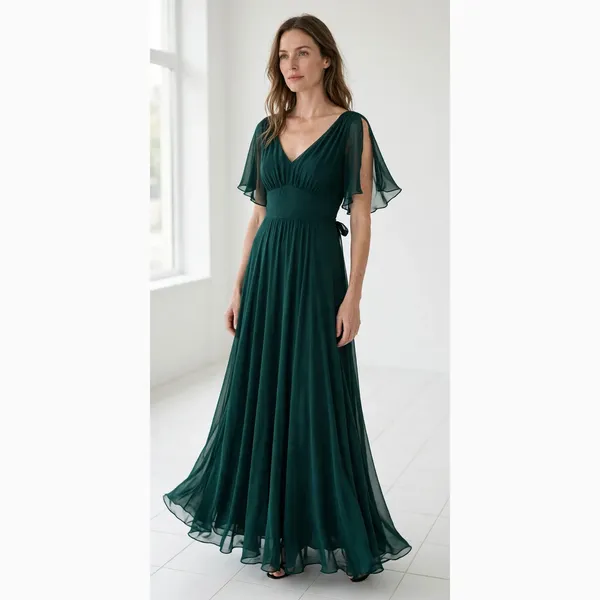
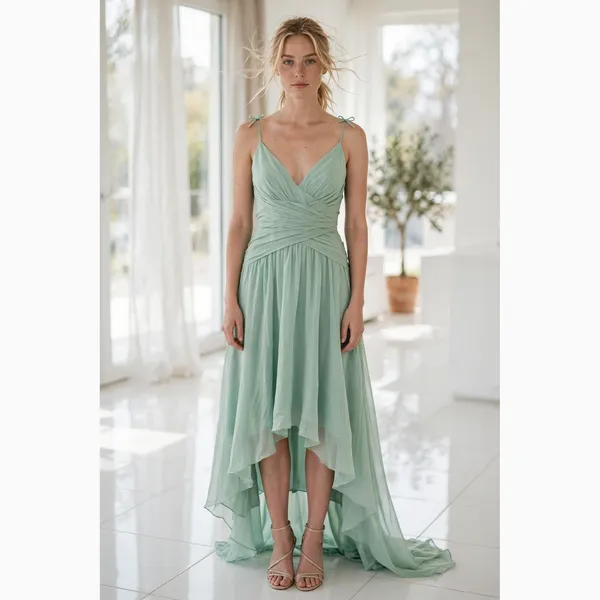
Answer two is the dye answer, and it is the one my trade is positioned to give. The straps, the bandeau and the skirt of an infinity dress do not always come off the same roll, or even the same dye lot. A maker cutting costs or chasing a deadline assembles the garment from what the warehouse holds, and soft fabrics in the same named color from different lots drift apart quietly, a drift that hides under workshop lighting and steps forward in daylight and in photographs. A wrapped style crosses the strap over the skirt again and again, laying lot against lot across the whole torso, which means this particular dress design is a machine for displaying dye drift. A normal dress hides its seams. This one frames them. When a boutique orders bridesmaid quantities through a wedding dress wholesale catalog, the question worth asking is not the color name. It is whether every component of every dress came off one lot, and a supplier who answers that one precisely is telling you something real about their cutting room.
The bandeau deserves its own paragraph because nobody gives it one. It is a plain band with elastic, the least photogenic part of the garment, and it carries the entire structure. Elastic recovery is a measurable thing: stretch the band, release it, watch whether it returns to its length or returns to most of its length and keeps the difference. That small kept difference, multiplied by a warm room and a long reception, is a dress migrating south all evening while its wearer performs discreet adjustments in doorways. Upstream, elastic is sold by grades with honest differences between them, and the grade in a budget convertible dress is chosen by someone who knows the wearer will blame the wrapping instructions. She will. She will stand in front of a video tutorial at midnight, retying and retying, certain she is doing it wrong, and the instructions are fine and the bandeau is tired.
Three answers, none of them complete
Answer three is the wear answer, and it might be the truest. Every conversion is a stress event, that part of the original claim holds up. Straps get pulled through themselves, knotted, dragged across skin and jewelry and the rough edge of a watch. The styles that load the fabric hardest are the impressive ones, the Grecian crosses and the deep wraps, so the dress ages fastest exactly when it is used as advertised. A garment engineered for the photograph survives the photograph. A garment engineered for style forty survives the season. From the fabric side, the tell is the strap width at the shoulder fold and the stitch density where strap meets skirt, because those junctions take the twisting load of every arrangement anyone invents, including the arrangements the tutorial never showed.
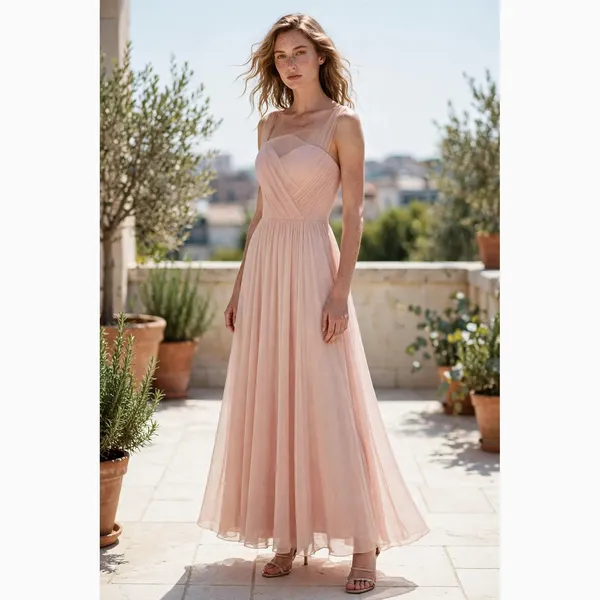
None of these answers settles the question I started with, and I have stopped expecting one to. The straps are the dress when the elastic is honest. The dye lot is the dress when the light changes. The junctions are the dress at style forty. What I know from my counter is narrower and more useful: the fabric inputs of this garment are unusually exposed, unusually load-bearing, and unusually easy to check before money moves, if a buyer knows to check inputs instead of photographs. Ask which way the straps are cut. Ask whether the set is one dye lot. Stretch the bandeau and time its recovery with your own hands. A dress that passes those three is not guaranteed. It is merely arguing from evidence, which in my trade is the highest grade anything gets.
No, I should correct the yardage figure before it hardens into something I said. Two-fifths was the number for the versions with the longest straps I have measured against their skirts. Shorter-strap versions run nearer a third. The point survives the correction, the straps are a major share of the cloth by any version, but the exact fraction wanders with the pattern, and I have quoted the dramatic number in conversation more often than the careful one, which is a habit my side of the trade shares with everyone else’s.
For bridesmaid parties the economics have their own wrinkle, and it is worth stating plainly because it explains the design’s stubborn popularity. One dress, bought in a run of sizes, solves the problem of six different bodies and six different comfort levels without a single alteration appointment, and for a boutique stocking the style from a women’s apparel factory catalog at ten pieces per style, the wrap system absorbs the sizing risk that fitted bridesmaid dresses dump on the shop. That is a real service and the dress performs it. The failures I catalogue are not an argument against the design. They are an argument against believing the number seventy-two, which counts arrangements the way a menu counts combinations, technically true and practically a different thing.
| Wearing style | Bandeau used | Support at the bust | Coverage |
|---|---|---|---|
| Strapless | Yes, as the base | Lowest, relies on the wrap tension | Lowest |
| One-shoulder | Optional | Medium | Medium |
| Halter | Optional | Highest of the wrap styles | Medium |
| Cross-back | Optional | Medium to high | Highest at the back |
| Worn as a skirt | No | Not applicable | Full, floor length |
Buyers ask me at the counter, usually holding a strap
Seventy-two styles printed on the tag. How many will my bridesmaids actually wear at the wedding?
In practice, three to five per person, and the party as a whole will settle on about six across everybody, because bodies vote. The wraps that need a bare back rule out anyone wearing a real bra. The styles that need height rule out the shortest bridesmaid in heels she already fears. What remains is a respectable handful, and it is enough, it genuinely is, one dress becoming a halter for one woman and a one-shoulder for another is the actual product. The seventy-two counts every knot geometry a patient person can tie in a quiet room. A wedding morning is not a quiet room, and honestly the gap between tag arithmetic and morning arithmetic is where most disappointment in this category is manufactured, long before any fabric fails.
The straps keep rolling into cords instead of lying flat. Is that my tying, or the dress?
Usually the dress, and specifically the cut. A strap cut along the straight grain, or cut from a fabric with too much lengthwise stability, wants to roll under tension, and wrapping is tension. Test it on the hanger before the event: wrap the strap twice around your forearm the way a style would, and watch whether it lies as a band or twists into rope. If it ropes on your arm it will rope on a torso. Bias-cut straps behave, which is why the better versions cost what they cost, the cutting wastes more cloth. You cannot tie your way out of a grain problem, and I wish someone would print that on the tag instead of the style count, because women blame their own hands for a decision made at a cutting table months earlier.
Two dresses, same color name, and the straps on one are visibly warmer in tone. The shop says it is the light. Is it the light?
Sometimes it is the light, and the way to know is to swap the dresses between the two spots where you compared them and look again. If the warmth follows the dress, it is not the light, it is a dye lot difference between components, and on this design the straps crossing the skirt will display it all day in photographs. Suppliers who cut a full order from one lot exist and will say so when asked directly. The ones who assembled from warehouse stock will talk about lighting at length. I have sold the fabric both ways, to both kinds of maker, and the cloth itself reported nothing. It is the asking that separates them, and asking costs a buyer one sentence.
The bandeau felt fine in the shop and loose by the reception. Did it stretch out in four hours?
It gave back most of its stretch and kept the difference, which is what mid-grade elastic does under warmth and repeated load, and four hours of a wedding is a genuine load test. The shop try-on tells you almost nothing, because the band was fresh and the test lasted minutes. Before an event, wear the dress at home for an hour doing ordinary things, and the band will show you its evening behavior while there is still time to size down or add a safety solution. What frustrates me in this trade is that elastic grades are cheap to upgrade relative to the price of the dress, pennies at the roll level, and the saving from the weaker grade is invisible to everyone except the person adjusting her dress in a doorway at nine in the evening.
My whole party wants this dress in one color, ten pieces across sizes. What do I confirm before I pay?
Confirm the lot, the strap cut and the elastic, in that order, and get the answers in writing while the order is still an order. One dye lot across every component of every dress. Straps cut for drape, not for yardage. A bandeau sample you can stretch yourself. Ten pieces of an existing style is a standard start, so the order is an ordinary one and deserves ordinary, specific answers. What I would not spend time confirming is the style count, the tutorials, the photograph arrangements. Those are the marketing layer, and the marketing layer of this dress has never once been the part that failed at a wedding. It fails at the counter level, in cloth and elastic and dye, in the inputs nobody photographs.
The question is still open on my side of the counter, and I have made a kind of peace with carrying it. A roll of soft fabric leaves my hands and becomes seventy-two promises in somebody else’s shop, and which of those promises it keeps depends on decisions I can describe but never stand over: a cutter’s angle, a lot number, a grade of elastic chosen in a purchasing office. I sell the inputs. The dress is an argument the inputs have with each other, later, on a dance floor, and I only ever hear how the argument ended.