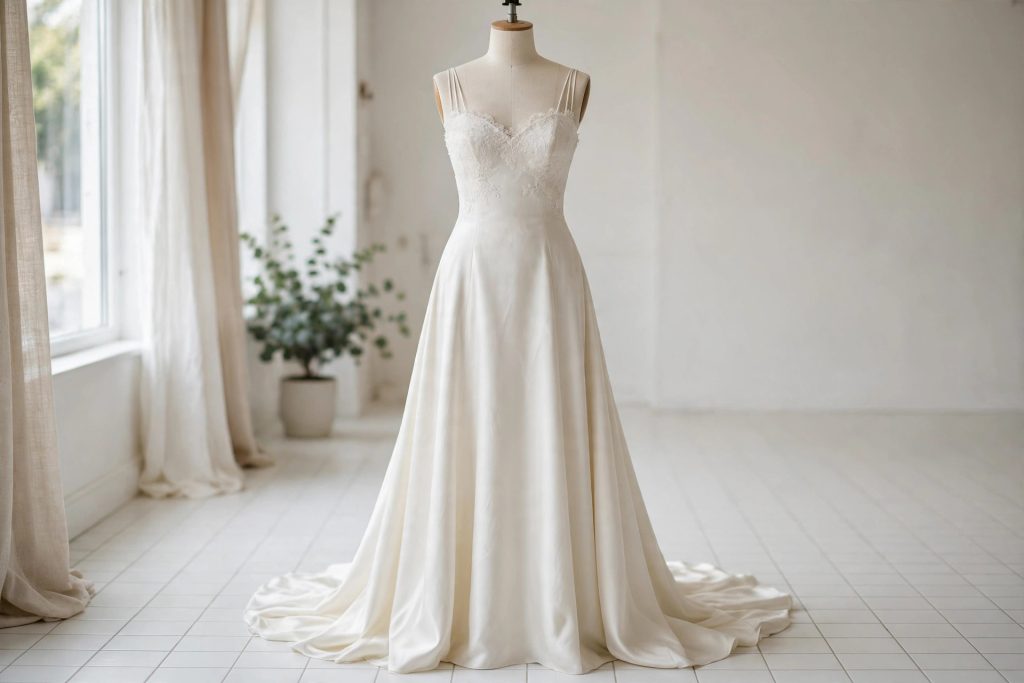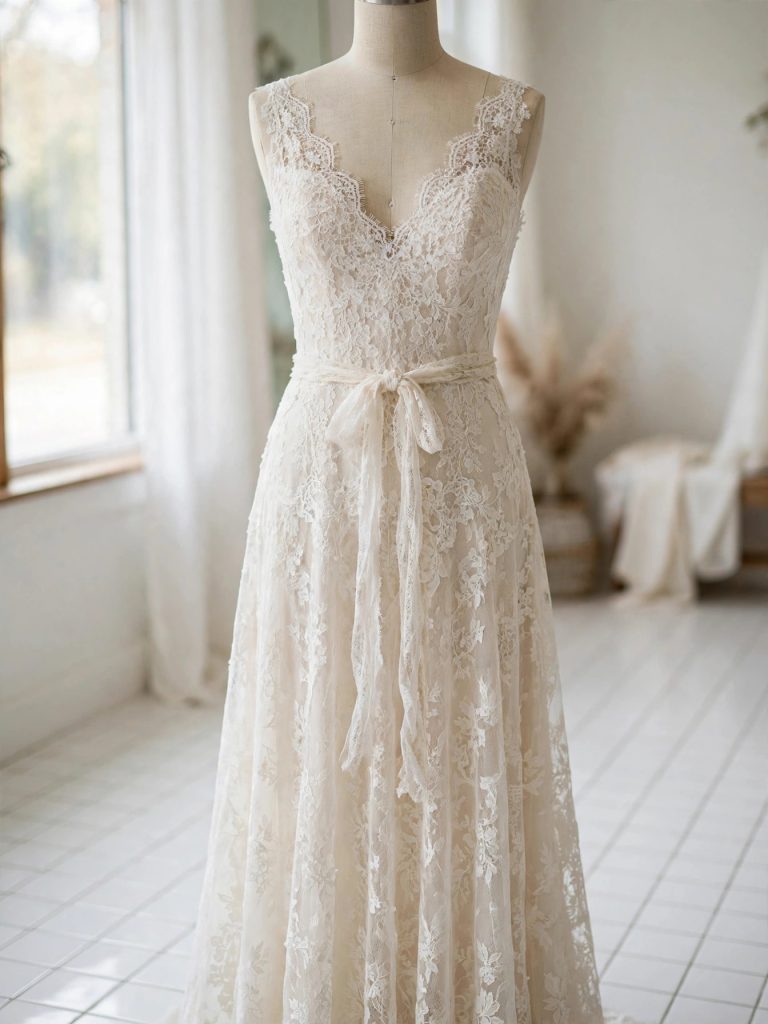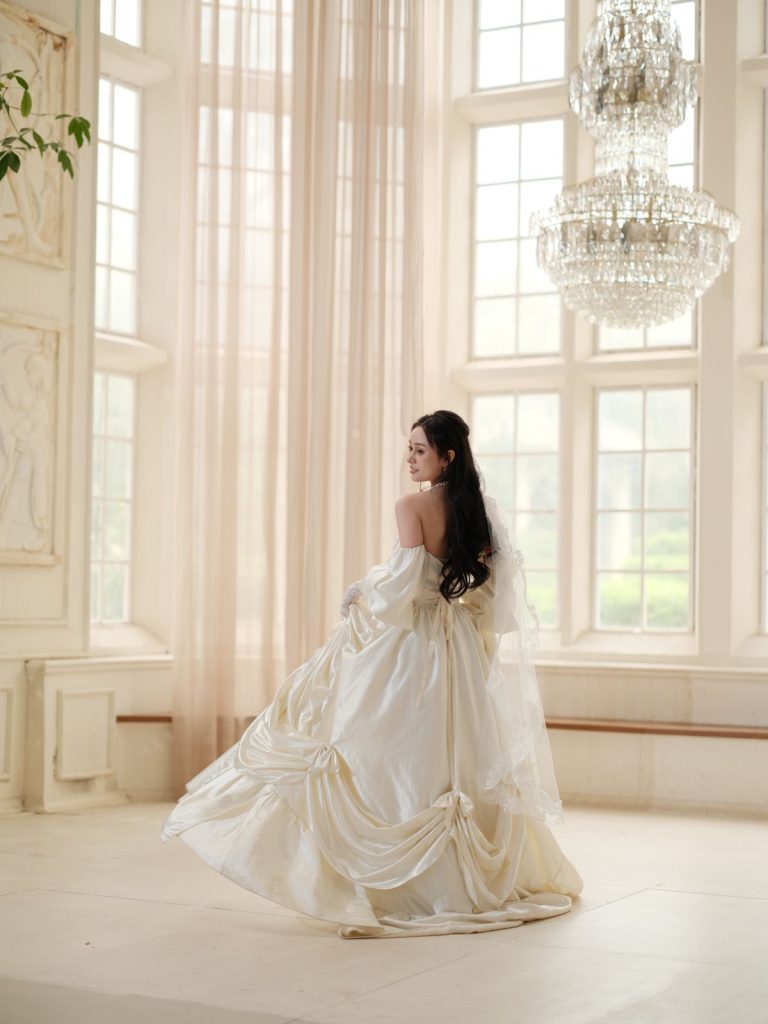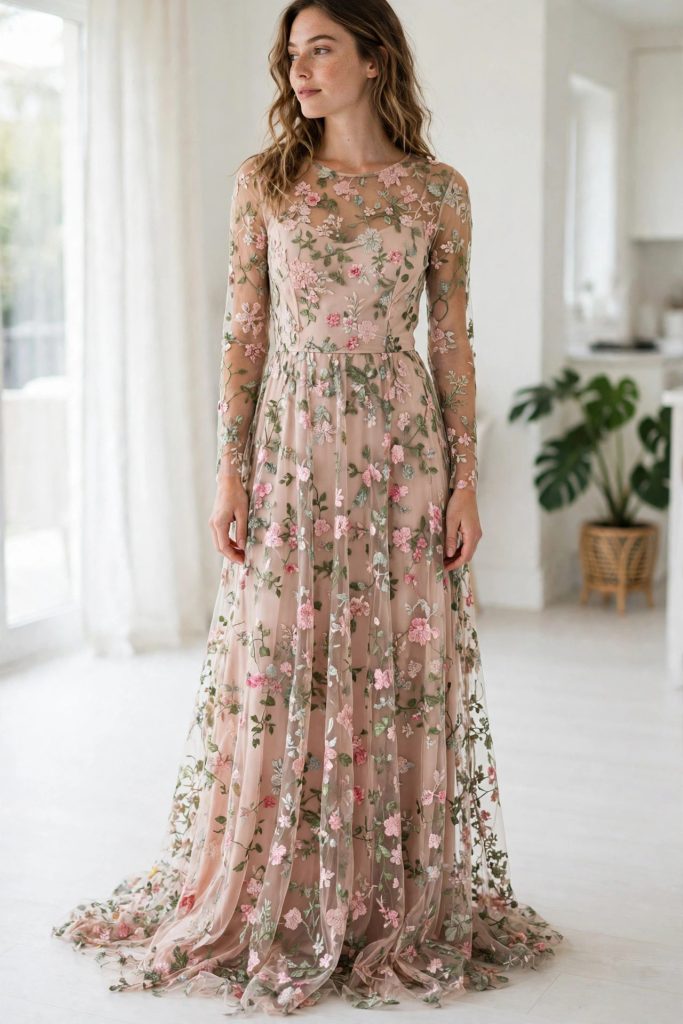
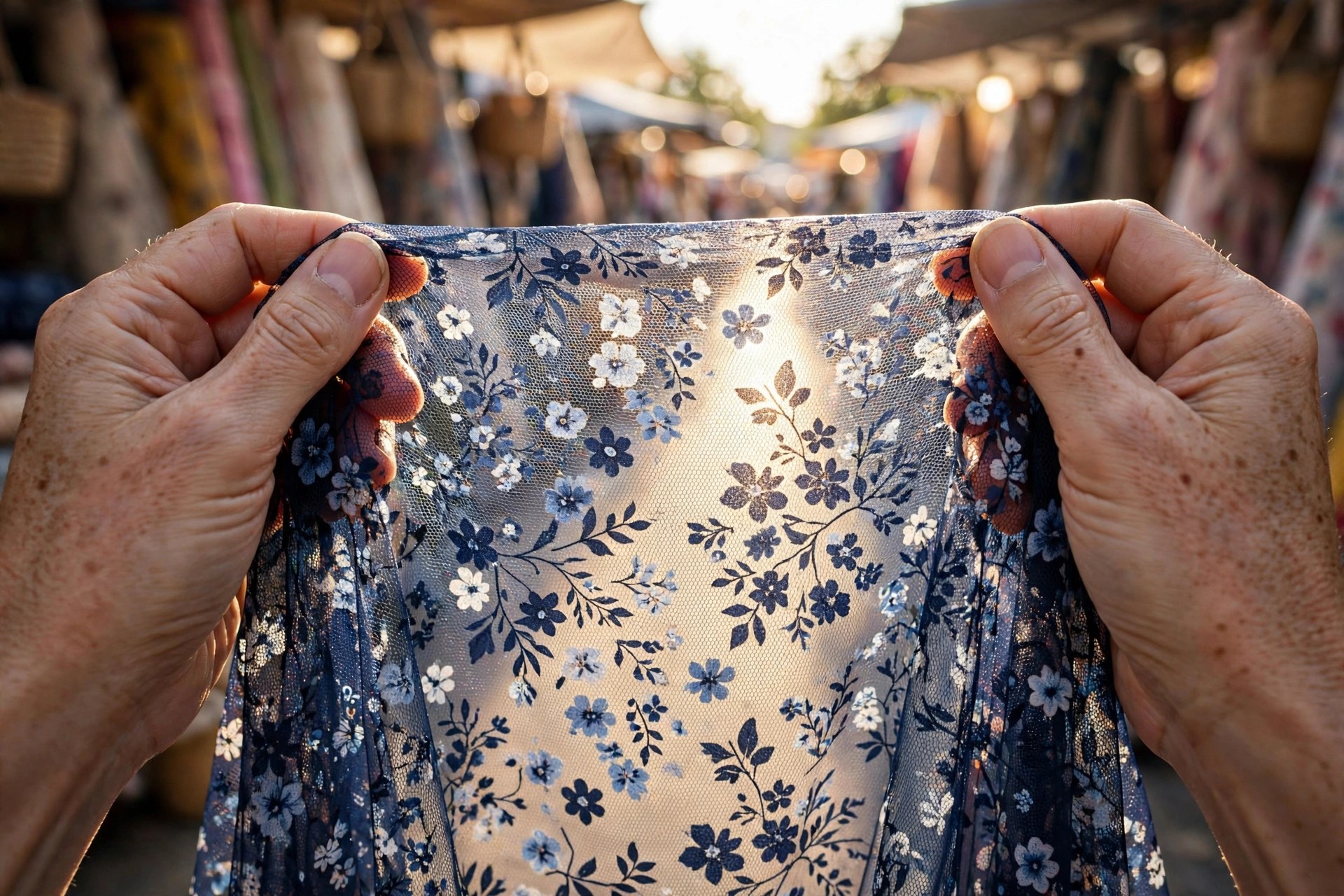
The sheet lands on the cutting table with the dress not even started and it is already a problem, because a made-to-measure floral mesh maxi does not enter production the way a standard size does. There is no size run to hide inside. One body, one set of numbers, one piece of mesh with flowers printed across it that have opinions about where they want to sit. I work the production side of dresses like this, and the first thing I look at is not the measurements. It is the flowers. The same dress in its lighter warm-weather styling is covered in the Verdusa floral mesh maxi write-up for formal and wedding wear, which is the version most boutiques picture for summer orders.
A big bloom across the bust reads as a design choice in a photograph and as an accident on a body, and the difference between the two outcomes is a cutter spending an extra ten minutes per piece nudging the pattern pieces around the print. On a standard run nobody nudges. The print falls where it falls, size after size, and the occasional awkward bloom is averaged out across fifty dresses and forgiven. On a single custom piece there is nothing to average against. The customer will look at her one dress, closely, in good light, possibly in photographs she keeps for years, and the flower sitting sideways across her waist seam will be the thing she remembers about the order.
Pattern placement on printed mesh also eats fabric in a way buyers rarely budget for. A plain mesh maxi cuts tight, pieces nested close, very little waste. A floral mesh where the blooms have to land clear of the waist seam and balanced across the skirt can waste close to a third more yardage, because whole sections of the roll get skipped over while the cutter hunts for a clean run of print. That skipped fabric is real money and it belongs to somebody. On a bulk order it dissolves into the unit price. On one dress it sits there, visible, and the argument about who pays for the skipped flowers is an argument I have watched happen at the edge of a cutting table more times than I can count.
The measurements themselves are the second trap, and they are a quieter one. A made-to-measure order form asks for the numbers a tailor would ask for, and customers answer them standing straight in front of a mirror, breathing in a little, holding the tape the way the diagram shows, which is to say not the way they will stand at a wedding four hours in. The number that decides whether a fitted mesh bodice works is not the standing bust. It is the seated waist and the bust measured over the undergarment the dress will actually be worn with. Two centimeters of optimism in those two numbers and the dress arrives technically correct and practically unwearable, zipped by a determined friend and unzipped by dessert.
Mesh forgives some of this and then stops forgiving all at once. A floral mesh overlay has give across the width, almost none along the length, and the lining underneath it has its own behavior again. Cut the overlay a fraction generous and it ripples where it meets the lining at the armhole. Cut it exact and the print distorts when the wearer sits, the flowers stretching wider across the hip in a way that reads, unkindly, like the dress is straining even when the lining underneath fits fine. The production fix is unglamorous. The overlay and the lining get cut as a pair, laid together, checked together, and the pair gets a fraction more room than the tape numbers suggest, with the extra taken out at a seam where nobody photographs.
There is a step in honest custom work that impatient buyers try to talk the factory out of, and it is the plain-cloth fitting piece. Before the floral mesh gets cut, a cheap cotton version of the bodice gets sewn and fitted, on the body if the customer is near, on a stand set to her numbers if she is not. It feels like paying twice for one dress. What it actually buys is the right to discover that her left shoulder sits lower, or that the waist point on the pattern is an inch above her real waist, while the discovery is still cheap. Skip the fitting piece and the same discoveries arrive later, written into mesh that cannot be unpicked without leaving needle marks in the print. The fitting piece is where made-to-measure is made. Everything after it is sewing.
The made-to-measure facts behind this dress, in order. A piece like this is cut to one buyer’s measurements, and custom work at the Guangzhou factory starts from a single piece for a gown-style order, with the floral mesh chosen from photographs before anything is cut. Before sampling, the fabrics are photographed and sent to the buyer to review and choose from, since a mesh read off a screen and a mesh read in the hand are two different fabrics. Making time runs 10 to 15 days once the fabric and the measurement sheet are both confirmed, and the fit this suits is a store offering a made-to-measure service on a known style, or a buyer who already knows her measurements are honest.
The flowers decide first, the tape decides second
Buyers who order this category through a women’s apparel factory catalog usually meet the standard version first, cut in a size run, priced per piece, ten pieces per style to start. The made-to-measure version of the same dress is a different animal wearing the same photograph. The photograph cannot show the fitting piece, or the skipped sections of the roll, or the cutter’s ten minutes. It shows flowers and a hem. So the quote for one custom dress lands looking absurd next to the per-piece price of the standard run, and the buyer concludes somebody is padding. Nobody is padding. The standard price is the custom price divided by a run and stripped of every decision that only had to be made once.
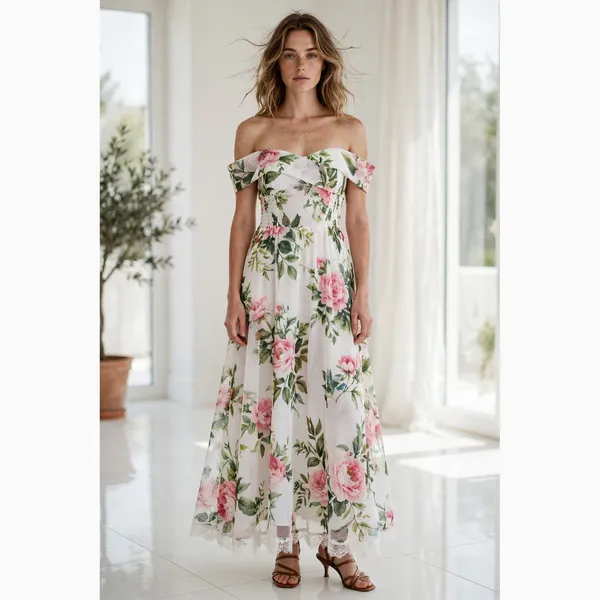
Length is where custom orders go wrong in the most avoidable way. A maxi length is not a number, it is a number plus a shoe. The same woman is three lengths depending on whether she measured barefoot on a kitchen floor, in the heels she plans to wear, or in last year’s heels because this year’s are still in a box at a shop. Mesh hems make it worse because a mesh overlay wants to hang a touch longer than its lining and will creep toward the floor over an evening as the bias sections relax. A careful order form asks for the heel height as its own line, and a careful customer answers it with the actual shoe, and even then the production side adds a small, private allowance for the creep, because a maxi that kisses the floor at six in the evening is stepping on itself by ten.
Color is the argument nobody expects. Floral mesh photographs warm. Under shop lighting the background tone of the mesh shifts, and a customer comparing the dress to a screen image in daylight is comparing two different dresses and blaming the factory for the difference. The grounded way to handle it is a fabric photograph taken before cutting, sent for approval, the same habit any careful sample process uses: the cloth gets photographed, the customer picks and confirms, and only then does cutting start. It adds days. It removes the particular misery of a dress that is right in every measurement and wrong in the one thing the customer sees first.
No, I am putting the cart in the wrong place there. Approval photographs matter, but they are not where these orders are saved or lost. They are lost at the order form, in the gap between the numbers a customer knows about herself and the numbers a pattern actually runs on. Shoulder slope. The distance from neck point to waist at the back, not the front. Whether she carries the dress’s weight comfortably at the natural waist or wants it lifted half an inch. A good order form asks about these in plain language with small diagrams. A bad one asks for bust, waist, hips and a prayer. Most of the custom dresses I have seen fail were sewn exactly to the numbers provided. That was the failure.
For shops rather than individuals, the arithmetic changes shape again. A boutique ordering a floral mesh maxi as a standard style, the kind listed beside the gowns in a wedding dress wholesale catalog, takes the size run, ten pieces per style, mixed colors and sizes inside that, and the print placement lottery becomes a display question instead of a complaint question, because a rack of twelve dresses with the blooms landing differently on each is a rack that looks designed. The same variation that sinks a single custom order sells a rack. I think about that inversion a lot. The factory does the identical work in both cases, places the identical flowers, and one customer calls it carelessness while another calls it charm, and the only difference is how many dresses she bought.
What buyers ask, once the dress is on the table
I sent nine measurements and the form came back asking for six more. Is the factory stalling, or does it actually need my back waist length?
It actually needs it, and the six extra questions are usually the sign of a workshop that has been burned by exactly your dress before. A front waist length and a back waist length differ on most bodies, sometimes by more than an inch, and a mesh bodice cut to the front number alone will pull at the back zipper all evening. Answer the extra questions with a friend holding the tape, standing the way you stand when nobody is measuring you. The form is not stalling. It is trying to move the fitting argument to before the cutting, where the argument is cheap, and I would rather get a form with too many questions than a dress with too few answers, even if the form is irritating at midnight.
One custom dress costs nearly what six standard ones do. Where does that money actually go?
Mostly into time that cannot be shared. A standard run spreads the pattern work, the print placement decisions and the machine setup across every piece in the run, while a single dress carries all of it alone, plus a plain-cloth fitting piece that a run never needs. Add the extra yardage lost to placing the flowers clear of the seams and the slower sewing, because mesh over lining at custom tolerances is not work you hand to the fastest machinist on the floor. The six-for-one feeling is real. It is also roughly honest, which is an uncomfortable thing to hear when the photograph of the two dresses looks identical, but the photograph is the only identical part.
The flowers sit right across my waist seam and I hate it. Can that be fixed after the dress is made?
Almost never, and this is the answer I least enjoy giving. Print placement is a cutting decision, and once the mesh is cut the flowers live where they live. A waist seam can sometimes be raised or lowered a few millimeters to move a bloom off the seam line, and a good workshop will try it, but a flower centered on the seam is centered forever. This is why the placement conversation belongs at the order stage, with the customer saying out loud which placements she cannot stand. Factories guess at this constantly and guess wrong in both directions, hiding blooms a customer would have loved and featuring ones she cannot look at, and the guessing is nobody’s fault exactly, it is just what happens when the conversation gets skipped.
My event is in five weeks. Is made-to-measure still realistic, or am I buying a panic?
Five weeks is realistic if the fitting piece goes out in the first week and comes back approved without a second round, and it turns into a panic the moment revisions stack up. The sewing itself is days. The calendar is eaten by approvals, by the fabric photograph, by the fitting piece traveling or being assessed from photographs, by the small human delays of a customer who is also planning an entire event. Count backwards from the event and protect one full week at the end for the dress to simply exist in your house, tried on with the real shoes, before it has to perform. The orders that end in tears are rarely the slow ones. They are the ones where every approval took four days because life was busy, and nobody added the four days up until the total was the whole schedule.
The dress that started this piece, the one with the long sheet of numbers, came back to the floor twice. Once for a waist that had been measured over the wrong undergarment, once for a hem measured against a shoe that was later exchanged for a taller one. Both times the numbers on the sheet were accurate. Both times the dress was wrong. I keep that sheet pinned where the cutters can see it, not as a warning about customers, who did everything they were asked, but as a reminder that a tape measure only ever answers the question it was asked, and the asking is the skilled part, and the skilled part is the bit nobody wants to pay for because it leaves no trace on the finished dress at all.