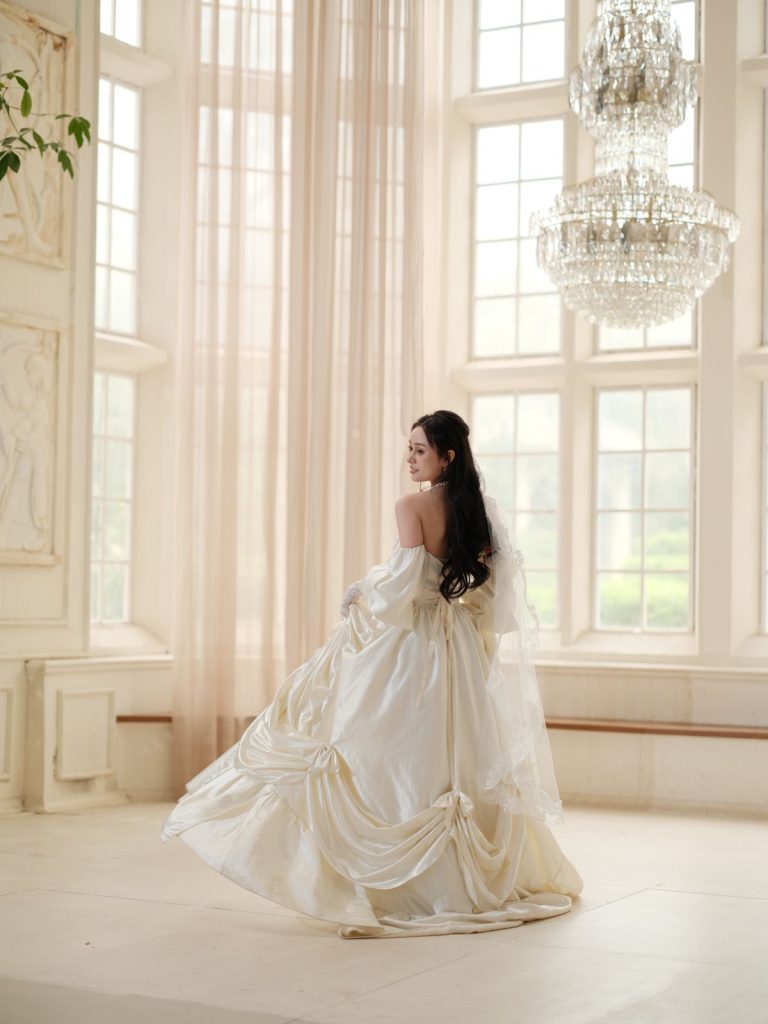
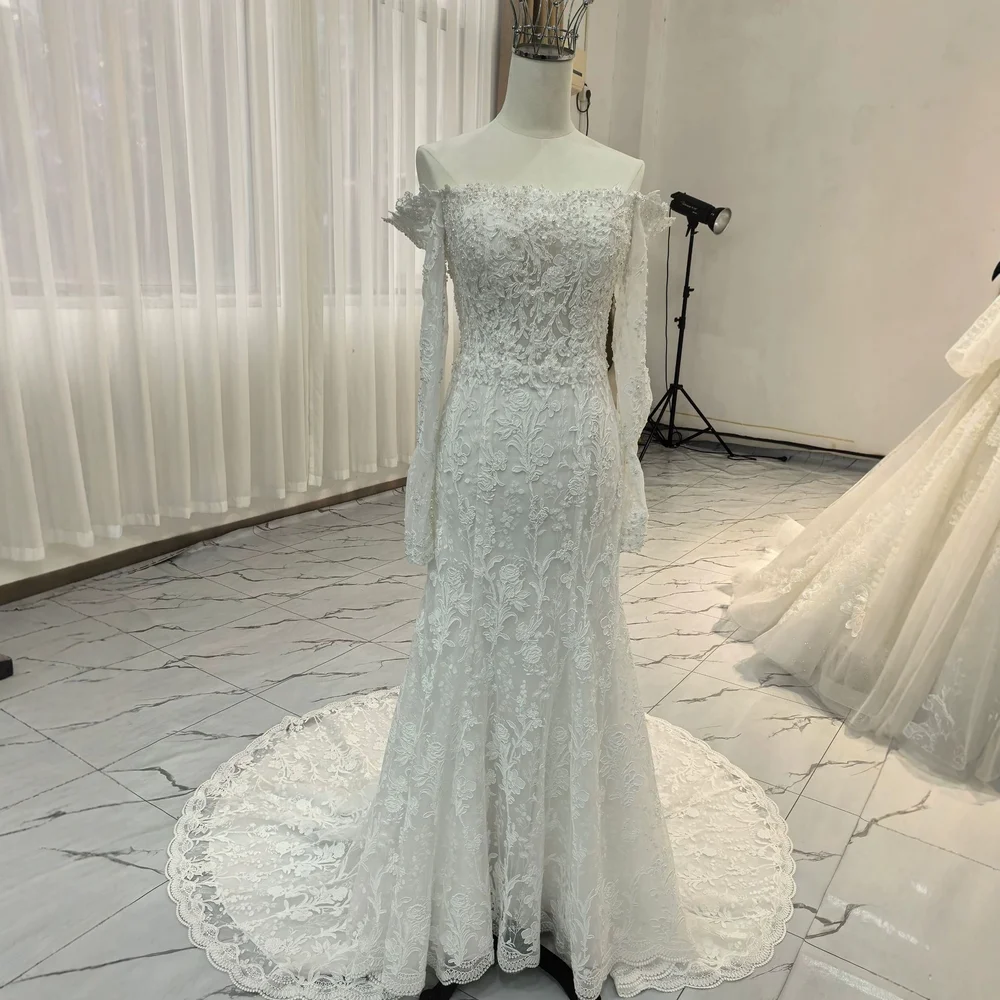
Start at the end, with the fitting that goes wrong. The bride raises her arms for the photograph, the off-shoulder line slides down over the top of her arms, and the lace sleeves, which were the reason she chose the dress, pull her reach short like a polite rope. Work backwards from that moment and every step that caused it is a production step, not bad luck. An off-shoulder satin bridal gown with lace sleeves and a corset bodice is three engineering problems sharing one dress: a neckline that must stay up with no straps to hold it, sleeves that must move with the arm they decorate, and a structured bodice that must shape a body it also has to let breathe. The gown in the original review wears all three gracefully in its photographs. Photographs are the one fitting where nothing has to move.
Back one step: the shoulder line is held by fit, not hope
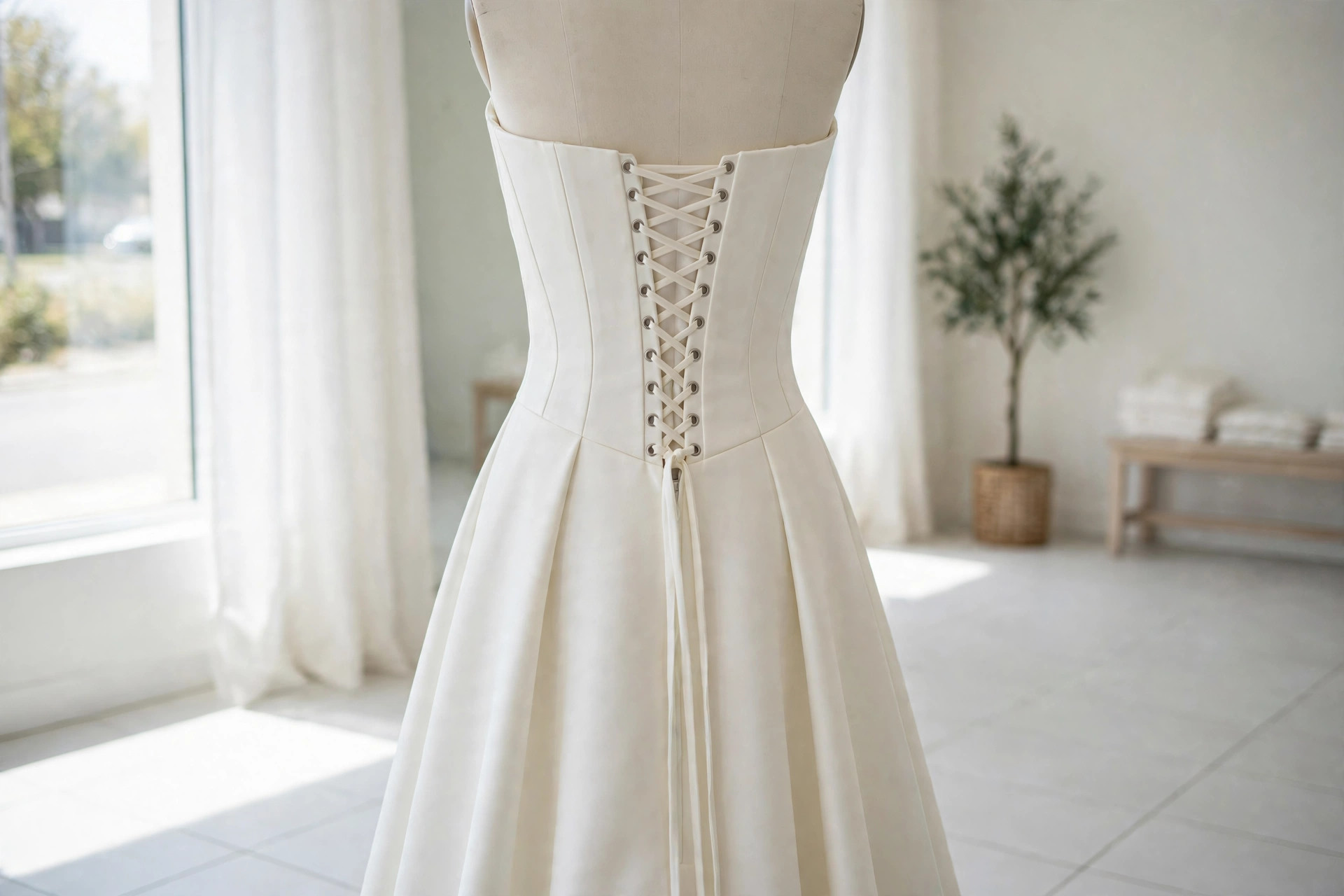
A bare shoulder line stays in place when the bodice underneath is doing quiet structural work. The corset is that work: boning channels sewn straight, a waist stay that carries the weight of the skirt so the top edge is not being dragged down by it, and enough grip at the upper chest that the dress holds the body instead of hanging from the shoulders it has just bared. Where the saving gets taken on cheaper builds, it is usually the waist stay that goes first, and the neckline then spends the day travelling. Benches sewing this style for a wedding dress manufacturer test the top edge with the skirt’s full weight on it, arms raised, because that is the test the wedding will run.
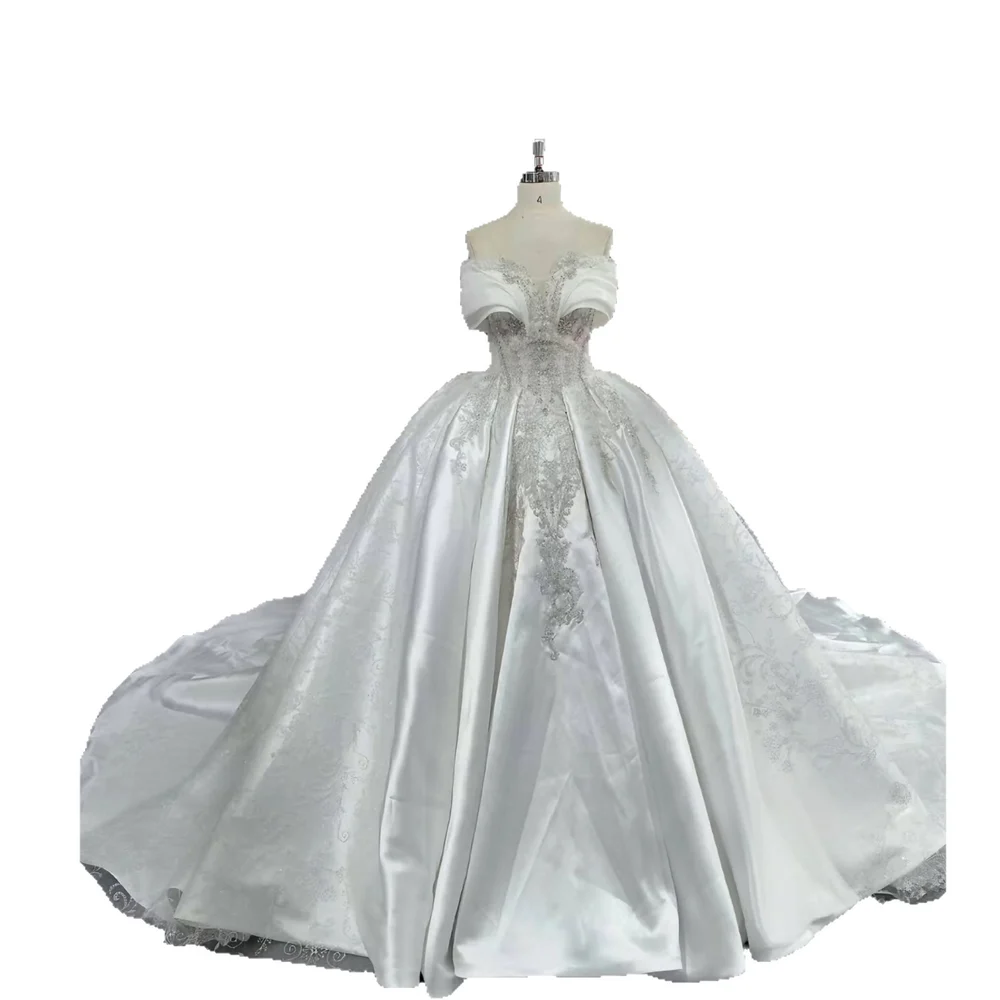
The lace sleeves are the second problem, and they are a pattern problem before they are a lace problem. A sleeve attached to a low, wide neckline has less room to rotate than a sleeve set into a normal armhole, so the pattern has to borrow its movement from somewhere: a little extra length worked into the back of the sleeve, a gusset of stretch mesh hidden under the arm, lace cut with its stretch running the helpful way. Skip the borrowing and the sleeve is beautiful at rest and binding at the first dance. The sample check is embarrassingly simple. The wearer reaches forward, then up, then holds both positions while somebody looks at where the lace goes white with strain.
Back to the cloth: satin reports every decision
Satin is the honest surface in this dress and the unforgiving one. It shows a pressed seam, a boning channel that wanders, a lace motif placed a centimetre off its mirror twin across the bodice. On a corset detail gown the eye is drawn to exactly those lines, which is why the sample room spends its minutes on channel stitching and motif pairing before it spends them anywhere else. No wait, before even that, it spends them on the lace layout for the sleeves, because a motif that lands split at the shoulder point reads as damage in photographs while the same motif centred reads as design, and the layout is decided once, at the marker, for the whole run.
Grading is where this style quietly earns or loses its larger sizes. A corset bodice graded by simply widening every panel keeps the shape and loses the structure, because the boning spacing and the waist stay position have to move with the grade or the support lands in the wrong places. Careful makers re-place the channels per size group. It is pattern work done once and carried inside every reorder’s price, the part of a quote for custom bridal manufacturing a store never sees itemised and always pays for, at the pattern table or at the alteration rail.
On the factory calendar this gown is sewn after the double-layer veils for bachelorette and wedding days order, checked against the lace mermaid gowns with flare sleeves range, and packed with the pearl wedding hangers file nearby, because a structured bodice is judged by everything that has to live with it on the day.
Questions buyers and stores actually ask
The off-shoulder line slips by the reception. Which part of the dress failed first?
Usually the waist stay, or its absence. The stay carries the skirt’s weight at the waist so the top edge is not dragged down all day. Without it the bodice travels, the neckline follows, and the sleeves get blamed for a structural shortcut taken inside the bodice. Asking whether a style has a waist stay, in words, is a fair sampling question.
Lace sleeves that bind when the arms lift. Pattern fault, or lace fault?
Pattern, most times. A sleeve on a low neckline has little rotation room, so movement has to be patterned in: length at the back of the sleeve, stretch mesh under the arm, lace laid with its give running the right way. Lovely lace sewn to a still pattern will still bind. The reach test at sampling, forward and up, held, shows it in a minute.
A corset bodice across eight sizes. Why does the largest size fit worst on cheaper runs?
Because the grade widened the panels and left the structure where it was. Boning spacing and the waist stay have to be re-placed as sizes rise, or support lands off the body it is meant to shape. A supplier who re-places channels per size group does pattern work a flat grade skips, and the largest size is where the difference introduces itself.
Satin shows a wandering seam line down the bodice. Pressing problem, or sewing problem?
Sewing, usually, with pressing taking the blame. Satin reports channel stitching exactly as it was sewn, and a line that drifts on the cloth drifted at the machine. It cannot be pressed straight afterwards. On a sample it is worth tracing one channel with a fingertip; the hand finds a wander the eye forgives in photographs.
Five pieces per style is the bridal wholesale floor on some ranges, ten on others. Which sample sizes should a store insist on?
A middle size and the largest size it plans to carry, whatever the quantity. The middle size proves the look. The largest proves the grading, the sleeve movement, and the corset placement, which are the three things this style gets wrong at scale. Two honest samples cost less than one season of alterations on a run that was only ever tried in an eight.
Begin, then, where the backwards walk ends: at the sample. One pre-production sample in a middle size and one in the largest size the store plans to carry, both worn moving, arms up, sitting, turning, tells a buyer more about this gown than a rail of photographs. The style can be genuinely lovely, satin clean as a pour, lace doing its old magic at the arms, the corset giving the whole thing its posture. It just cannot be judged standing still, because nothing about its day involves standing still, and the factory that built movement into it is a different factory, at a different price, from the one that built only the photograph.