Start at the end, with the refund. A store credits a bride for a cathedral lace veil in March, the lace edge has lifted away from the tulle along a full section, and the photographs from the wedding show the border hanging slightly separate, like the veil was coming undone in slow motion while everyone smiled. The store writes it off as a faulty unit. It was not a faulty unit. It was a price, working itself out.
Step back one move. Before the refund there was a delivery, sometime in the new year, of veils ordered at a deep seasonal discount in late autumn. The cartons were light, the units counted correctly, the samples pulled from the top of one carton looked right. Nobody ran a fingernail along the lace edge of a unit from the bottom carton, because the top unit was fine and the price had been the point of the order. The discount had a reason, and the reason was in the stitching, and the stitching was never going to be inspected by a spreadsheet.
Step back again, to the negotiation itself, because the money side of bridal accessories is where I sit, tallying what payment structures do to the goods that eventually arrive. A one-tier lace veil at cathedral length carries roughly a hundred and eight inches of lace edge. Fingertip length carries about forty-eight. The cathedral version therefore holds more than twice the attachment work, more than twice the lace cost, and more than twice the length along which an attachment method can fail, and yet in seasonal clearance the two lengths often sit at suspiciously similar prices. Similar prices for double the edge work is not a bargain signal. It is a question wearing a bargain’s coat.
How the lace is attached is the whole invoice
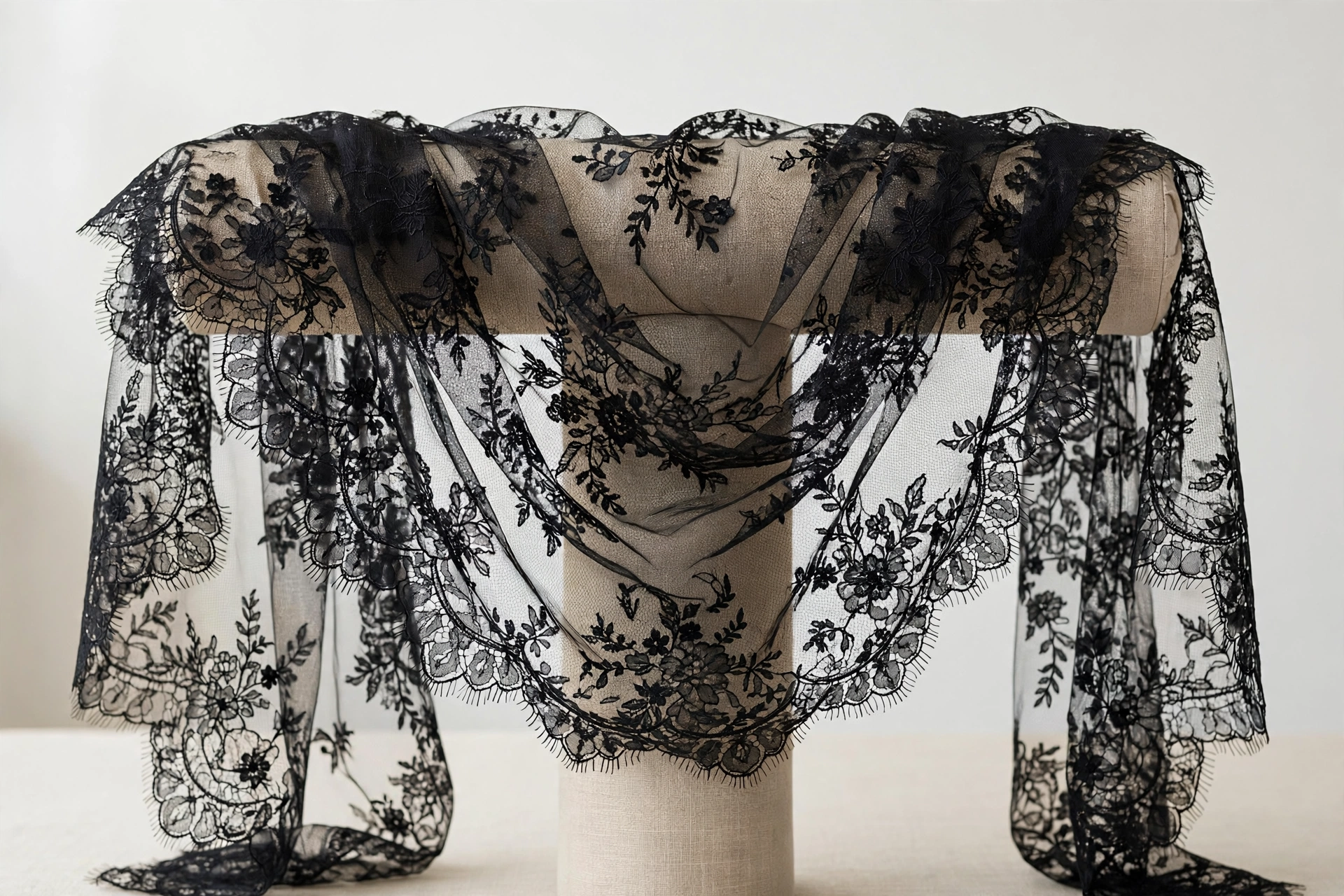
Lace gets onto tulle in a small number of ways, and they cost different money, which is why they matter to anyone reading a quote. Hand-tacking at intervals is slow and dear and survives a wedding. A machine zigzag is fast and cheap and can survive one too, if the tension is sane and the thread is decent and the tulle underneath is not so fine that the stitch line perforates it. A glued edge is cheapest of all and survives approximately until the room warms up. The listing language for a veil like this rarely says which method is in the box. The price usually does, translated, for anyone willing to read it that way.
The tulle weight underneath is the silent partner in that calculation. Soft bridal tulle around twenty denier drapes the way brides want and punishes a careless stitch, because a dense zigzag down a fine net cuts a dotted line the way perforations cut paper, and a sideways tug, a comb drawn through hair, a child grabbing the pretty border, starts the tear along the dots. Heavier net tolerates the machine better and drapes worse. Every cheap cathedral veil is a negotiation between those two facts that somebody settled while the buyer was looking at the discount percentage instead of the construction.
Now step back to the calendar, because the timing of the order explains the timing of the construction. Bridal sells in a season, spring through early autumn, and warehouse space costs money in every month that is not that season. Late autumn repricing of veils is not a conspiracy, it is rent. Odd dye lots, a discontinued lace pattern, lengths that did not move, all of it gets converted back into cash at whatever the market will pay, and factories clearing a line will accept construction shortcuts on the clearance units that they would not accept in March, because in March the buyer is a boutique with a bride attached and in November the buyer is a spreadsheet with a target attached.
Payment structure decides how much of that risk the buyer actually carries, and this is the part of the transaction my side of the business wishes buyers took personally. Full payment up front for a clearance order transfers every gram of the construction risk to the buyer before a single carton opens. A deposit with the balance held until the goods are checked keeps the risk shared, and suppliers who know their stitching is honest rarely fight that structure hard. When a supplier insists on everything up front and a deadline to decide by Friday, the insistence itself is information. It is the supplier pricing in the probability that you will not check the bottom carton.

| Veil length | Typical length | Falls to | Usual pairing |
|---|---|---|---|
| Fingertip | 100 to 110 cm | The fingertips with arms down | Gowns with no train or a short train |
| Chapel | Around 230 cm | The floor, past the hem | Gowns with a chapel train |
| Cathedral | 280 to 300 cm | Well past the hem, pooled | Gowns with a cathedral train |
| Lace edge on all three | Same lace, priced by the metre of edging, so the cathedral length carries roughly three times the edging cost of the fingertip | ||
What the numbers on this veil actually say
Work the arithmetic the way a buyer should have worked it in November. One tier, so no second layer doubling the net cost. Lace edge, so the lace and its attachment dominate the labour. Cathedral at about a hundred and eight inches against fingertip at about forty-eight, so the long version consumes roughly two and a quarter times the edge material of the short one. If the long version is priced at a small premium over the short one during a sale, the gap has to come out of somewhere physical. It comes out of lace quality, stitch density, tulle weight, or the comb, and of those four, the comb is the one buyers find first, usually by it coming away in a stylist’s hand.
The comb deserves its own line in the ledger. A cathedral veil hangs over a hundred inches of net and lace off one small comb, for eight hours, through wind at the church door and a receiving line of hugs that all land at exactly comb height. A sewn comb spreads that load into the gather stitching. A glued comb concentrates it onto an adhesive joint that heat and hairspray spend the day dismantling. Asking whether the comb is sewn costs nothing and is worth more than most of the questions buyers do ask, like whether the lace pattern has a name. The lace pattern’s name has never held a veil on a head.
No wait, I am underselling the deposit point, let me put it back in its proper place, ahead of the comb. A buyer who held back a balance until inspection would have caught the lifting lace in January, in the warehouse, with options. A buyer who paid in full caught it in March, in a bride’s photographs, with none. The construction was identical in both worlds. The payment terms were the entire difference, and payment terms are the one variable in this whole story that the buyer completely controlled. That is the uncomfortable heart of it, and it is why the money side keeps insisting on being invited into what looks like a sewing conversation.
There is a comparison worth making with the gowns these veils accompany, over in the wedding dress wholesale catalog, because a gown at clearance pricing shows its compromises in the fitting room, on a body, before money fully changes hands. A veil’s compromises hide in a folded square of net in a plastic sleeve. Accessories are where inspection discipline goes to die, precisely because the units are small and cheap and numerous, and the failure, when it comes, arrives attached to the most photographed day of somebody’s life, which is a disproportionate amount of consequence for a folded square of net.
Back at the beginning, which was a price
So the chain, read forward this time, runs like this. A lace pattern is discontinued or a warehouse bill comes due. A price drops in the season when bridal buyers are tired and discount-hungry. The price is achieved somewhere in the construction, most often in how the lace meets the tulle. The order ships, the top carton passes, the bottom carton waits. A bride wears the arithmetic down the aisle. None of the people in that chain lied, exactly. The factory answered the price it was given. The buyer bought the number that was offered. The veil just carried the difference between the two, in its edge, for a hundred and eight inches.
None of which makes a discounted cathedral veil a bad buy, and it is important to be clear about that before the caution curdles into superstition. Clearance is also where a careful buyer finds a genuinely well-made veil whose only fault is being last season’s lace, at a price that leaves room in the budget for the inspection the style demands. The difference between the two outcomes is not luck. It is a fingernail run along a lace edge in January, and a balance payment still sitting in the buyer’s account while she does it. Brides comparing the full picture can also look at the shorter end of the range, in the short tulle veil review, where the same attachment questions apply across far fewer inches of edge.
I keep the refund paperwork from that March case in a drawer, not out of sentiment. Out of calibration. Every autumn, when the prices drop and the group chats fill up with bargains, I take it out and read the number on it, and then I read the original order total next to it, and the distance between those two numbers is the tuition this industry charges for skipping a question. The question costs nothing. It never has. That is what makes the tuition so annoying to pay.
Questions buyers keep asking about this one
The cathedral veil costs barely more than the fingertip one in the sale. Should that worry me, or is it just clearance?
It should get your attention, because the cathedral carries more than twice the lace edge, roughly a hundred and eight inches against forty-eight, and edge work is where the money in this product lives. Clearance explains a low price. It does not explain the two lengths converging. When they converge, the difference came out of lace, stitch density, tulle weight, or the comb, and you will find out which one eventually. I would rather find out in the warehouse than read it in a refund request, personally.
Half the price in November. Is a discounted veil automatically a worse veil?
No, and treating it that way wastes the one genuine opportunity clearance offers. A discontinued lace pattern on a well-made veil is just unfashionable paperwork, the construction can be completely sound. The discount tells you the seller wants the shelf back, it says nothing reliable about the stitching either way. That is what inspection is for. The buyers who get hurt are not the ones who bought cheap. They are the ones who bought cheap and checked nothing because the price felt like the achievement.
Full payment up front, balance after inspection. Does it really change what arrives?
It changes what you can do about what arrives, which amounts to most of the game. A held balance means lifting lace in January becomes a conversation instead of a loss, and suppliers who trust their own stitching accept that structure without much theatre. The insistence on everything up front, against a Friday deadline, is the supplier telling you how they expect inspection to go. I have learned to believe them when they tell me things like that. It saves time.
One question, if I only get to ask one about a lace veil. Sewn comb, lace attachment, or tulle weight?
Lace attachment, because at cathedral length it is the longest thing that can fail and the most expensive thing to do properly. Ask how the lace is fixed and listen for a method rather than an adjective. Hand-tacked, zigzag with sane tension, those are methods. Beautiful and high quality are not. The comb question comes second and the tulle third, which is not the order most buyers ask them in, but ordering questions by cost of failure has served me better than ordering them by what shows in a photograph.