The stack was ten high, navy on navy, and the sign said nine dollars for the navy maxi dresses. Late August, the part of the season when the wholesale market stops pretending. I held my phone flashlight against one navy maxi dress and the light came through like a window. The stall owner was already sorting the next stack by weight, heaviest first, and the thin ones went to the discount rack without a second look.
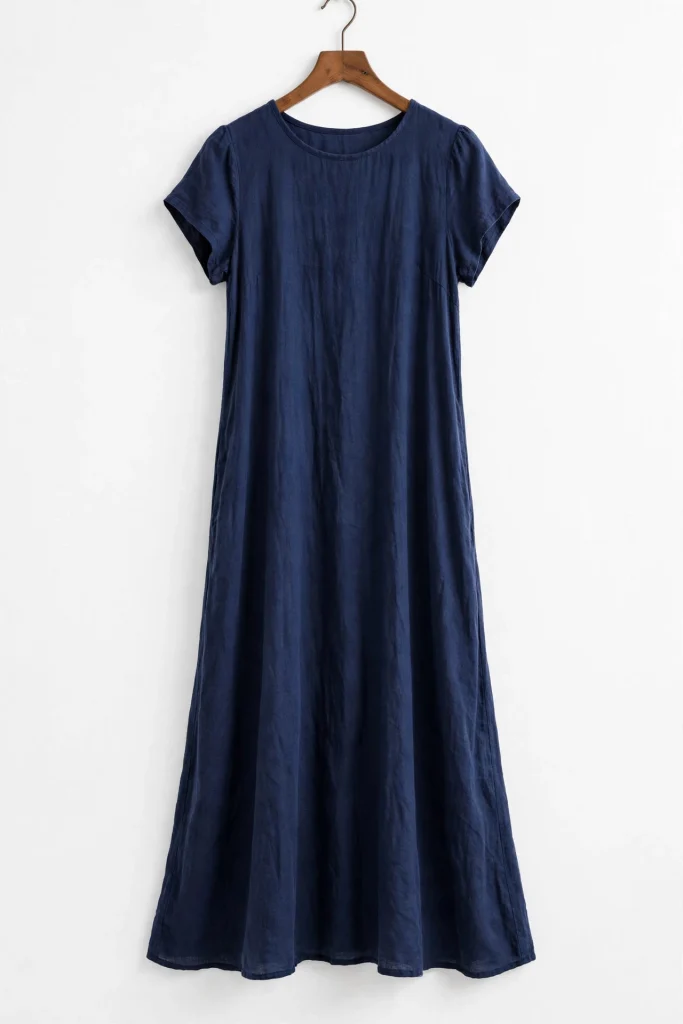
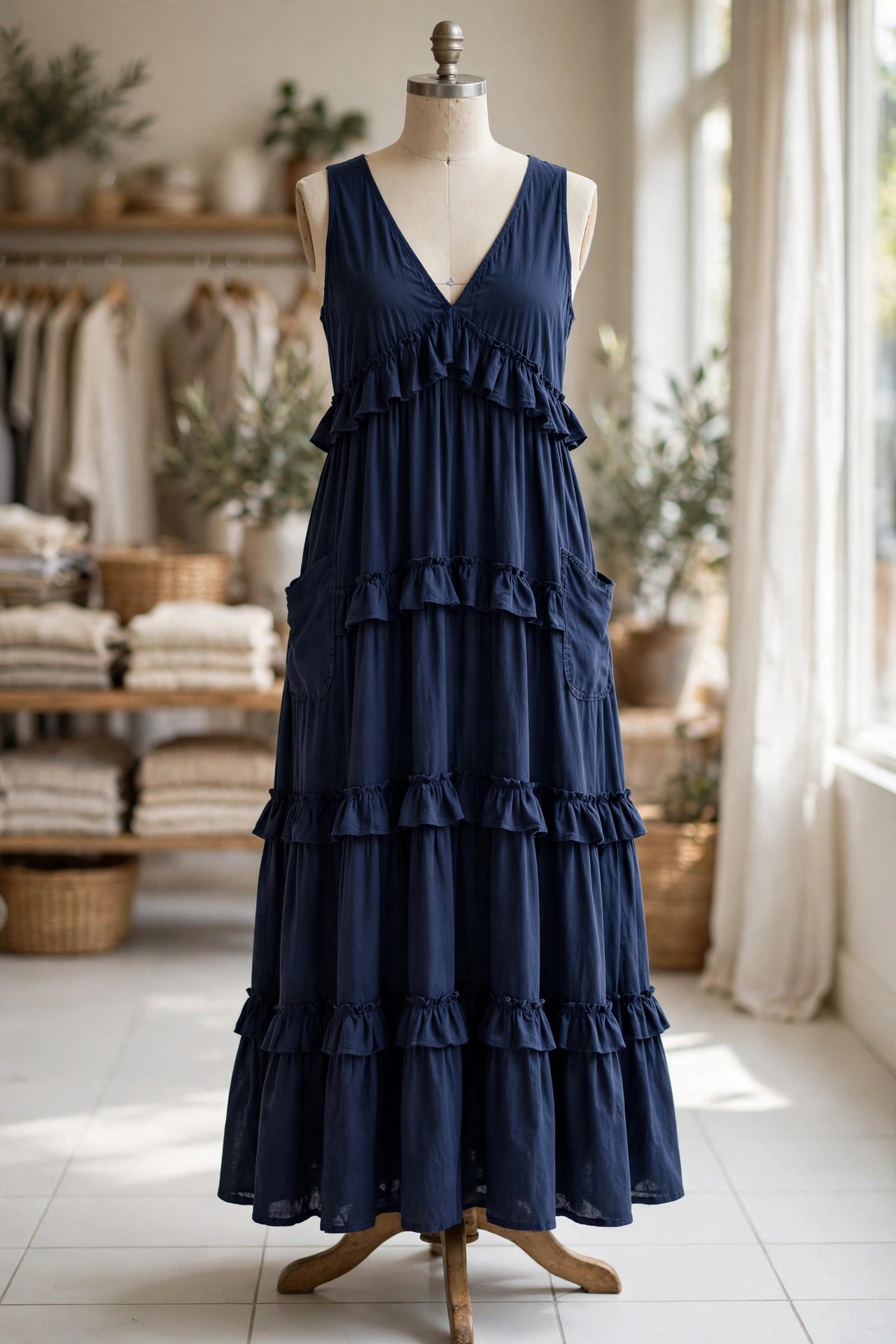
That was a BTFBM-style navy casual maxi dress, or close enough that the difference didn’t matter. Same V-neck, same tiered ruffles, same side pockets. In March that navy maxi dress would have been listed somewhere around twenty-five dollars wholesale. In August it was nine, and the nine-dollar ones were the honest ones. The dishonest ones were still listed at twenty-five on platforms nobody checks anymore.
Nobody sets out to buy a nine-dollar navy maxi dress. The nine dollars is what happens after three earlier mistakes, and I have watched the same three happen every year. The first mistake is March. Every buyer looks at a navy maxi dress and thinks safe. It hides sweat, it hides dust, it photographs like a premium shade on a white background. The listings peak in mid-March and every boutique orders the safe navy maxi dress, which is how a safe color becomes the most dangerous color in the building.
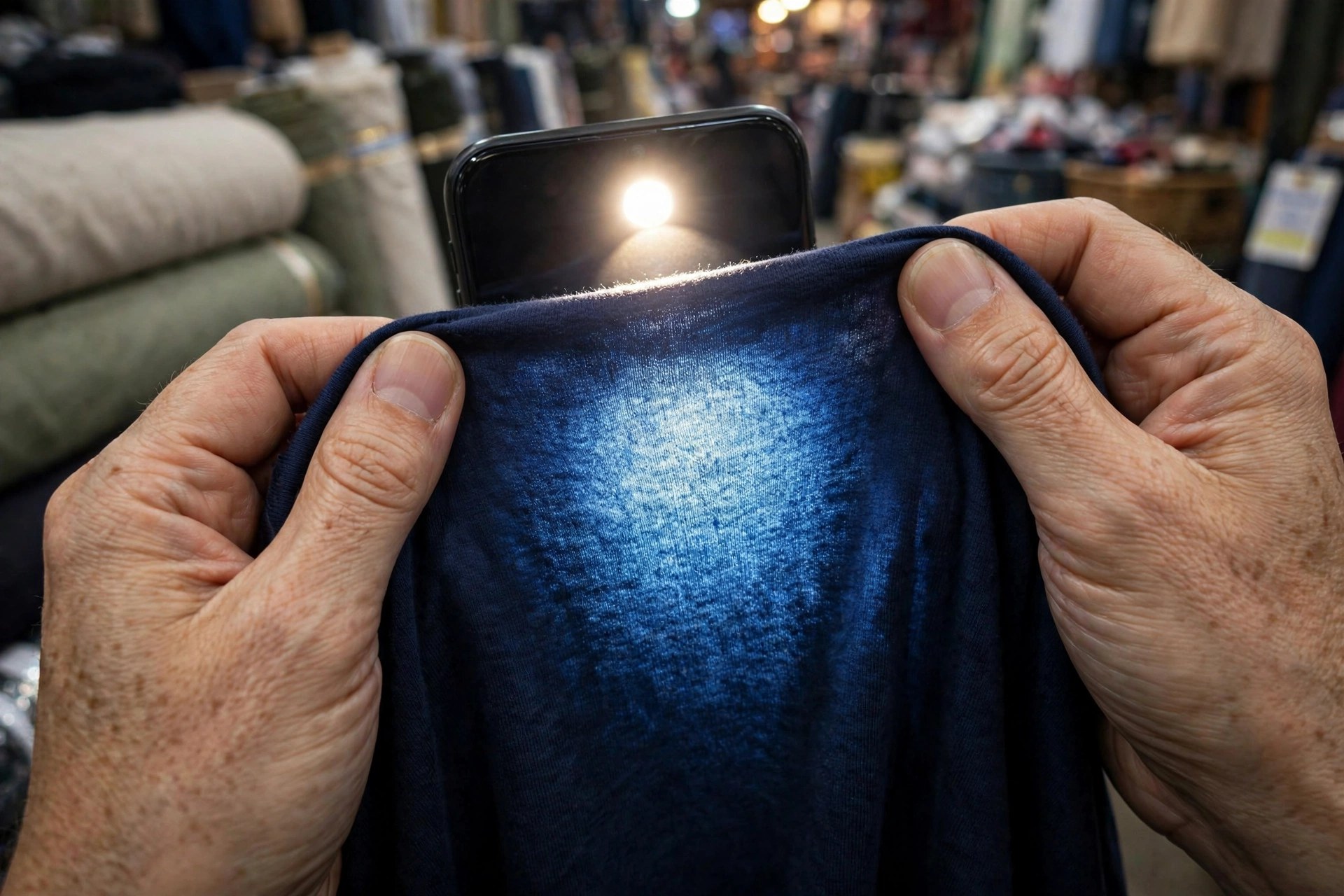
The second mistake is the fabric weight. Every navy maxi dress buyer learns this one the same way. The listing says flowy cotton and the early reviews say not too sheer, and both of those things are true of the sample. Samples get cut at an honest 160 to 180 GSM. The bulk rolls that arrive in July are a different story. When the looms run faster to hit peak-season volume, the rolls come in at 140 to 150, and nobody sends a warning with the shipment. The listing still says flowy cotton. Technically it is still cotton.
I ask for the weight in grams now.
Every time.
What a $9 navy maxi dress tells you
The nine-dollar navy maxi dress stall is not one event. It is two waves, and the people who buy closeouts know which wave they are standing in. The first wave lands in late August. Boutique leftovers, shelf-sorted, the navy maxi dresses that never sold at full price. The second wave lands in October. E-commerce returns consolidation, and it prices fifteen to twenty percent lower than the August wave, because return-sorted lots carry the damage the shelves never showed. If you only ever see the August wave, you are overpaying for deadstock.
This is the part of the trade most buyers never see. A navy maxi dress does not go from twenty-five dollars to nine in one step. It goes from the March listing to the July clearance section to the August stall to the October returns lot for navy maxi dresses, and at each step somebody takes a smaller cut of a smaller number. By October the only question anyone asks is the flashlight question. Light through the skirt, discount rack. No light, maybe it holds at twelve.
The trade press will tell you the maxi dress market is growing. It is growing in units. The average selling price fell off a cliff while fast fashion compressed the whole category, and the reports leave that part out because nobody wants to print it. Growth in units with falling prices is just more dresses changing hands for less money. The stall owners know. They stopped reading the reports years ago.
The GSM slide nobody lists
Cotton jersey moved about fifteen percent in price last year, up and down, and the workshops did not raise their quotes. They thinned the fabric instead. The number on the listing stayed at whatever the sample weighed. The rolls got lighter. This is not a conspiracy. It is arithmetic. When yarn moves half a yuan and the quote is fixed, something has to give, and the something is always the thing the buyer cannot see in a photo.
The give usually happens mid-run. A workshop starts the order on the quoted roll and swaps to a cheaper roll halfway through, because the color matches and the hand feel is close enough that nobody catches it at receiving. The color matches. The hand feel doesn’t. I have pulled apart enough deadstock lots to know the swap by touch now, and the navy lots are the worst for it, because a solid dark color shows every gram it lost.
The GSM number is the distraction everyone argues about. The real tell is the pocket bag. Side-seam pockets on a cheap navy casual maxi dress use unhemmed bags, and the bag tears at the stress point after five to ten washes. It never shows in the product photo. It shows the third time a customer sits down hard. Nine percent of one-star reviews mention pockets ripping, and every one of those reviews is a workshop that saved pennies on a hem.
Here is the ugly math of the listing that brags about a tiny minimum. Five pieces tell you nothing about whether the fiftieth piece matches the first. The workshops that survive on tiny orders are the ones that swap rolls mid-run when the price moves, because they have no margin to absorb it. That is not an accusation. It is the reason the closeout market exists at all. Somebody has to buy what the tiny-order workshops produce when the rolls change halfway through.
Seams decide the closeout price
A V-neck A-line with tiered ruffles and side pockets is a dozen stress points wearing a pretty silhouette. The spec sheet says one centimeter of seam allowance. The rush orders come in at six to eight millimeters. Nobody measures at receiving. They measure after the returns start, and by then the lot is already split across three boutiques.
The tier joins are where it shows first. Each join is a long horizontal seam, and the cheap runs serge it with three threads and leave it to roll. On the hanger it looks fine. After the first wash it ripples like a flag. A proper run presses the join flat and topstitches it so the ruffle falls instead of flaring. The closeout stalls figured this out before the buyers did. Topstitched tier joins hold their price in the deadstock market. Serged-only joins get dumped first. The seam decides the closeout price, and the stalls learned that before the buyers did.
The print never mattered.
A print hides a bad seam for one season. I have watched it happen with summer floral dresses where the pattern pulls the eye away from the join until the first wash. A navy solid casual summer maxi dress has nowhere to hide. That is why the reviews for navy maxi dresses keep saying not too sheer and never mention the seams at all. The buyers are looking at the wrong thing, and the stalls are pricing the right thing.
A finger along the inside of the tier tells the story. Cheap serging feels like a tiny rope.
What the reviews are actually saying
The review data reads like a confession the factories will never sign. Same-category navy casual maxi dresses sit between twenty and forty-six dollars across the big marketplaces, the BTFBM right in the middle of that band, ratings clustered at four point zero to four point three. The one-star keywords tell the real story. See-through or sheer leads at thirty-one percent, and sizing runs large at twenty-four. After that the complaints thin into a long tail: wrinkles easily, color fading after a few washes, and pockets ripping at nine percent, which never makes the headline but always makes the returns pile. Nobody wrote “the workshop swapped the roll mid-run.” They wrote “thin fabric,” which is the same thing in consumer language.
Navy maxi dresses carry a special tax. It gets “color not as pictured” complaints at one point six times the rate of black, because navy photographs darker than it arrives. Under a ring light on TikTok Shop it looks premium. On the doorstep it looks flat. The listing photo is not lying exactly. It is just shot under the kindest light available. The doorstep never looks like that.
The returns data is worse than the reviews. Nine to eleven percent of casual summer maxi dresses go back, and forty-one percent of those returns cite sizing. Twenty-two percent cite sheerness. No wait. The weight story is only half of it. The other half is the grade, and nobody talks about the grade because it is harder to photograph. The XL to 2X sizes get “too tight in the bust” at three times the rate of small to medium, which is a grading problem mislabeled as a fabric problem, and it haunts the whole casual summer maxi dress category. An A-line dress forgives a grading error because the skirt does the work. A tiered maxi forgives nothing. Every tier is a new place for the grade to go wrong.
The factory side says its navy maxi dress is not too sheer. The buyers say sheer. Both are telling the truth about different rolls. That contradiction is the whole article, really. The sample was honest and the bulk was lighter, and the review was written about the bulk. Nobody lied on purpose, and everybody lost money anyway.
Buyer questions with bad answers
160 GSM on the listing, 140 GSM in the box. Scam or normal?
Normal, which is the worse answer. Mills quote 160 to 180 for navy cotton jersey in sampling season, and peak-season bulk lands at 140 to 150 because the looms run faster to hit volume. The listing keeps the sample number. Nobody updates it. I have stopped treating the listed GSM as a specification and started treating it as a rumor. The fix is boring: ask for the weight in grams on the purchase order, in writing, and check one roll per shipment with a scale. Nobody does this. The stalls stay in business because nobody does this.
Navy hides everything. So why do 31% of one-star reviews say “see-through”?
Navy hides sweat and dust. It does not hide light. A 140 GSM jersey in a dark color still passes light, and the customer holds it up to a window, not to a product photo. The factory tested the sample at 170 GSM and wrote “not too sheer” with a clear conscience. The bulk went out lighter. Both things are true and the customer is the one standing in front of a window. The flashlight test at the stall exists because the industry already knows this and priced it in years ago.
Ten pieces at $22 a style. What’s the catch?
The catch is the fiftieth piece. Ten pieces tell you the workshop can cut and sew. They tell you nothing about roll consistency across a real run, and tiny-order workshops are the ones most likely to swap rolls mid-run when yarn prices move. Anyone buying women’s dresses wholesale outside bridal has seen the pattern: the sample is perfect, the first fifty are fine, and somewhere around piece two hundred the hand feel changes. The catch is not the price. The catch is believing ten pieces predict two hundred — the October stalls will show you the rest.
Still holding navy casual summer maxi dresses in September. Markdown now or hold for spring?
Markdown. Every September holder I have ever watched do the math talked themselves into holding, and every one of them met the October returns wave, which prices fifteen to twenty percent lower and buries whatever is left of your margin. Navy does not get better with age. It gets compared to cheaper navy. The boutiques that cleared in August bought their spring stock with the cash. The ones that held are still holding, and the market can smell it.
I still see the nine-dollar navy maxi dress stack when I walk past the stalls in August. Navy on navy, ten high, the flashlight test already done. Somebody ordered a safe navy maxi dress in March, and somebody else is sorting it by weight in August. The color didn’t change. The price did. It always does, and I am too tired to be surprised anymore.