It starts small with a one-shoulder dress. It always does. A customer writes that the dress was lovely and the neckline would not stay where she put it. Not a sizing complaint, exactly. Not a quality complaint, exactly. A migration complaint, filed in the polite language people use when a garment spent the evening travelling and they spent the evening pulling it back.
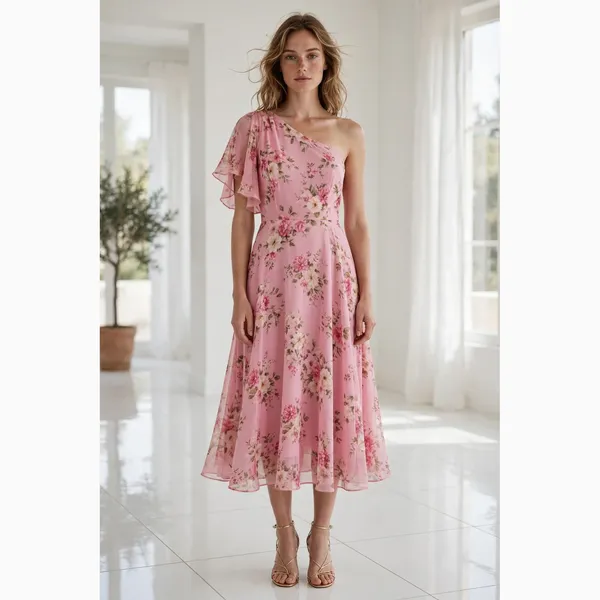
Then there is a second one, a few weeks later, about a strap that twisted. Then a photograph in a review where the single shoulder of a floral dress sits two centimetres lower on one side of the night than it did at the start, and the wearer is holding it in two of the pictures without seeming to notice she is doing it. Handling returns and customer messages for cross-border dress sales teaches you to read that photograph properly. The customer rarely complains about the engineering. She complains that she could not relax. Same thing, translated.
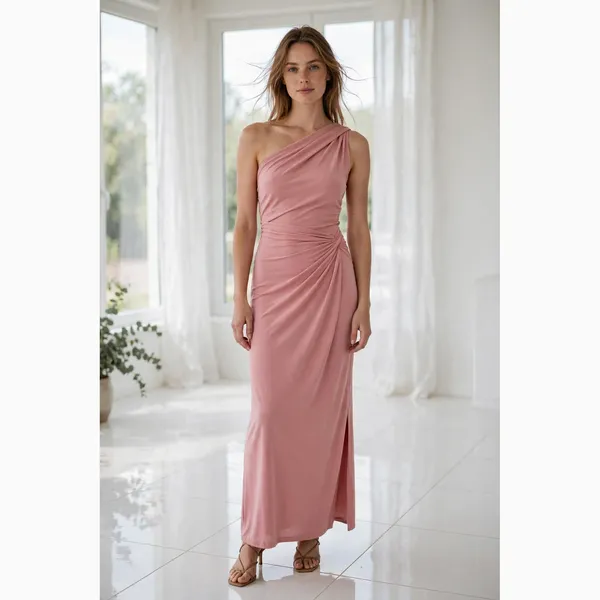
A one-shoulder formal dress is an asymmetric bet. All the visual drama sits on one side, and all the structural work does too, because one shoulder strap is doing the job that a pair of straps would normally share, while the bare side of the bodice has nothing holding it up except fit, friction, and whatever structure is built into the bodice itself. A floral print softens how that looks. It does not change how it behaves.
The complaints arrive in the wrong order
What customer service sees first is usually the print. Floral dresses draw colour comments before anything else, because a screen shows a print brighter and smaller than life, and a large-scale floral that looked delicate on a phone arrives looking bolder across a bodice. That is a description gap, and it is survivable. The comments that matter for a one-shoulder style come later and quieter, in the second week after a wedding-guest weekend, and they use words like slipping, adjusting, and pulling up. By the time three of those land on the same style, the strap attachment is the conversation, whether the customers name it or not.
The attachment is a stress point in a way a two-strap dress never has to think about. On a standard bodice each strap carries a share and the shares are modest. On a one-shoulder, the single strap anchors at an angle, and the angle means the stitching at the base of the strap takes a sideways pull every time the wearer raises the opposite arm, reaches across a table, or dances. Sideways pull is what seams hate most. A narrow strap stitched through one layer of fashion fabric will start to lean after a few wears, and once a strap leans, the neckline migrates, and once the neckline migrates, the customer is in the bathroom adjusting it and writing the review in her head.
The versions that hold up tend to cheat in one of a few ways. A wider shoulder band spreads the load across more stitching. A strap anchored into the side seam or the waist seam borrows strength from a seam that was built to work. Some bodices hide a waist stay, a grosgrain ribbon inside that hooks at the waist and quietly carries weight the strap never sees. None of this shows in a product photograph. All of it shows in the returns rate by the second month, which is the only place a consumer-side operator ever really gets to see construction, translated into percentages and complaint words.
Sizing complaints on one-shoulder styles mislead buyers who read them at face value, and this is a pattern worth naming. A customer between sizes will often report that the dress runs small, when what actually happened is that the bare side of the bodice has less tolerance than a strapped side. A two-strap bodice forgives a centimetre. An asymmetric bodice spends that centimetre immediately and the wearer feels exposed rather than snug, so the review says small. The size chart gets blamed. The size chart, for once, was fine. It is the architecture that has no slack in it.
What the floral is doing while nobody watches
A floral print on a formal dress is camouflage, and I mean that as a compliment and a warning at the same time. Print breaks up the surface, so the small things a plain fabric announces, a slightly uneven gather, a seam that sits a shade off, a pressed edge that could be crisper, all go quiet under flowers. That is why floral one-shoulder dresses photograph so forgivingly and why they sell so well into the wedding-guest market through the women apparel factory catalog and everywhere else. The warning is that camouflage works on the buyer at sample stage too. A plain version of the same dress would get its construction inspected. The floral version gets admired.
Print placement is the part of a floral dress that separates a considered garment from a lucky one. A large motif landing dead centre on the bodice looks deliberate. The same motif cut in half by the single shoulder strap looks like nobody was watching the cutting table. On a one-shoulder there is an extra trap, because the diagonal neckline slices through the print at an angle, and a floral that runs in neat horizontal rows will fight that diagonal all the way down. None of this is visible in a thumbnail. It is very visible across a shop rail, which is where boutiques actually sell the dress, one hanging garment at a time.
Then there is the discount-season problem, because this style gets bought hard during sales events by customers who planned to spend less and judge faster. A wedding-guest dress bought on a deal is worn to an event full of photographs, and the buyer’s remorse, when it comes, attaches itself to whatever felt slightly off. Consumer-side data has a rhythm here that repeats every year. The first cold snap and the first big discount weekend both change what people complain about, one by changing how fabric feels on skin and the other by changing what people feel they paid. A one-shoulder dress sits exposed to both, being mostly a warm-weather, event-driven, photograph-heavy purchase.
No, I am putting that slightly wrong. The discount is not the risk by itself. The risk is that a deal speeds the decision up, so the customer never does the small checks, the reach test, the sit test, the bag-on-the-shoulder test, that an asymmetric dress demands. The dress did not change. The amount of doubt the customer brought into the evening changed, and doubt is what turns a minor slip into a one-star review instead of a shrug.
Small accumulations, one conclusion nobody likes
Add the pieces up the way they arrive over a season and a picture forms that no single complaint tells you. A strap that leans by November. A neckline that migrates in photographs from June. A run of runs-small reviews that are really architecture reviews. A print that hides construction at sample stage and reveals it at the rail. Each item on its own gets filed and answered politely. Together they describe a style that needs more structure than its price point usually gets, which is the whole quiet story of the one-shoulder category.
For a boutique, the practical reading of all this is not to avoid the style, because the style sells, and it sells for good reasons, it photographs beautifully, it stands out in a sea of strapless and spaghetti straps, and wedding guests are tired of both. The practical reading is to buy it one grade more carefully than its neighbours on the rail. Check what the strap is anchored into. Look for the waist stay. Pull the print question and the structure question apart at sample stage, because the print will try to answer both and it is only qualified for one. Stores comparing guest-attire options can also sit this style next to the gowns in the wedding dress wholesale catalog and see how differently a bodice behaves when it is built for a bride who will be fitted twice.
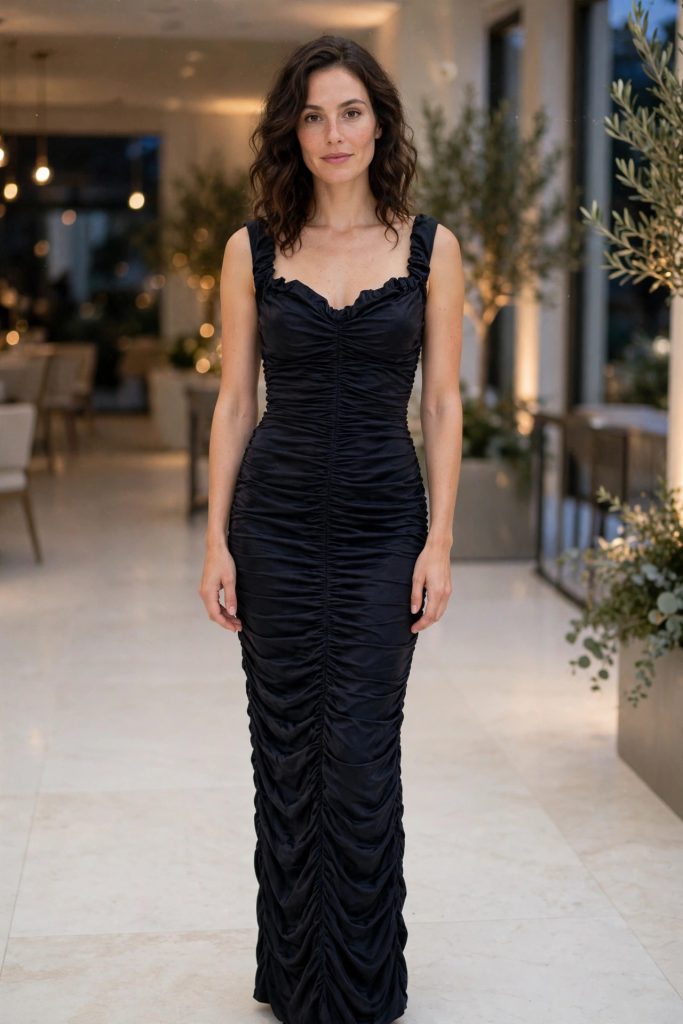
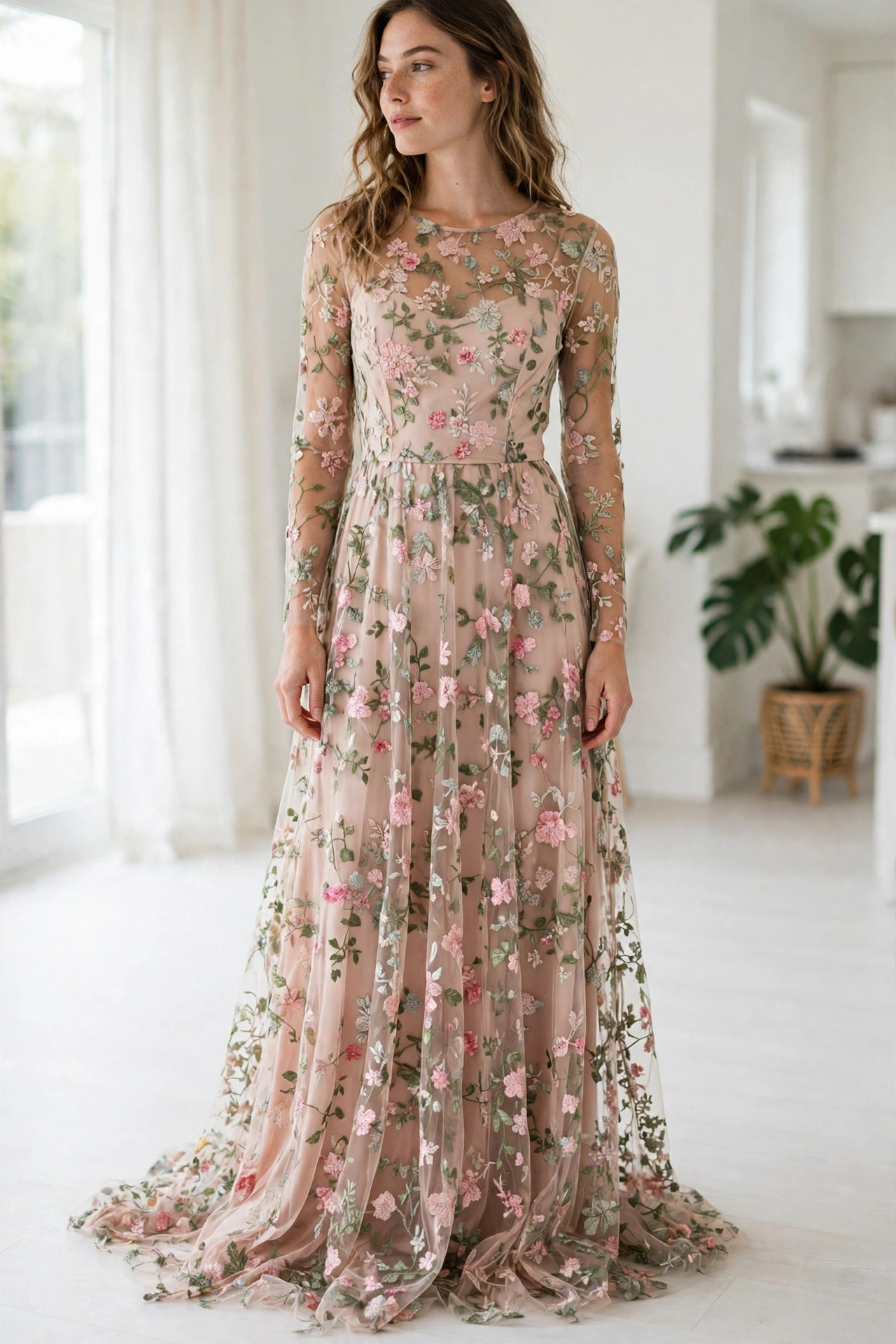
The embroidered floral mesh route, the made-to-measure kind of piece shown in the third photograph here, is what some buyers move toward after a season of print complaints, since embroidery cannot drift out of scale the way a printed motif can and the flowers sit where the pattern put them. It costs more and it weighs more and it is not the same dress at all, really. It just answers the same customer wish, flowers on a formal dress, with a completely different set of failure modes, most of them slower and kinder.
Care instructions sound like the dullest part of this dress and they quietly shape its complaint profile too. A floral formal dress often mixes a printed outer with a plain lining that shrinks at a different rate, and the first hot wash or enthusiastic steam can leave the lining a fraction shorter, tugging the hem into a tilt nobody ordered. Customers describe that tilt as the dress hanging wrong, and they are right, it does hang wrong, just not for the reason the size chart gets blamed for. Dry-clean-only labels on a guest dress annoy people. On an asymmetric one, where every seam is already working at an angle, they are sometimes the only thing standing between the dress and a slow twist.
What stays unresolved, season after season, is whether customers actually want the engineering or only want the neckline. The neckline is the photograph. The engineering is the evening. A dress can win the photograph and lose the evening and still sell again next season to somebody new, which might be the most honest sentence consumer-side work ever produces about occasion dresses. I answer the messages, I log the words slipping and adjusting, and the style goes back on the rail, beautiful and slightly underbuilt, waiting for the next wedding.
Questions buyers keep asking about this one
The reviews say this one-shoulder dress runs small. Does it, or is something else going on?
Usually something else is going on, honestly. An asymmetric bodice has less slack than a two-strap one, so a customer between sizes feels the bare side as exposure rather than snugness and reports the dress as small. The size chart is often fine. I get this one wrong myself sometimes when I skim, because the word small is right there in the review and the real story is in the photograph next to it, where the neckline has clearly travelled.
One strap for a whole bodice. How long before it starts to lean?
A narrow strap anchored through a single layer can start leaning within a few wears, and once it leans the neckline follows it. Wider bands and straps anchored into a side or waist seam last far longer, though putting a number on it is guesswork since so much depends on how the wearer dances, reaches, and carries a bag on that shoulder. The lean shows up in photos before the customer ever names it, which is a strange little detail I cannot unsee now.
Ten pieces to test a style. Is that enough dresses to learn anything real?
Ten pieces is enough to learn whether the strap behaves and whether the print reads well on a rail, which are the two questions that decide this style. It is not enough to learn your return rate, that takes a season, and anyone who tells you otherwise is selling something. Ten will show you the architecture. The architecture is the part that cannot be fixed later with better photography or a kinder description, so as a test size it earns its keep, I would say.