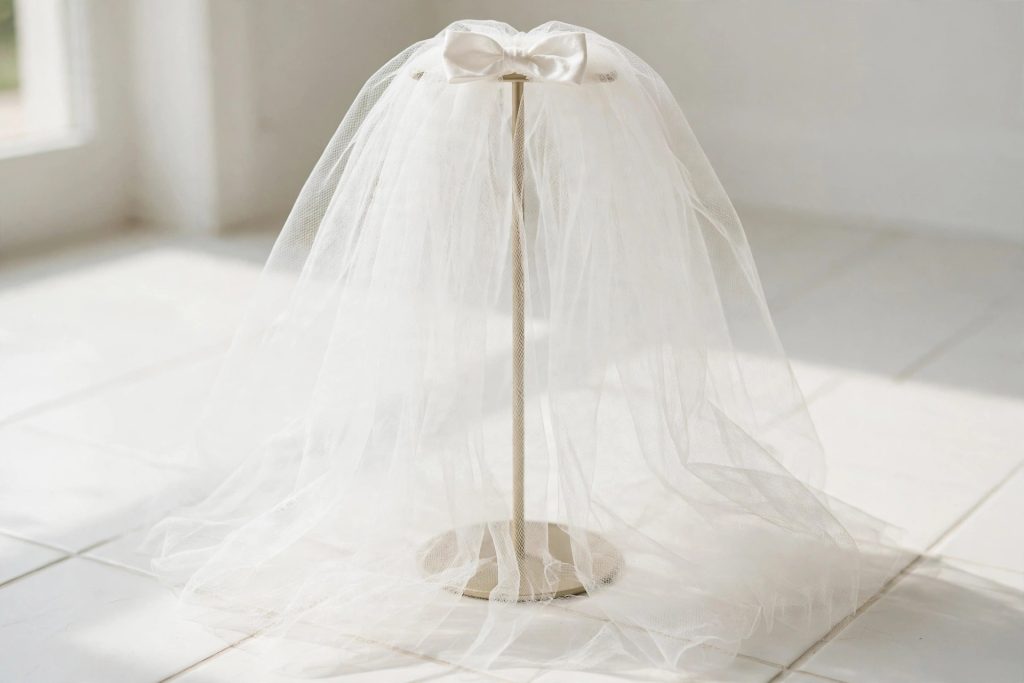
$2.40. That is what a white bow veil costs to make — two layers of tulle, a stitched satin bow, a metal comb, a polybag — and the question I have carried for a few years now is why nobody on the buying side has ever managed to do anything about the distance between that number and sixty dollars. It wholesales around $8 to $12, the boutique sells it for $50 or $60, and everyone in the chain knows the arithmetic — the factories, the buyers, the boutique owners. And the margin has not moved in years.
I am a buyer. I sit on the buying side of the table, which means my job is supposed to be squeezing exactly this kind of margin out of bridal veil quotes. I have been doing it for three buying seasons, long enough to stop believing the obvious explanations. The obvious explanations are all true and none of them are sufficient, which is the part that keeps me up.
Here is the cost broken down the way a quote never breaks it down. Soft illusion tulle runs $0.55 to $0.80 a meter, and a two-layer veil eats roughly a meter and a half once you count the cutting waste, which the factory prices in without itemizing. The metal comb is $0.22 to $0.35 in bulk. The satin bow, stitched rather than glued, carries about four minutes of labor. The polybag is pennies. Add it up and you land near $2.40, and here is the first thing I learned that the trade press never prints: the tulle is quoted by the cut, not the meter, and a 3-meter veil wastes around 0.4 meters in cutting. That waste is in your unit price. It is just never on the piece of paper. Buyers who ask for the cut yield get a different price than buyers who do not ask. I ask now. I did not use to.
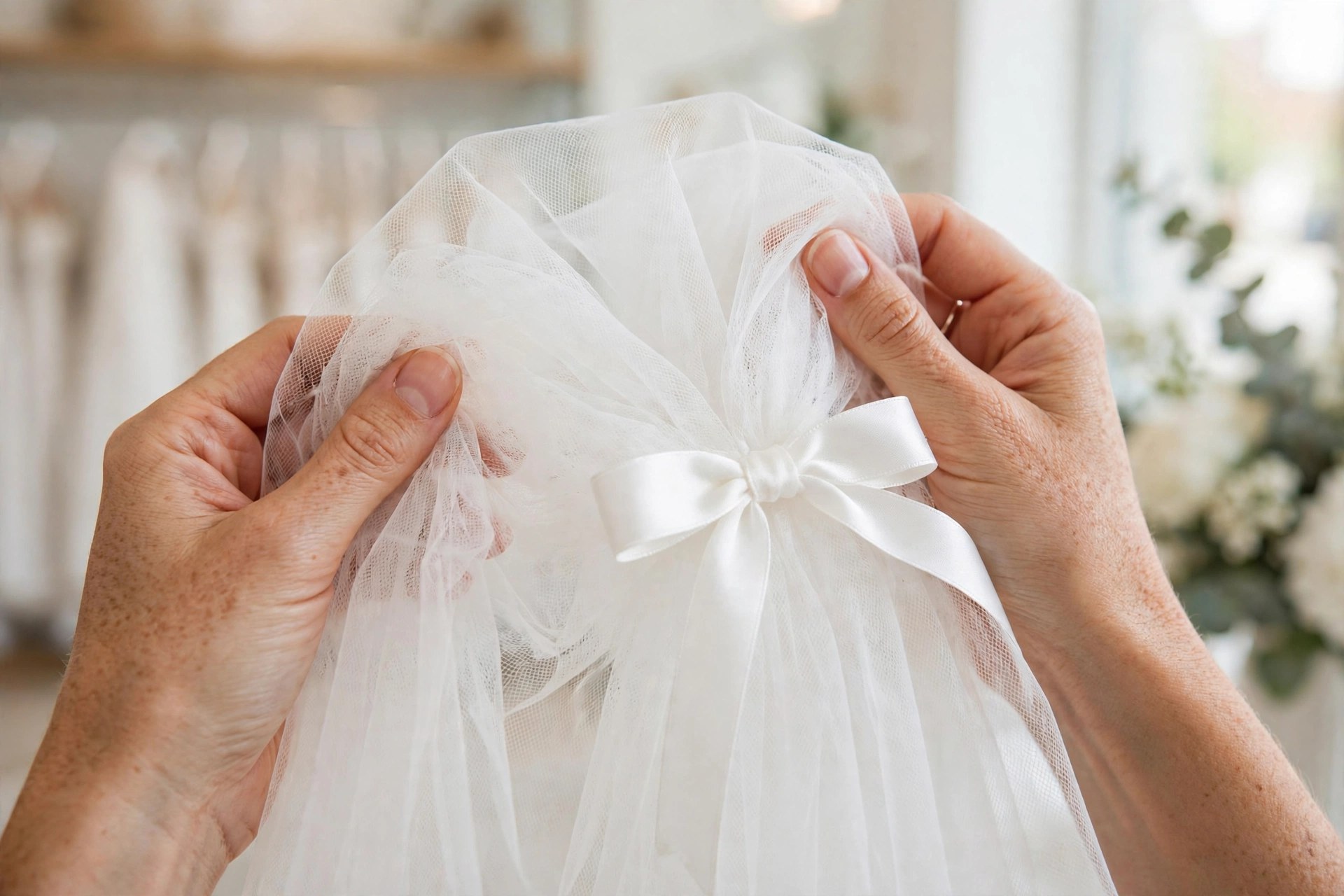
What bridal veil wholesale quotes never itemize
The first answer I tried was the emotional one. Brides do not comparison-shop a bridal veil. It is purchased once, in a hurry, on an emotional day, usually after the gown decision has already drained the budget conversation of all remaining resistance. A bridal veil is the single highest-margin item in most bridal boutiques — higher than the gown, higher than the shoes — and brides pay it happily because the purchase is tangled up with the wedding itself. You cannot put a price-comparison spreadsheet next to a fitting-room mirror and expect it to win.
That answer felt complete for about a year. Then it stopped being complete. Because the same $2.40 object sells on the major platforms for $7.99 to $24.99, ratings clustered at 4.2 to 4.5, and the brides buying there are the same brides, just on a different website. The margin compressed online and held firm in boutiques. If the emotional-purchase theory were the whole story, the online price would look like the boutique price. It does not. Something else is holding the boutique number up, and “emotions” is the explanation people reach for when they have stopped asking.
The second answer I tried was the subsidy theory. The trade press will tell you bridal accessories carry 4 to 6x margins, and what the reports leave out is that the bridal veil margin is what keeps boutiques alive through gown discount season. The veil pays for the sample gowns on the floor. Every boutique owner who cries about gown margins rings up a veil without blinking, same day, and the two facts are not a contradiction. They are a business model. The gown gets the customer in the door at a thin margin and the veil recovers it at the register.
That answer lasted longer. It dies on Etsy. The handmade veil sellers there price at $35 to $80, carry no gowns, subsidize nothing, and their complaints center on “not worth the price” rather than quality. No floor samples to fund, no discount season to survive, and the margin is still there. So the subsidy theory explains the boutique but not the category. I keep the theory. I just no longer pretend it is the answer.
The comb spec number nobody asks for
The third answer is the one from my side of the table, and it is the most embarrassing, because it means the failure is partly mine. The padding is in the quote, and I know where it lives. The comb is the cleanest example. That metal comb on a white bow veil costs $0.22 to $0.35 in bulk, and the identical comb — same stamping, same teeth — is sold to hair-accessory factories under a spec number. Ask for the comb spec number and the padding on that line disappears, because the factory knows you can price it independently. I learned this from a comb vendor’s display table at the Canton Fair accessory hall, where the same comb sat under three different brand cards and the spec number was the only honest thing on the table.
The white bow veil’s bow is the same game with worse odds. A stitched satin bow takes about four minutes of labor. A glued bow takes forty seconds. The quote rarely says which one you are getting, and I have the transaction to prove what happens when you do not ask: a 500-piece order arrived with glued bows though the quote said stitched, and the factory offered a $0.12 per piece credit instead of rework. The credit was taken. The reviews on those bachelorette veils later mentioned bows, and twelve cents did not fix a single veil.
So here is the uncomfortable part. Even when I strip the padding — cut yield asked, comb spec’d, bow verified — the retail number does not move. The factory will sell me the honest $2.40 veil all day. The boutique will still ring it up at $60. My influence ends at the wholesale line. Everything past it belongs to someone else’s business model, and no buyer has ever successfully negotiated with someone else’s business model.
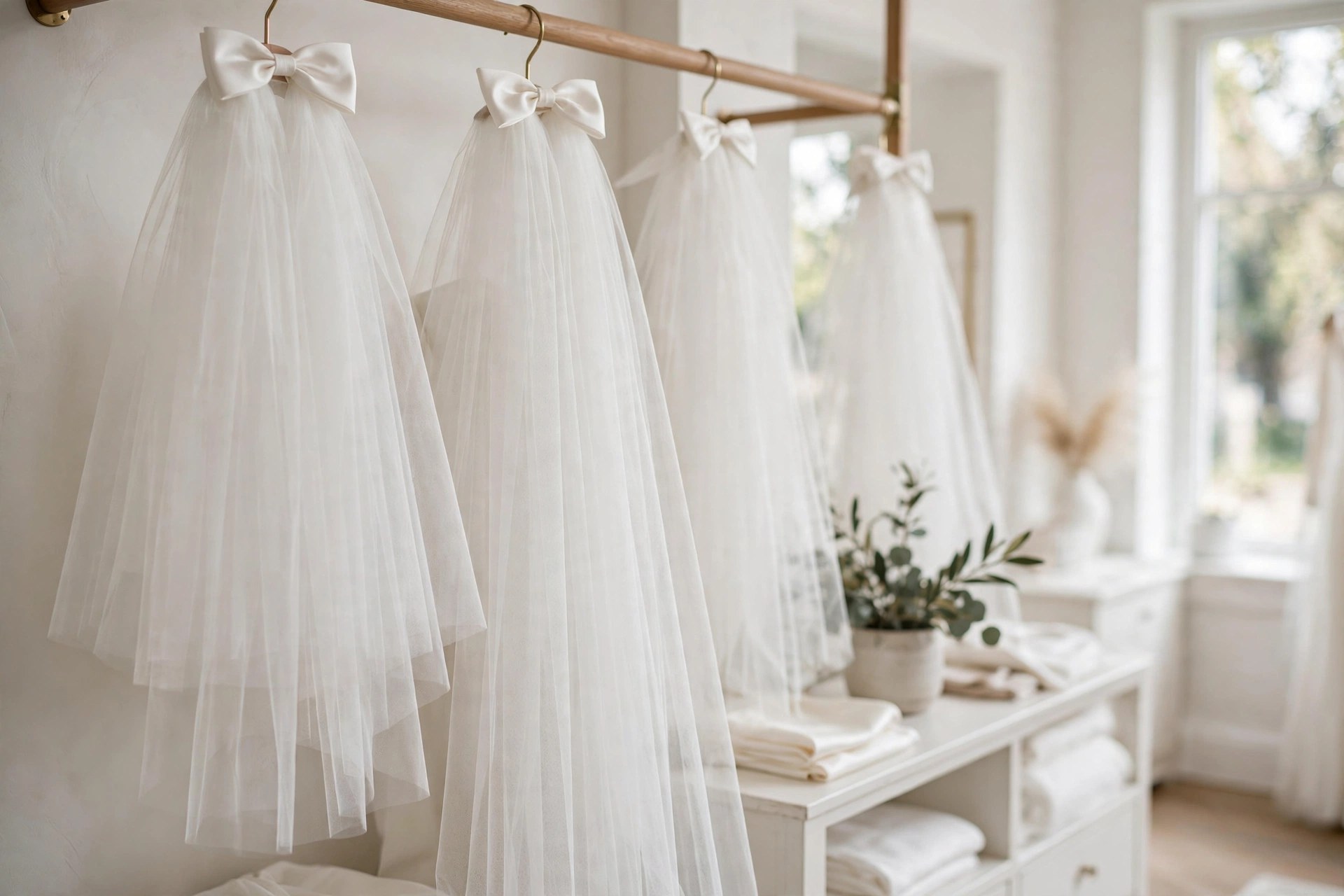
Bachelorette party veil economics
The bachelorette version is where the margin gets truly silly, and the numbers are all public if you know where to look. A bridal veil and a bachelorette veil are the same $2.40 object with different photography. The bachelorette one sells in multiples — one for the bride, five for the bridesmaids — and the multi-packs outsell single bridal veils two to one in unit volume on the platforms. All of them worn for exactly one evening and then kept in a drawer forever, which is the whole bachelorette party veil business model in one sentence. The bachelorette party veil has the lowest reorder rate of anything I have ever seen quoted, because nobody needs a second one. Bought once, rarely reviewed, margin collected, drawer closed. It is the same one-wear logic that moves wedding guest dresses every spring, just with a veil instead of a hemline.
The review data reads like a margin report with the numbers filed off. One-star keywords on bridal veil listings cluster hard: comb snapping or hurting at 31%, tulle scratchy or itchy at 27%, too short at 18%, color not white at 14%. The comb complaints are always the plastic ones — $0.06 to $0.09 versus $0.22 to $0.35 for metal — always discovered by the bride, never caught in receiving. The color complaints on white bow veils are almost always ivory versus white: listings shot under warm light read ivory and arrive white, and the bride holding it up in daylight sees the difference the product photo was designed to hide.
There is one more line item I should mention, because it is the kind of thing buyers discover in March and pay for in silence. Standard lead time on veils is 15 to 20 days, and March/April orders carry a rush line of 8 to 12%. That line is negotiable if the bridal and bachelorette SKUs go in together in January. Almost nobody orders them together in January. The bachelorette trend data does not exist yet in January, the buyers wait, and then they pay the rush line in March and complain about it in April. I have watched this cycle three years running. The rush fee is not a factory problem. It is a calendar problem, and the calendar belongs to the buyer.
Yiwu tells the same story from the other side. The veil suppliers cluster in one hall, and the same white bow veil sits at six or more stalls with $0.30 to $0.50 of unit variance, every stall claiming the same workshop. No, I’m misremembering. It might have been eight stalls. The exact number does not matter much — the variance was the negotiation. The variance is the negotiation. Nobody at those stalls is confused about the cost. The confusion is entirely downstream, and it is profitable, which is why nobody upstream volunteers to clear it up. The same opacity runs through formal ball gown supply chains, where the beading hours disappear the same way the cut yield does here.

Buyer questions with numbers attached
100-piece MOQ on a $2.40 veil. What am I actually paying for under 100 pieces?
A surcharge the factory will not name. Veil MOQ sits at 100 pieces per style as a matter of habit, and below that most workshops add 15 to 20% without writing it on the quote — it shows up as a slightly worse unit price and no explanation. The honest version is that changeover time on a 40-piece run eats the margin, so they recover it quietly. I ask for the sub-MOQ price in writing now. Half the time the number comes back lower than the implied one, which tells you the surcharge was never about changeover. It was about whether the buyer would ask.
The comb snapped on first wear. Is that a nine-cent problem or a thirty-five-cent problem?
It is a nine-cent decision made months earlier. Plastic combs run $0.06 to $0.09, metal $0.22 to $0.35, and the failure mode is always the same: the teeth snap on first wear, the bride discovers it, the review says the comb hurts. Thirty-one percent of one-star veil reviews mention the comb. Nobody catches it in receiving because receiving checks the veil, not the comb’s flex strength. I spec metal now and eat the difference. It is the cheapest insurance in the whole accessory category, and most quotes still default to plastic unless you say the word metal out loud.
Ivory in the photo, white at the door. Whose fault is the color?
The listing’s, mostly, with an assist from physics — fourteen percent of one-star reviews cite color mismatch, and it is almost always ivory versus white: the photo was shot under warm light, the veil arrives in daylight, and the bride sees what the camera was told not to show. The wedding guest dress listings pull the same warm-light trick on chiffon. Tulle dye lots drift between runs anyway, which nobody mentions, but the main offense is the photography, not the dye. I have started asking for a daylight photo before approving bulk. The suppliers hate the extra step, but the returns stopped.
Six veils, one order, one very good night. Why does nobody reorder the bachelorette pack?
Because the product did its job too well: bachelorette multi-packs move at twice the unit volume of single bridal veils and carry the lowest reorder rate in the accessory trade — worn once, drawer forever. From the buyer’s side this looks like a dead SKU. From the margin side it is the perfect SKU: full price, zero returns, zero reorders, zero complaints because nobody wears it twice. I used to read the low reorder rate as a problem. It took me three seasons to see it as the business model working exactly as designed.
So the question stands, and I am still carrying it. The $2.40 veil, the $60 register ring, the chain of people who all know the numbers and none of whom can move them. Maybe the answer is that the margin is not a bug in the bridal trade but the load-bearing wall, and nobody renovates a load-bearing wall while they are still living in the house. Or maybe I am just a buyer who has not figured out the right question yet. Either way, the veil stays $2.40, the register stays $60, and I keep asking.