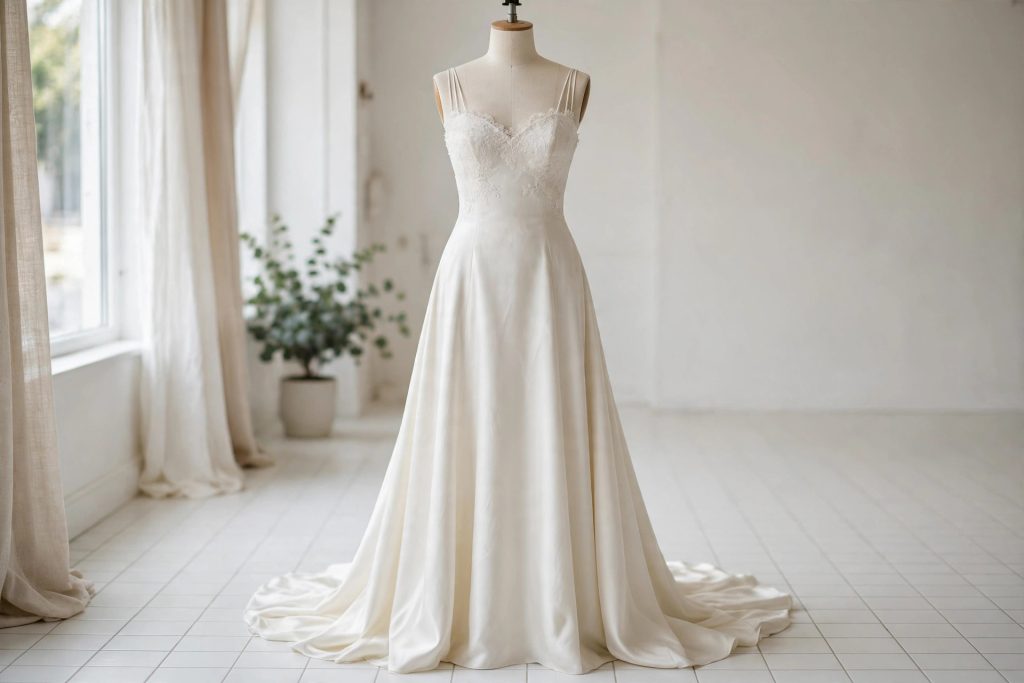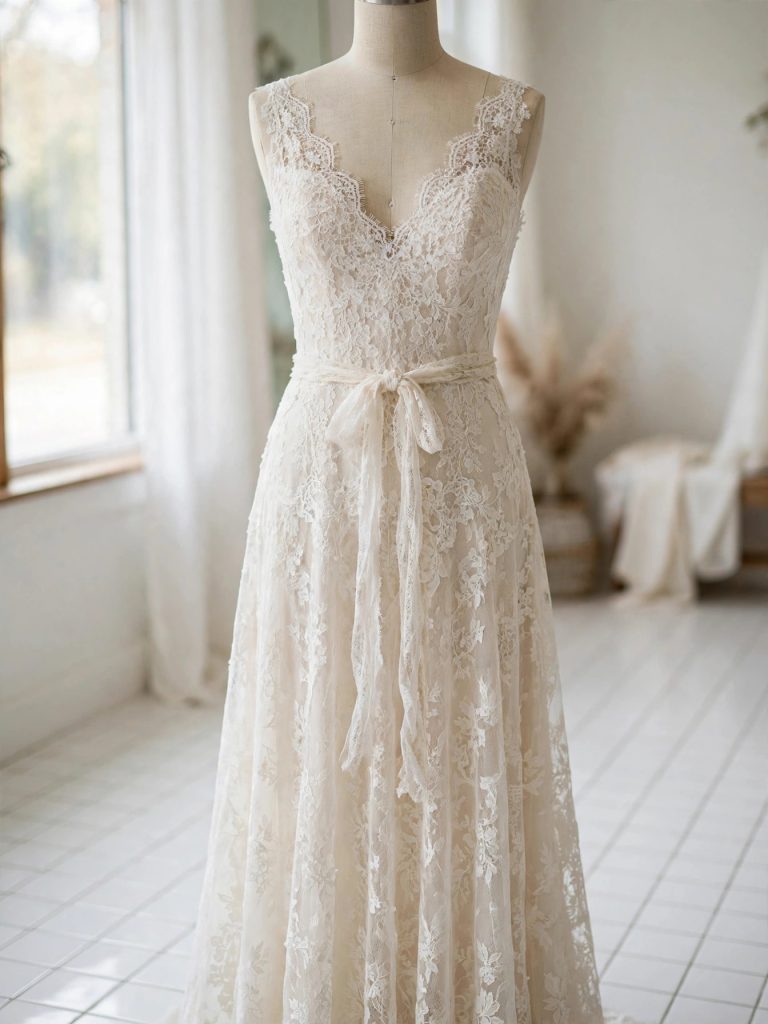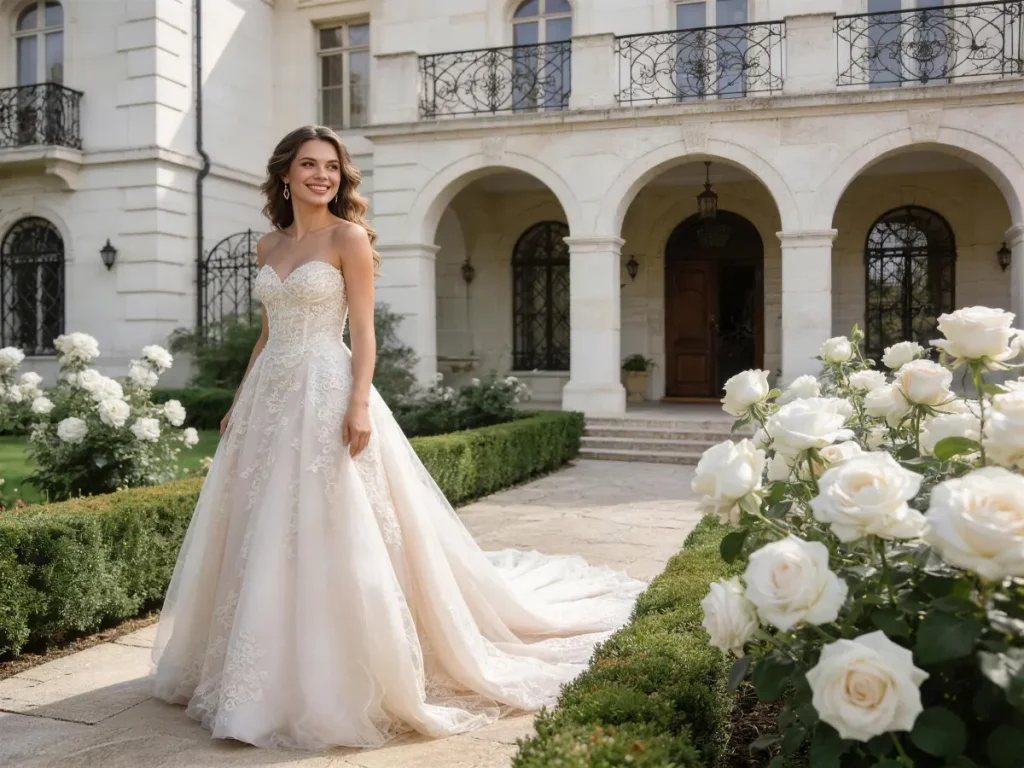
The counterintuitive fact about a single custom lace wedding dress is that the money has to behave like a bulk order even though there is only one dress. Buyers arrive assuming the opposite — one gown, one bride, one payment, a simpler transaction than a boutique’s fifty-piece order. From the finance side of the table, where I sit, a single custom gown is the riskiest piece of paper in the whole bridal trade. It cannot be resold. It cannot be redirected to another customer if anything goes wrong. Every payment decision around it has to carry the weight that a fifty-piece order spreads across fifty dresses. The dress is lace and tulle. The transaction underneath it is pure risk allocation, and the couples who understand that early have calm orders. The ones who learn it late learn it from a dispute. For the fit side of the same question, see how a lace A-line is broken down by fit, fabric and QC before a boutique commits to it.
My side of this business is the payment side — deposits, balances, terms, the arguments that happen when the money and the garment are in different places. I do not cut lace and I do not fit brides. What I know is how the money moves around a custom order, where it sticks, and which sentence in a negotiation predicts trouble three months before the trouble arrives wearing a veil it does not own yet.
The ordering facts for a single custom lace gown, stated once so the rest of this article can argue about them. A made-to-order wedding dress starts from one piece, no style minimum, and the measurements are the buyer’s own rather than a size run. The sample and the gown are the same garment here, and the making runs 10 to 15 days for a lace gown of ordinary complexity once fabric is confirmed, with heavier construction quoted per style after the photographs are reviewed. Before sampling starts, the factory photographs the fabrics and sends them to the buyer to review and choose from, because a lace decision made from a listing photo is where most single-gown orders go wrong.
The deposit is not a down payment on a dress. It is the factory’s only insurance.
Custom work runs a dispute rate of around twelve percent, against something like seven for ordinary apparel orders, and the gap is not about dishonesty. It is about resale. A returned or abandoned standard dress goes back into stock. An abandoned custom lace gown, cut to one woman’s measurements with lace placed for her proportions, goes nowhere. There is no second bride with that body and that taste arriving next month. So the deposit on a custom order is structurally different from a deposit on stock: it is not a gesture of commitment, it is the maker’s compensation for building something that has exactly one possible owner. On selling platforms, well over half of custom dress listings over two hundred dollars state a non-refundable deposit or custom deposit term, and the review fights on those listings are almost always about the deposit, not the dress. The dress usually gets made. The fight is about what happens to the money when a wedding moves, a budget breaks, or a bride changes her mind in week nine of a twelve-week process.
The size of the deposit predicts the ending with an accuracy that still surprises new people in my line. Orders taken at a thirty percent deposit see the buyer walk away from the balance roughly three times as often as orders taken at fifty. Factories are not naive about this — a maker who accepts thirty percent quietly buries a risk premium of eight to twelve percent somewhere in the price, because the walk-away rate is a cost like any other and somebody pays every cost. The buyer who negotiates the deposit down and celebrates should know what she actually won: a higher unit price wearing a lower deposit as a costume, or a maker who has privately decided this order is expendable. Neither is a victory.
And that power does change sides, completely, and both parties feel the exact moment it happens. While the gown is unfinished, the maker holds the power — the dress does not exist yet, the wedding date does, and time is the maker’s ally. The moment the gown is finished and paid for in part, the power begins its migration. Ship the finished gown before the balance clears and the migration completes: once the dress has left the building, the maker has no leverage left, which is why the factories that survive in this trade hold finished goods until the balance lands. Always. The ones who ship on promises and warm feelings do not survive to have opinions about it. I have read the post-mortems.
The clock starts when the money lands, not when the paper is signed
Here is a piece of arithmetic that wrecks more wedding timelines than any sewing problem: fabric cutting on a custom order starts only after the deposit clears, not when the proforma is signed. The gap between signature and cleared money averages about eleven days — international transfers, bank checks, weekends, the slow plumbing of cross-border payment — and the production clock, the eight to twelve weeks a bride counts from, does not start until the money arrives. A bride who signs in a flush of decisiveness and pays eleven days later has not lost eleven days to anyone’s laziness. She has lost them to the gap between a document and a deposit, and nobody told her the clock was still at zero while she was telling her mother the dress was being made. It was not being made. It was being financed into existence, at the speed of the banking system.
Document discipline sounds like the driest corner of this trade and it is where clean orders go to stall. Under the standard documentary rules the banks work by, they examine documents, not goods. A one-word mismatch on a packing list — a singular where there should be a plural — can park an otherwise perfect shipment for weeks while the paperwork is argued over by people who will never see the dress. The gown is finished, correct, beautiful, and stationary, held by a typo. There is no second carton to absorb the mistake.
Under-declared value is the other paperwork trap, and it springs at the worst moment. A shipment declared low to save duty — the paperwork saying a small figure while the real price was far higher — behaves fine until something goes wrong, at which point the maker cannot claim the real value anywhere that counts, because the official record disagrees. The saving was real. So is the ceiling it puts on every remedy. On a one-of-one gown, where the entire value sits in a single box, that ceiling is not an abstraction. It is the whole dress.
The payment structure that survives all of this is unglamorous and I will describe it the way the survivors arrange it: forty percent to start, thirty at a pre-shipment inspection point, thirty against the shipping documents. Each slice is small enough to lose, which sounds pessimistic until you understand it as the opposite — it is the structure that lets both sides stay calm enough to finish the dress, because neither side is ever exposed for the whole amount. No wait. Even that understates it. The inspection slice is the load-bearing one. It converts the most dangerous moment of the order — the finished gown, unpaid balance, wedding approaching — from a confrontation into a checkpoint both sides agreed to when they were still being polite. Agreements made in politeness are the only kind that survive week nine.
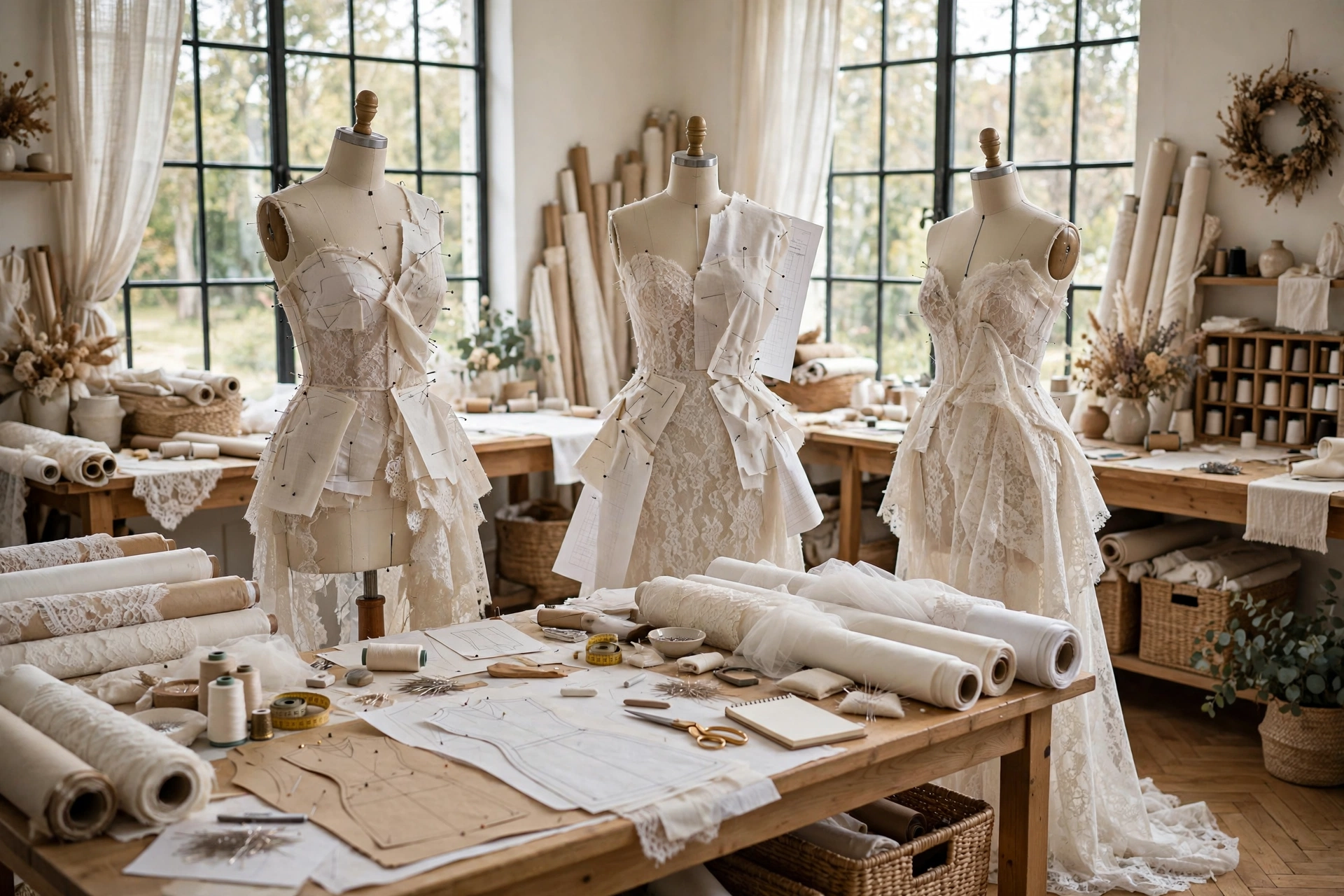
For a single gown ordered directly, the same logic scales down into simpler shapes: a deposit that reflects the no-resale reality, a balance tied to finished-gown photographs and measurements checked against the order sheet, and dates counted from cleared funds. Single custom gowns start from one piece by definition here, while boutique wholesale on bridal styles runs from 5 pieces per style — the two transactions look similar from the bride’s side and are entirely different animals from the finance side, which is why importing bulk-order payment habits into a one-gown order causes so much avoidable pain. The manufacturing process walkthrough shows where the money stages sit against the making, the timeline for making a custom dress with a manufacturer covers the calendar in detail, and the ball gown bridal style is what this payment structure looks like applied to a fuller silhouette.
Questions about money, asked in the order couples ask them
The deposit is non-refundable. Is that the maker being difficult, or is there a reason?
There is a reason, and you can test it with one question — who else could this dress be sold to? A custom lace gown is cut and placed for one body. If the order stops in week six, the maker holds a half-built garment with no second buyer, real lace already cut into shapes only one person can wear, and hours of handwork that cannot be unpicked into stock. The non-refundable deposit is the price of that one-way door, and on platforms well over half of custom listings over two hundred dollars state the term openly because sellers learned, expensively, what happens when they do not. She is either not doing true custom work, or she has priced the expected walk-aways into everyone’s gowns, including yours — usually the second one, in my experience, though I admit I check the first possibility before I pay anyone.
We signed three weeks ago and nothing has happened. Where is our dress?
Your dress is most likely waiting exactly where the paperwork says it is, which is before the start. Cutting begins when the deposit clears, the gap between signing and clearing runs about eleven days on average, and the production slot is calculated from the clearing date — so a three-week-old signature can easily be a ten-day-old order wearing a three-week-old expectation. This is the single most common source of panic in custom orders and it is nearly always a communication failure rather than a production one. The uncomfortable part is that from the bride’s chair the silence feels like evidence, and by the time anyone explains the banking gap she has already rehearsed the dispute in her head. Makers who send a one-line message when funds clear — deposit received, cutting starts Tuesday — have dramatically calmer customers. It costs them nothing. I have never understood why it is not universal, and I have stopped expecting a good answer.
Can we pay the balance when the dress arrives, so we can check it first?
That sentence, in my line of work, is where deals go to be quietly reclassified as risks. Once a finished gown leaves the maker, the maker has no leverage left, and everyone in the trade knows it, which is why the honest version of what you are asking for already exists in the structure I described: an inspection-stage payment before shipping, triggered by finished-gown photographs, measurements against the order sheet, and video if you want it, with the final slice against shipping documents. You get to verify before the last money moves. The maker never ships an unpaid one-of-one garment into the world on trust. Nobody escapes the arithmetic. The cost just lands in a different place.
A friend ordered at 20 percent deposit and it worked out fine. Why won’t makers take ours?
Because your friend is a sample of one, and makers price the whole distribution. Buyers who push the deposit under thirty percent walk away from balances at a rate the experienced side of this trade can recite from memory, and a single custom gown is the worst possible place to carry that risk — there is no stock to absorb it, no reorder relationship to protect, just one dress and one date. The makers who survive long enough to have reputations handle first orders by transfer, in stages, and only loosen terms after clean cycles have given them a reason to. It feels like distrust. From my side of the table it looks more like the accumulated memory of every finished gown that ever sat in a workroom while its balance became a conversation about quality that was, on inspection, a conversation about cash. The dress is rarely the problem in those conversations. It is just the only hostage available.
The invoice value on the shipping papers is lower than what we paid. Should we care?
Yes, and before the dress ships rather than after. A low declared value saves duty on a good day and caps every remedy on a bad one, because no claim, arbitration or insurer will pay out against a value the paperwork itself denies. On a bulk order that ceiling is a business problem. On a single custom gown it is the whole transaction — the dress is one of one, its real value exists in exactly one set of documents, and if those documents say a fraction of it, then as far as every institution you might need is concerned, a fraction is what you lost. I would rather pay honest duty on a dress that exists at full value in every record than save a small amount insuring a fiction. The week it matters is never a happy one, and the signature is already dry.
What I am left with, after years of watching the money move around dresses I will never see worn, is a suspicion I cannot quite prove and cannot quite drop: the couples who argue hardest about the deposit at the start are rarely arguing about money. They are arguing about whether this transaction, with strangers, across borders, for the most emotionally loaded garment of their lives, is safe to enter at all. The deposit is just the only part of that fear with a number on it. The makers who understand that answer the fear instead of the number. The ones who answer only the number get the order, sometimes — and then they get week nine.