
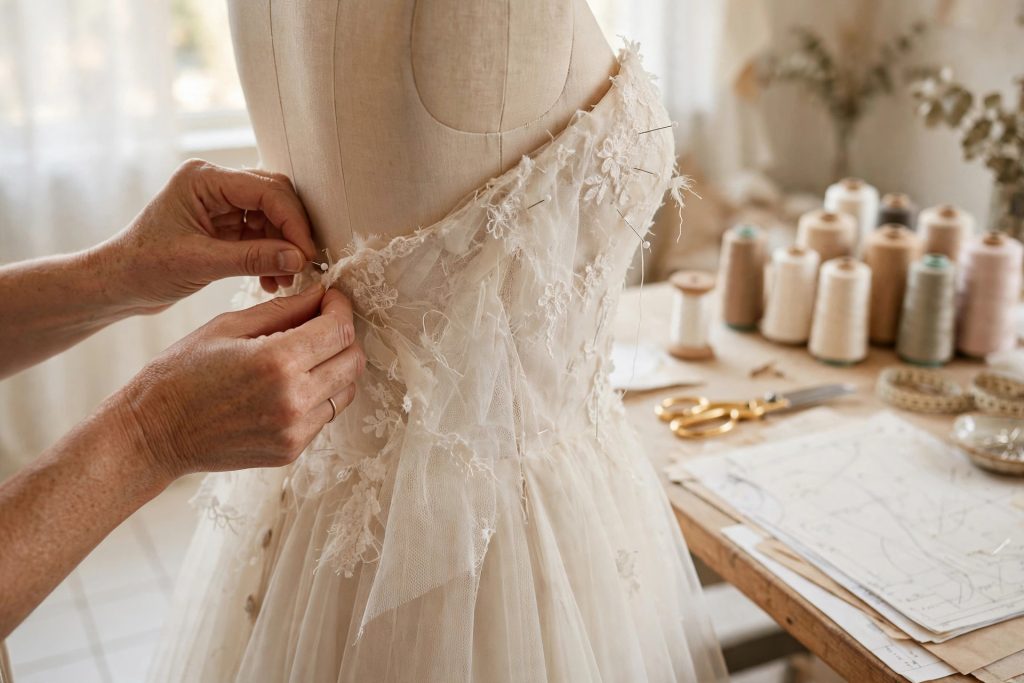
“How long does it take to make a custom wedding dress?” If you are a boutique owner, an online seller, or a startup bridal brand planning to order from a manufacturer, this is one of the first questions you need a straight answer to. The short answer: plan for 4 to 6 months from your first inquiry to dresses arriving at your door. That window breaks down into roughly 2–4 weeks for sampling, 6–10 weeks for bulk production, and 1–4 weeks for shipping and customs clearance. Below is a stage-by-stage breakdown of where the time goes, what can speed it up or slow it down, and how to plan your order so you are never caught short.
What Is the Typical Production Timeline for Custom Wedding Dresses?
A realistic door-to-door timeline for a custom (OEM) wedding dress order is 4 to 6 months; semi-custom (ODM) orders based on existing designs can be 1 to 2 months faster. Here is how that time is normally distributed:
| Stage | Typical duration |
|---|---|
| Sampling (first sample + revisions) | 2–4 weeks |
| Pre-production sample and approvals | 1–2 weeks |
| Bulk production | 6–10 weeks |
| Quality inspection and packing | 3–7 days |
| Shipping and customs clearance | 1–4 weeks |
These are industry-typical ranges, not guarantees — your exact timeline depends on design complexity, order size, fabric availability, and the factory’s schedule. Always confirm the schedule in writing before you pay a deposit.
How Long Does the Sampling Stage Take?
Expect 10 to 20 days for the first sample of a custom wedding dress, and budget for one to two rounds of revisions before the design is locked. Sampling is where the factory turns your tech pack, sketches, or reference photos into a physical dress, and it is the stage most new buyers underestimate.
Three things decide how long sampling takes. First, the quality of your inputs: a clear tech pack with measurements, fabric specs, and construction notes gets you a usable first sample much faster than a single inspiration photo. Second, fabric and trim availability: standard satin, tulle, and lace are usually in stock, but a specific embroidered lace or beaded appliqué may need to be ordered or dyed, which can add one to two weeks on its own. Third, handwork: heavy beading, 3D florals, and intricate draping are hand-done and slow by nature.
Once you approve the development sample, the factory makes a pre-production (PP) sample — the “golden sample” sewn from the actual bulk fabrics. Mass production only starts after you sign off on it, so treat PP approval as a hard milestone in your calendar.
How Long Does Bulk Production Take After Sample Approval?
After the PP sample is approved, most wedding dress factories need 45 to 75 days to complete bulk production. This is the longest single stage, and it is largely fixed: patterns must be graded across sizes, fabrics cut, bodices constructed, skirts assembled, and every dress finished, pressed, and checked.
A bigger order does not scale the timeline linearly. Going from 100 to 300 pieces of the same style typically adds days or a couple of weeks, not months, because the setup work — pattern grading, marker making, machine settings — happens once. What really stretches production time is complexity: hand-sewn beading and embroidery can double the sewing time of a plain satin gown, and designs with many layers of tulle or structured corsetry move through the line more slowly.
Factory capacity matters too. If you order during peak season (more on that below), your production slot may start later than the day you approve the sample. Ask the factory for a written production schedule with start and finish dates, not just a duration.
How Long Does Shipping from the Factory Take?
Express air shipping from China to the US, Europe, or Australia typically takes 7 to 12 days door to door; sea freight takes 25 to 40 days, plus 2 to 5 days for customs clearance. Most wedding dress buyers choose express air or air freight because dresses are high-value and relatively light, and the cost difference per piece is small compared with the risk of a late season.
One detail many first-time buyers miss: clarify who handles customs. A DDP (Delivered Duty Paid) quote means the factory or forwarder clears customs and pays duties for you; an EXW or FOB quote means you arrange freight and customs yourself. If your factory quotes EXW, line up a freight forwarder early — customs paperwork is not something to figure out the week your dresses land.
What Causes Most Manufacturing Delays?
Four culprits account for the vast majority of timeline overruns: fabric sourcing, slow approvals on the buyer’s side, mid-production design changes, and peak-season capacity.
1. Fabric and trim sourcing. If your design needs a specific lace, beaded fabric, or custom-dyed lining, sourcing can stall everything before cutting even begins. Whenever possible, ask the factory to confirm fabric availability — and get swatches — before the sampling clock starts.
2. Slow sample approvals. The factory cannot move forward until you approve each sample. Every week a sample sits on your desk is a week added to your timeline. Build internal review time into your plan, and designate one decision-maker so feedback does not go through three rounds of internal debate.
3. Design changes after approval. Changing the neckline, skirt shape, or fabric after the PP sample is approved effectively restarts part of the process. Minor tweaks are normal; structural changes are expensive in both time and money.
4. Peak season. Wedding dress factories are busiest from late summer through early winter, when buyers stock up for the spring wedding season, and capacity tightens again before major holidays. If you must order in peak season, add a two- to three-week buffer to every estimate.
How Far in Advance Should You Place Your Order?
Start 6 to 8 months before you need the dresses in hand, and plan backwards from your retail date. Working backwards is the most reliable method: take the date the dresses must be on your racks, subtract shipping and customs time, subtract bulk production time, subtract sampling time, and add a two- to four-week buffer for the unexpected. The date you land on is your latest inquiry date — not your deposit date.
One calendar event deserves special attention: Chinese New Year. Most Chinese garment factories close for two to four weeks around late January or February, and production lines take another week or two to ramp back up. If your timeline crosses that window, add at least a month to your plan or shift your order earlier.
If you are new to ordering custom dresses, it also helps to understand minimum order quantities before you start — MOQ and timeline planning go hand in hand, since sampling fees and production slots are quoted per style.
Frequently Asked Questions
Can I get custom wedding dresses made in 30 days?
Some factories offer rush service with a surcharge, but 30 days is realistic only for very simple designs made from in-stock fabrics with no handwork. For a genuinely custom design, rushing usually means skipping revision rounds, which raises the risk of fit and quality problems. If your deadline is tight, ask about semi-custom options based on the factory’s existing designs instead.
Does a smaller order mean faster production?
Not exactly. Setup work — pattern making, grading, fabric sourcing — takes the same time whether you order 50 or 500 pieces. That said, small orders are often easier to slot into a factory’s schedule between larger runs, so they can start sooner even if they do not finish proportionally faster.
What is the difference between a development sample and a pre-production sample?
The development sample is the first physical version of your design, used to check the look, fit, and construction. The pre-production (PP) sample is made later, from the actual bulk fabrics and trims, and serves as the quality reference for the entire production run. Bulk production should never start without your written PP approval.
How does the timeline differ for women’s dresses versus wedding dresses?
Standard women’s dresses are generally simpler to construct than bridal gowns, so both sampling and production run shorter — often 3 to 4 months door to door for custom orders. If you are developing both categories, you can read more about our women’s apparel OEM/ODM services to see how the process compares.
Planning a custom wedding dress order and want a realistic schedule for your designs? Contact us with your sketches or reference photos and your target delivery date, and we will map out a timeline — including sampling, production, and shipping — before you commit to anything. You can also browse our wedding dress wholesale catalog for designs that can ship on a shorter, semi-custom timeline.