“The dresses weigh almost nothing. So why is the air quote the price of a small car?”
That is the buyer, on the phone, looking at a freight invoice for long sleeve ruched maxi dresses, the BTFBM-style fall dress every boutique seems to be moving for winter wedding season. And the answer I give, in some version, several times a week from October onwards, is that the airline is not charging for the dresses. The airline is charging for the air inside the cartons, and a ruched maxi packs a remarkable amount of air per dress.
“But we weighed them. Three hundred and fifty grams each.”
They did weigh them, and the scale was telling the truth, and it did not matter. Air freight charges on whichever is greater, the real weight or the volumetric weight, and volumetric weight is just the carton’s dimensions multiplied out and divided by a number the carrier chooses. A knit maxi at three hundred and fifty grams, folded into a carton with its ruching sprung back to full puff, occupies the space of something several times its weight. Forty cartons of that is not a light shipment. It is a large shipment that happens to contain light dresses, and those are different invoices.

“Can’t you just squash them?”
Every buyer asks this, and the honest answer is that ruching is the one construction that refuses to be squashed on command. Ruching is gathering, fabric drawn up along seam lines and fixed there, and the gathering is springy by design, it is what makes the dress forgive a waist seam that sits a centimetre off and hide the stitching shortcuts a plain bodycon would announce to the whole room. Press a ruched dress flat in the morning and by the time the carton is sealed it has pushed itself back toward its gathered shape, taking its space with it. Vacuum packing, which flattens a plain knit beautifully, fights the elastic in the gathers and loses slowly over a long flight, and a carton that arrives re-inflated has paid volumetric rates for the privilege of the fight.
“Sea, then. Sea is cheap.”
Sea is cheap, and sea is slow, and the winter wedding season does not move its dates for anybody’s container. A maxi dress ordered in autumn for December events has to leave while the calendar still says autumn, because the ocean leg is only the first portion of the journey. There is a port at the far end, and a customs queue, and a truck, and a warehouse in its busiest fortnight of the year, and each of those has its own idea about how long things take in December. Buyers who plan sea freight for seasonal dresses in September are planners. Buyers who discover sea freight in November are donors, paying air rates to rescue a season they already sold.
Working the distribution side teaches you the calendar from the wrong end, from the delivery date backwards, and the dresses themselves blur together after a while. What stays distinct is the shape of each product’s mistake. A flat knit dress’s mistake is weight, somebody ordered too many and the kilos added up. A ruched maxi’s mistake is volume married to a deadline, a dress that cannot be compressed, cannot be rushed cheaply, and is wanted for specific weekends in December and January after which its value drops off a cliff made of unsold party dresses.
The long sleeves on this fall version add a wrinkle the summer maxis do not have, and it is worth a sentence because it changes how the dresses should be packed. Sleeves on a ruched knit dress crease at the elbow if they are folded hard under the bodice weight, and they arrive looking slept in, which for a winter wedding guest dress means steaming labour at the destination that nobody budgeted. Packed with the sleeves laid along the dress rather than under it, the carton gets slightly bigger and the dresses arrive wearable. Freight people get blamed for creased sleeves they warned about in writing. It is a living.

“So what would you do, if it was your money?”
Buyers ask this too, usually after the second quote, and the distribution answer is boring enough to be true. Split the season. The core sizes and the colours that will definitely sell go by sea, early, while there is still slack in the calendar for a port to have a bad week. The top-up order, the sizes that ran out, the colour that turned out to be the one, goes by air in December at the painful rate, in small quantity, because a small painful shipment that sells is cheaper than a large cheap shipment that arrives in January as stock for a season that has left. Deadstock party dresses clear in two waves, the first at a modest discount while the events are still happening somewhere, the second at whatever the market feels like, and the second wave is where margins go to be buried.
Container economics have their own version of the same lesson for anyone ordering at volume. A ruched maxi’s carton volume means a container fills by space long before it fills by weight, so the per-dress cost of a full container depends on carton dimensions more than on how many dresses a buyer wishes fitted inside it. Shaving two centimetres off a carton length, multiplied across hundreds of cartons, is real money, and it is money decided at the packing table, by how the dresses are folded, long before anyone negotiates a freight rate. Buyers negotiate rates for sport and ignore carton dimensions, which is roughly like negotiating the price of petrol and ignoring the size of the tank.
No, that comparison is not quite fair, and I will walk it back a little. Buyers ignore carton dimensions because nobody shows them the dimensions until the invoice, and the invoice is written in a language of kilograms that makes a volume problem look like a weight problem. The factory knows the carton size. The forwarder knows the divisor. The buyer knows the dress weighs three hundred and fifty grams and feels, reasonably enough, that somebody is robbing them. Nobody is robbing them. That is the sad part. The air inside the carton is genuinely being flown across an ocean and genuinely costs what flying things costs.
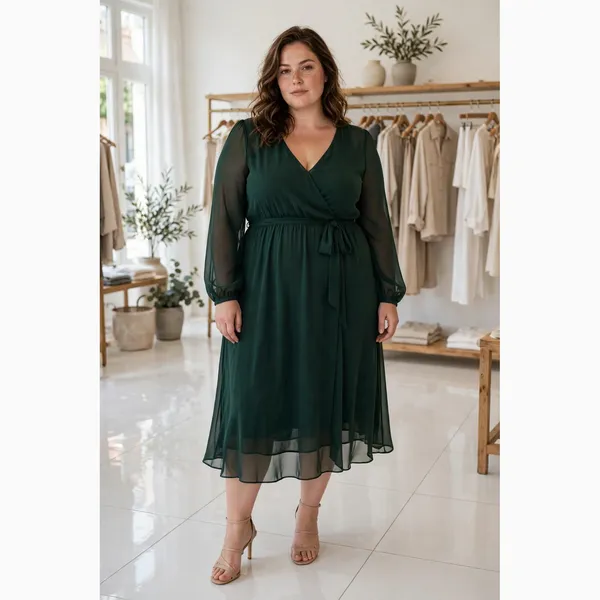
For boutiques planning the guest-dress rail, the practical comparison sits between styles as much as between carriers. A ruched maxi and a flat chiffon maxi of similar weight are different freight products wearing similar price tags at the factory gate, and the range in the women apparel factory catalog is worth reading with a carton’s eye as much as a customer’s. The style shown in the third photograph here, a long sleeve chiffon dress, folds flatter, steams faster, and forgives a late shipment slightly better, because chiffon tolerates being packed tight in a way gathered knit simply refuses to.
The call ends the way the calls end
“So I should have ordered in September.”
Yes. That is the whole conversation, most years, arriving in November wearing an air quote. The dress did nothing wrong. The ruching that makes it sell, that hides the construction shortcuts and flatters the customer and photographs like a much more expensive garment, is the same ruching that fills the carton and empties the margin, and no carrier on earth offers a discount for a dress being flattering. Freight is priced on geometry. Fashion is priced on everything except geometry. The two industries meet in my inbox every autumn and act surprised at each other, every single time.
What I cannot solve from the distribution side is the part buyers actually care about, which is whether the dress sells through before the season turns. A warehouse can hold a late dress. It cannot hold a date. Winter weddings happen on their weekends whether the cartons made it or not, and a maxi dress that misses its weekends becomes a January conversation about discounts, which is a conversation I also have, in a different tone of voice, with the same people, about the same dresses, now travelling in the opposite emotional direction at clearance rates.
There is also the carton count nobody thinks about until the warehouse calls. Forty cartons of maxis do not stack the way forty cartons of folded knit tops stack, because the dresses push outward against the cardboard as the gathering settles, and a carton that left the factory square arrives at the warehouse slightly barrel-shaped and unwilling to sit neatly on a pallet. Warehouses charge for the space a pallet actually occupies, not the space it occupied in a theory. So the volume gets billed twice in a sense, once by the airline that flew the shape and once by the building that stores it, and the buyer pays both times while insisting the dresses weigh almost nothing, which by then everybody in the chain can recite from memory.
He will order in September next year. They all say that, on the November call, and about half of them mean it, and the other half will be back on the phone next November with a new dress and the same invoice and the same disbelief that air can cost this much. I will give the same answer. The dresses weigh almost nothing. The cartons are big. You are paying for big. Some truths just get delivered annually, like the season itself.
Questions buyers keep asking about this one
Forty cartons, dresses at 350 grams each. Why is the air freight quote so high?
Because air freight charges the greater of real weight and volumetric weight, and a ruched maxi’s cartons are mostly volume. The gathering springs back after packing, so each carton holds a light dress and a large amount of air, and the airline bills for the space the carton takes on the plane. Your scale told the truth. It just was not the measurement the invoice uses, which catches every first-time importer of gathered dresses exactly once, usually in November.
Can’t the dresses be vacuum packed flat to cut the volume?
People try, and the ruching fights it, because gathered fabric on elastic keeps pushing back toward its gathered shape through a long flight. A plain knit dress stays flat and vacuum packing works beautifully on those. A ruched one re-inflates slowly and you have paid for compression labour to arrive at roughly the same carton. Packing the sleeves along the dress instead of under it saves more grief than vacuum bags do, honestly, since hard-folded sleeves arrive creased at the elbow and somebody has to steam every unit.
Sea freight in November for December weddings. Tight, or impossible?
Tight in the way that a missed connection is tight, technically survivable and practically a donation to the airline when it fails. The ocean leg is only part of it. The far port, customs, the truck, and a warehouse in its busiest fortnight all take their turn, and winter wedding dates do not slide for a late container. The buyers who make sea work ordered in September while calling it pessimism. It was not pessimism. It was the calendar, read from the delivery date backwards, which is the only direction freight has ever made sense.