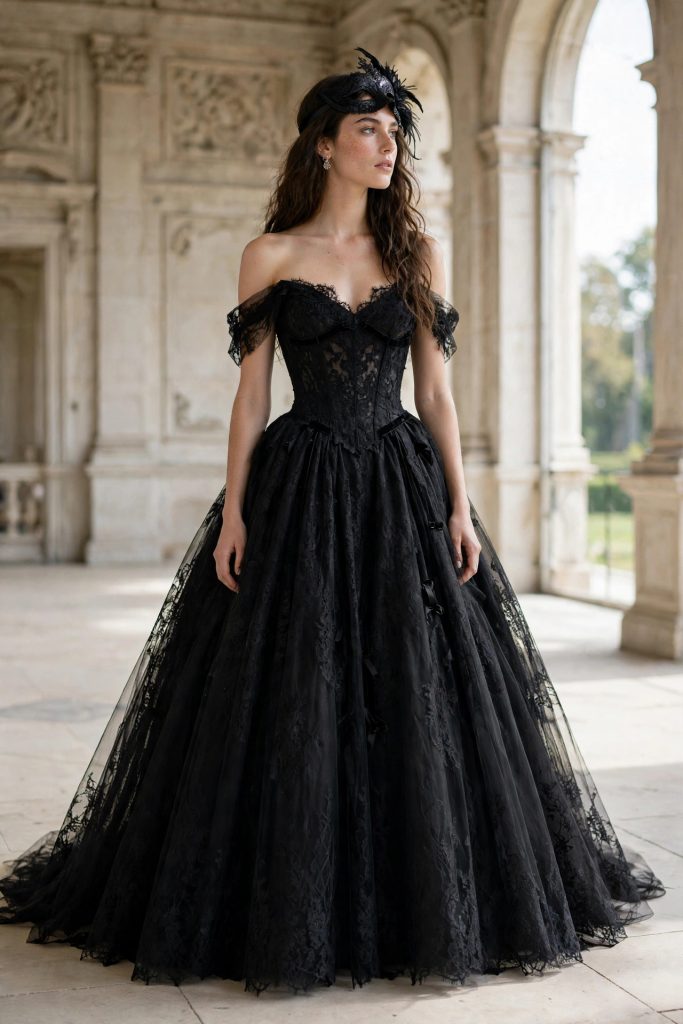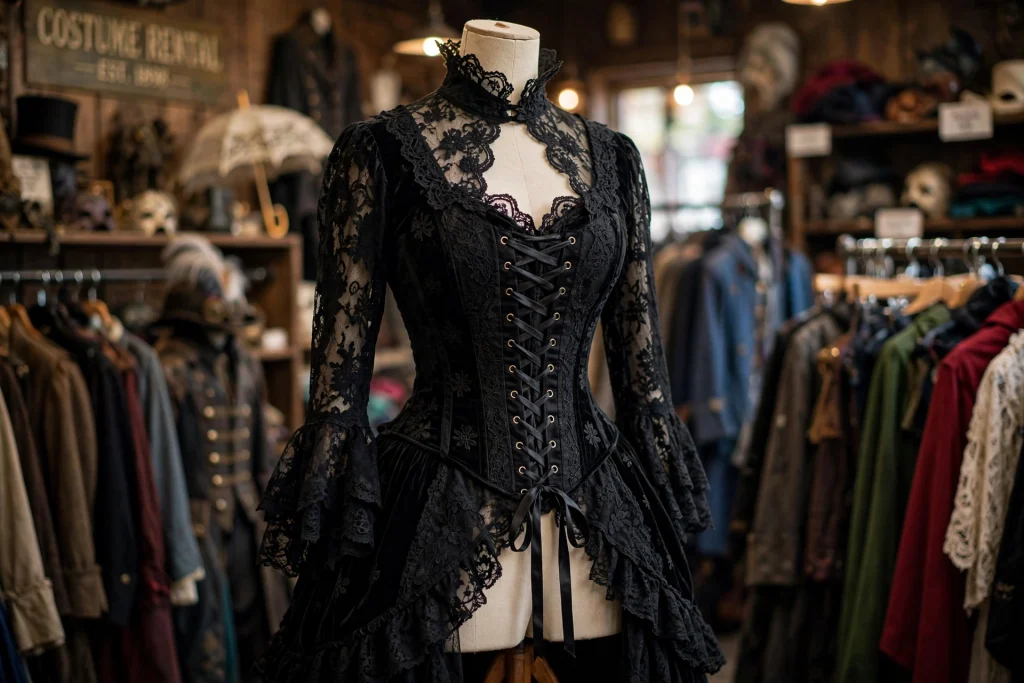
Here is a question I have carried through more sample rounds than I can count, and I still do not have a clean answer for it. A halter neckline hangs a whole bodice from the back of the neck. A corset bodice exists to hold a body firmly from below. Put the two together in one sleeveless lace dress, the gothic halter corset style in this review, and the garment is being pulled up by the neck and pulled in at the waist at the same time, by two systems that do not naturally agree. Which one is supposed to win? Ask the question in a sample room and you will get confidence. Watch the dress on a moving body for an hour and you will get the truth, which is that the answer changes as the evening goes on, and the dress has to be built for the change.
Start with the neck band, because the neck band is the suspension bridge of the whole garment. Every gram of a boned, lace-covered bodice travels up the halter straps and concentrates where the band closes behind the neck. A band cut soft, without interfacing, behaves politely for the first photograph and then begins to roll under load, twisting into a cord that digs in exactly where the wearer can least ignore it. The fix is structural and unglamorous. The band needs a firm inner layer, stitched so it cannot roll, and a closure, hook or button, set where the band ends meet under tension rather than where they meet at rest on a table. A sample checked only at rest will pass a closure that fails at hour two. The honest sample check is to wear the dress, move in it, and look at the back of the neck in a mirror afterwards. If the band has rolled, the dress has told you its first secret.
The straps themselves carry a second secret at their base, where they dive into the bodice. That junction takes a diagonal pull every time the wearer raises an arm, and on a lace dress the junction is often finished as decoration, a motif placed prettily over the join. Decoration is not reinforcement. Under the motif there needs to be stitching that spreads the load into the bodice panels, a short bar of dense stitches or a backed patch, because lace ground alone, the net that the motifs sit on, tears progressively around a stress point. It does not rip dramatically. It opens, stitch by stitch, across several wearings, which is the worst failure schedule a garment can have, because it completes itself after the returns window and inside the customer’s affections.
Maybe the corset is not in the lace at all
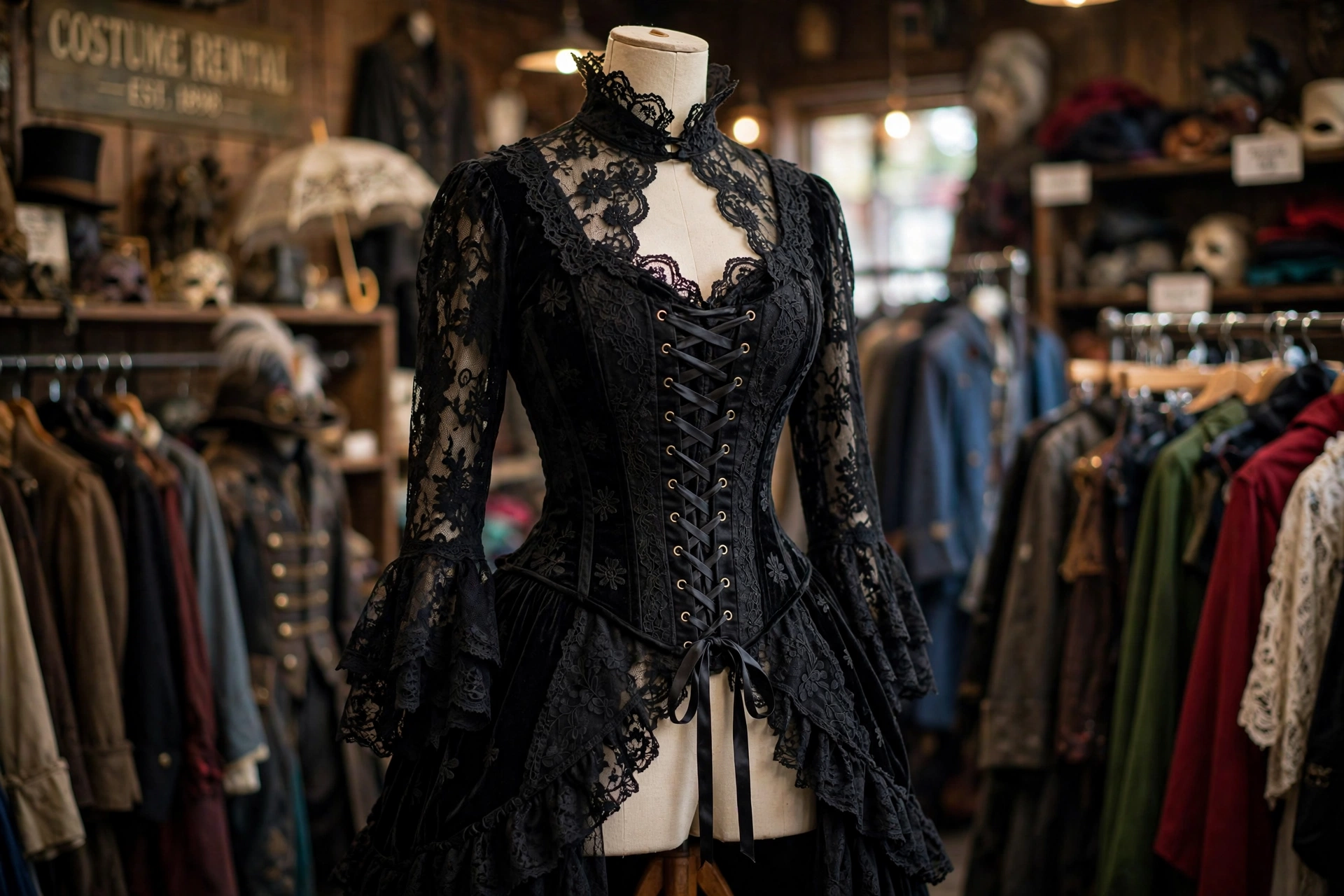
One possible answer to the opening question is that the two systems never actually meet, because a well-built corset lace dress is two garments pretending to be one. The structure, the boning, the firm panels, the lacing that does the holding, lives in an inner bodice made of materials chosen for strength. The lace lives on top of it as a skin, chosen for appearance, carrying no load at all. When this division of labour is respected, the dress works. The boning channels end on lined, stable fabric, never on lace alone, because a boning tip pressing against net will find its way through the net in time. The lacing at the back runs through a backed strip hidden under the lace edge, so the eyelets anchor in something with a weave tight enough to hold them.
When the division is not respected, which is to say in the versions built down to a price, the lace is asked to do structural work it cannot do. Eyelets punched straight into lace ground deform first into ovals and then into tears, because each lacing pull concentrates on the few threads of net around the hole. The tell, at sample stage, is easy to check and rarely checked. Turn the dress inside out. Look at what the eyelets are actually set into, and what the boning actually rests against. The inside of this dress is a more honest document than the outside. The outside is a photograph waiting to happen. The inside is the engineering, confessing.
The sleeveless armhole belongs in the same confession. A sleeveless lace dress has no sleeve to finish the armhole, so the edge is often the lace’s own scalloped border, placed along the armhole curve. That border is a motif edge, and cutting it to a curve means cutting through motifs, which then have to be re-joined, overlapped and re-stitched by hand so the pattern reads as continuous around the arm. That hand finishing is slow, and it is one of the first places a cheaper version saves money, by binding the armhole with a plain strip instead and letting the lace end where it ends. Neither choice is a scandal. But they are visibly different dresses at conversational distance, and a buyer comparing two quotes for this style should know which armhole she is buying, because the difference accounts for a real share of the price gap and most listings never mention it.

Or maybe the lacing is the truce
A third possibility, and the one I lean toward on good days, is that the back lacing is where the halter and the corset negotiate. A zip fixes a bodice at one circumference and lets the neck band carry whatever does not fit. Lacing adjusts. It lets the waist take more of the load on a body that needs it there, and less on a body that does not, which means the same dress distributes its weight differently on different wearers instead of imposing one distribution on all of them. That adjustability is the strongest argument for the corset halter as a commercial style. It forgives sizing uncertainty, which is why rental shops and costume-leaning retailers like this construction for gothic and Halloween-adjacent stock, where one dress may be worn by several bodies in a season.
No wait. Forgives is too generous, and I have watched enough fittings to know it. Lacing forgives circumference. It forgives nothing about length. A halter bodice that is too long in the torso will fold at the waist no matter how artfully it is laced, and one that is too short will pull the neck band down until the closure complains. The lacing can redistribute the dress around the body. It cannot change the distance between the neck and the waist, which is set in the pattern and graded, or not graded carefully, size by size. Buyers checking samples of this style should measure that distance, neck point to waist seam, on at least two sizes, and compare it against the size chart’s own torso figures. It is the measurement this silhouette lives or dies by, and it is the one most often missing from the spec sheet entirely.
There is also the matter of what the lace is lined with, and it is not a small matter. Black lace over a nude or pale lining reads as pattern first and dress second, the motifs standing out in relief. The same lace over black lining reads as texture, quieter, and more forgiving of a motif that repeats imperfectly. Gothic versions of this style almost always choose the dark lining, which means the quality question changes. With contrast gone, what remains visible is the regularity of the motif repeat and the finish of the edges, the two things a buyer can actually judge in a sample without any equipment at all.
The black lace itself deserves a colder look than it usually gets. Black lace over a black lining is a texture, not a contrast, and it reads in person as depth, motifs floating on a darker ground of the same colour. Photographed carelessly it reads as a flat black shape, and photographed with hard flash it reads as grey where the flash lifts the net. Reviews of this category divide sharply on exactly this, some calling the lace rich and others calling it dull, about dresses that may be identical. The variable is the light in the reviewer’s room as much as the lace on the dress. A shop selling this style should photograph it the way a customer will first see it, in ordinary indoor light, and accept the duller photograph as the honest one. The dress that survives an honest photograph will survive the evening. The reverse is not guaranteed.
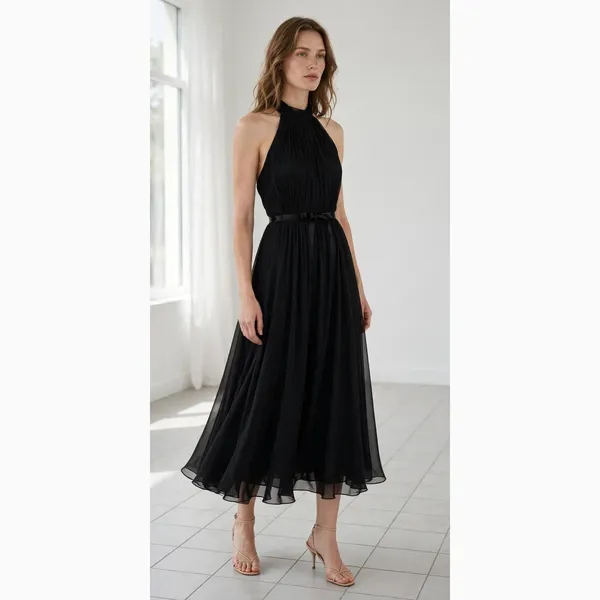
Terms, briefly, because the construction talk should not bury them. This style sits on the boundary the trade argues about. Sold as a wedding style on this site it follows the wedding frame, five pieces per style with sizes and colours mixable, and a single gown can be custom made for one bride. Sold as an occasion or costume-adjacent style in the women’s range, the ten piece per style minimum applies. Which frame a given order falls under should be settled with the order, not assumed from the photograph. The site’s own guide to judging this construction, how to tell corset wedding dress quality, goes deeper on boning and lacing checks, and the bridal range itself is in the wedding dress wholesale catalog.
Questions buyers actually ask about corset halter lace dresses
Two hours into the evening, the neck band has rolled into a cord. Was it sewn wrong?
It was built soft, which is a construction choice rather than a sewing slip. The band carries the whole bodice, and without a firm inner layer it rolls under that load as the hours pass. At sample stage, wear the dress and move in it, then check the back of the neck in a mirror. A band that has started to roll in a fitting will finish the job at the event. Asking what the band is interfaced with is a fair question before an order. After the event it is just an explanation.
The eyelets in the lace back are going oval. Is that normal wear?
No. Oval eyelets mean the lacing load is being carried by lace ground, and lace ground is a net, and nets open around stress points a few threads at a time. Eyelets in a soundly built version are set into a backed strip under the lace, so the load lands on tight-woven fabric. Turn a sample inside out and look at what the eyelets sit in. That one look, ten seconds, separates the construction that lasts a season from the construction that lasts until the third lacing, and no photograph of the back will ever show it.
Five pieces or ten for this style. Which minimum is real?
Both, depending on which frame the order is placed in. As a wedding style on this site, five pieces per style is the standing minimum, sizes and colours mixable, and a single gown can be custom made. As a women’s occasion style, ten pieces per style applies. The dress does not change. The category it is ordered under does, and the time to settle the category is before the quote, while it is still a question. Afterwards it becomes a negotiation, and negotiations about minimums are the least enjoyable conversations in this trade.
So, which system wins, the neck or the waist? After all these sample rounds my honest answer is that the question is wrong in an interesting way. The dress works when neither wins, when the load is shared so evenly that the wearer stops thinking about the garment, and it fails, slowly and politely, the moment one system starts doing all the work. I cannot tell that from a photograph. I am not sure anyone can. Inside out, on a body, at hour two. That is still the only examination this silhouette has ever really passed or failed, and I no longer trust any shorter version of it, including, on my tired days, my own.