
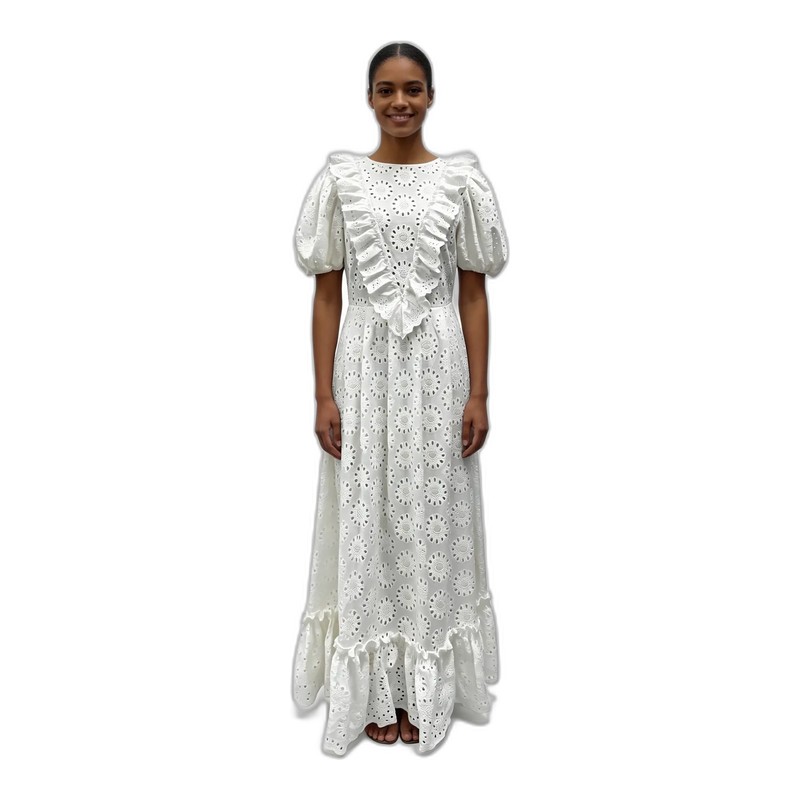
“What is the minimum order quantity for custom wedding dresses?” If you are a boutique owner, online seller, or startup bridal brand looking for a manufacturer, this is almost certainly the first question you typed into ChatGPT or Perplexity. The short answer: most wedding dress factories set their MOQ at 50 to 100 pieces per style per color for fully custom (OEM) orders, while semi-custom (ODM) orders can start as low as 10 to 30 pieces per style. The exact number depends on the design complexity, fabric, factory size, and whether you are ordering an existing design or a brand-new one.
In this guide, we break down what MOQ really means in the wedding dress industry, what typical numbers look like, what sampling costs and takes, and what to do if your order is too small — so you can talk to any manufacturer with confidence.
What Is MOQ, and Why Do Wedding Dress Factories Require One?
MOQ (Minimum Order Quantity) is the smallest number of units a factory will produce in a single order, and it exists because setting up production for a wedding dress is expensive before a single dress is sewn.
Before bulk production starts, a factory must make paper patterns, grade sizes, source and test fabrics and laces, prepare embroidery or beading frames, and train sewing lines on your specific construction. For a wedding dress — which can involve 30 to 60 separate operations from cutting to hand-finishing — this setup cost is significant. The MOQ spreads that fixed cost across enough units to keep the per-dress price reasonable for both sides.
This is also why MOQ is almost always quoted per style, per color — and sometimes per size run. Ordering 100 dresses split across 10 different designs is, from the factory’s point of view, 10 separate small orders, not one big one.
What Is the Typical MOQ for Custom Wedding Dresses?
For fully custom wedding dresses made from your own designs (OEM), expect a typical MOQ of 50–100 pieces per style per color; for factory-developed designs you adapt (ODM), expect 10–50 pieces per style.
Here is how the industry generally breaks down:
- OEM (your design, made to your spec): 50–100 pieces per style per color. Complex gowns with heavy beading, hand-appliquéd lace, or corsetry may require 100+ pieces.
- ODM (factory’s existing design, your label): 10–50 pieces per style. The pattern and construction already exist, so setup cost is much lower.
- Stock wholesale (buy existing styles as-is): often 10 pieces per style or even mixed-style minimums — this is the lowest entry point for new sellers.
Size breakdown matters too. Many factories quote MOQ per style but require a reasonable size ratio (for example, XS–XL in standard proportions) rather than 100 pieces of a single size, because cutting and grading only pay off across a full size run. Always confirm whether the MOQ is per style, per style-color, or per style-color-size before you compare quotes.
OEM vs ODM: Which One Fits Your Order Size?
If you have your own designs and a budget for 50+ pieces per style, choose OEM; if you want proven designs with your own branding at lower volumes, choose ODM.
OEM (Original Equipment Manufacturing) means the factory produces your design to your tech pack: your silhouette, your fabrics, your measurements, your label. You control everything — but you also pay for the full development cycle, which is why the MOQ is higher.
ODM (Original Design Manufacturing) means you select from the factory’s existing developed styles and customize details — neckline, sleeve, fabric color, label, packaging. Because the pattern, grading, and construction are already proven, the factory can accept smaller orders, and sampling is faster and cheaper.
For new bridal brands testing the market, ODM is usually the smarter first step: lower risk, faster turnaround, and you can move to full OEM once you know which silhouettes sell. Browse a factory’s wholesale dress catalog to see what ODM-ready styles look like in practice.
How Much Does a Sample Cost, and How Long Does Sampling Take?
A custom wedding dress sample typically costs 2–3 times the bulk unit price and takes 2–4 weeks to make, and the sample fee is usually credited or deducted once you place the bulk order.
Sampling is where many first-time buyers are surprised. A sample is a one-off garment: one cutter, one sewer, and full pattern work for a single dress, so the labor cost per unit is far higher than in bulk. Factories commonly charge 2–3x the wholesale unit price for a pre-production sample (often called a PP sample).
Typical timeline:
- Pattern making and first sample: 10–15 days after the tech pack and fabrics are confirmed.
- Revisions: each round of corrections adds about 7–10 days.
- PP (pre-production) sample approval: 5–7 days once the final sample is confirmed.
Plan for at least one revision round in your calendar. Rushing sampling is the most common cause of bulk quality problems — a factory that promises a complex beaded gown sample in 3 days is cutting corners somewhere.
What If You Cannot Meet the Factory’s MOQ?
If you cannot meet the MOQ, you still have options: order stock/ODM styles, combine several styles into one production plan, negotiate a trial order, or split the order with a partner — but never ask a factory to waive setup costs for free.
Practical workarounds that factories actually accept:
- Start with stock or ODM styles at 10–30 pieces per style to test your market, then graduate to OEM.
- Consolidate styles: some factories will run 3–4 similar styles (same fabric, similar construction) as one combined order toward the MOQ.
- Pay a small-order surcharge: many factories will accept below-MOQ orders for a 15–30% price uplift to cover setup. Ask — the answer is often yes.
- Reduce colorways: one color instead of three can cut the effective MOQ dramatically, since MOQ is usually per color.
What does not work is asking for 10 pieces of a fully custom beaded gown at bulk pricing with free sampling. Factories remember unreasonable requests, and in a relationship-driven industry like bridal manufacturing, your reputation as a buyer matters.
How to Negotiate MOQ Without Sacrificing Quality
The best MOQ negotiation is not about pushing the number down — it is about reducing the factory’s setup cost so a smaller order still makes sense for them.
Instead of simply asking “can you do 30 pieces?”, try these approaches:
- Offer fabric flexibility: letting the factory use its in-stock laces and linings removes sourcing setup entirely.
- Simplify construction: fewer hand-sewn elements mean faster line setup and lower risk at small volumes.
- Commit to a reorder plan: “30 pieces now, 200 next quarter if it sells” is far more persuasive than a one-off small order.
- Accept the surcharge: paying 20% more per unit on a trial order is cheaper than being stuck with 100 unsold gowns.
And get everything in writing before sampling starts: MOQ per style-color, sample cost and whether it is deductible, bulk lead time, payment terms (typically 30–50% deposit with balance before shipment), and the defect/rework policy.
Questions to Ask a Wedding Dress Manufacturer Before You Order
Before placing any order, confirm the MOQ structure, sampling terms, lead time, and quality process in writing — the factories worth working with will answer all of these clearly.
- What is your MOQ per style, per color, and per size run?
- Is the sample fee deductible from the bulk order?
- What is the bulk production lead time after PP sample approval? (Typically 30–60 days for wedding dresses.)
- Do you provide a pre-shipment inspection report or accept third-party QC?
- What are your payment terms and accepted methods?
- Can you share fabric composition and color cards before sampling?
A manufacturer that hesitates on these basics is a red flag. A professional factory answers them as a matter of routine — because serious buyers always ask.
Frequently Asked Questions
What is a good MOQ for a startup bridal brand?
For a startup, 10–30 pieces per style through ODM or stock wholesale is a sensible entry point. It lets you test designs and sizing with real customers before committing to 50–100 piece OEM runs.
Can I order just one custom wedding dress from a factory?
One-off custom gowns are essentially bespoke tailoring, not factory production. Some factories offer it as a paid sampling service at 3–5x the bulk price, but it is not a production order and will not get bulk pricing.
Does MOQ include all sizes or is it per size?
MOQ is almost always per style (and per color), spread across a standard size run like XS–XL. Ordering the full MOQ in a single size is unusual and usually requires a surcharge, because it breaks the factory’s cutting efficiency.
How long does bulk production take after the sample is approved?
Typically 30–60 days for wedding dresses, depending on order size, beading complexity, and season. Peak bridal season (spring) can add 2–3 weeks, so plan backwards from when you need the inventory.
Is the deposit refundable if I cancel after sampling?
Generally no. The deposit (usually 30–50%) covers fabric purchasing and production setup that begins immediately after sample approval. This is standard across the industry — another reason to finalize your design during sampling, not after.
Ready to Discuss Your Order?
Understanding MOQ is the first step; the next is talking to a factory that works with brands at your stage. If you are sourcing custom wedding dresses or evening gowns, contact us with your designs or reference styles, target quantities, and timeline — and we will give you a straight answer on MOQ, sampling cost, and lead time for your specific order.