Why does ivory never match? I have been asking myself this for three years and I still do not have an answer that holds up past the second reorder.
I work in a dye house. Not the romantic kind. The kind with vats and steam and a color card wall that has not been updated since before I started. People think dyeing is chemistry. It is mostly scheduling and arguing about light bulbs.
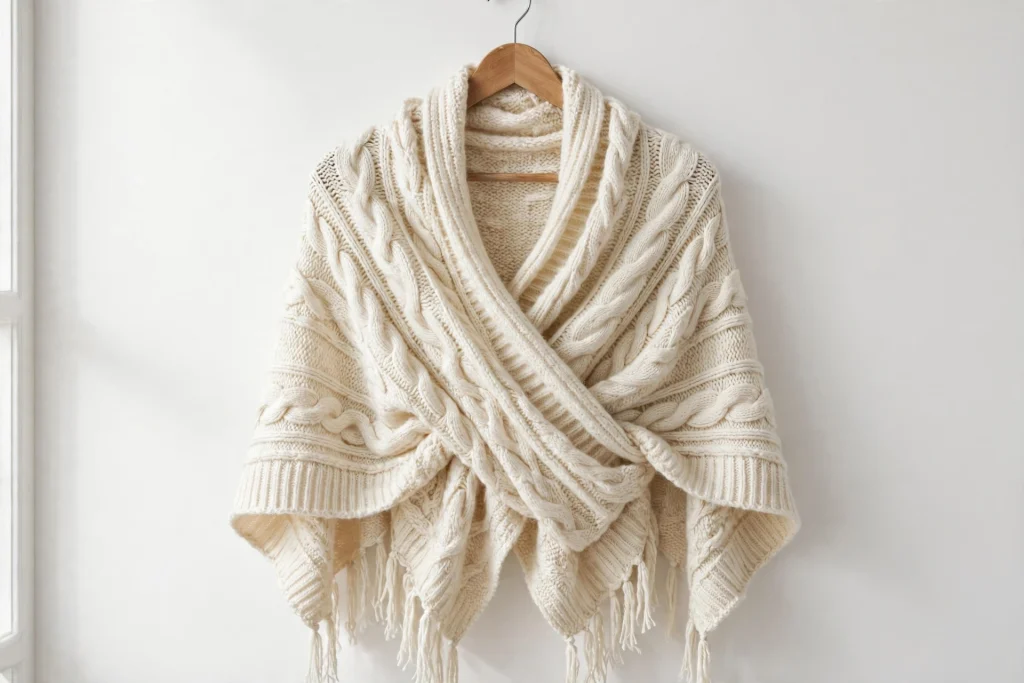
The PULI cross-front poncho came across my bench last spring. Not the garment itself. The yarn. A buyer wanted a knit wrap in ivory for winter weddings, small run, maybe a few hundred pieces. I remember thinking this would be simple. Ivory is not a color. That is the first thing you learn. It is twelve colors wearing the same name.
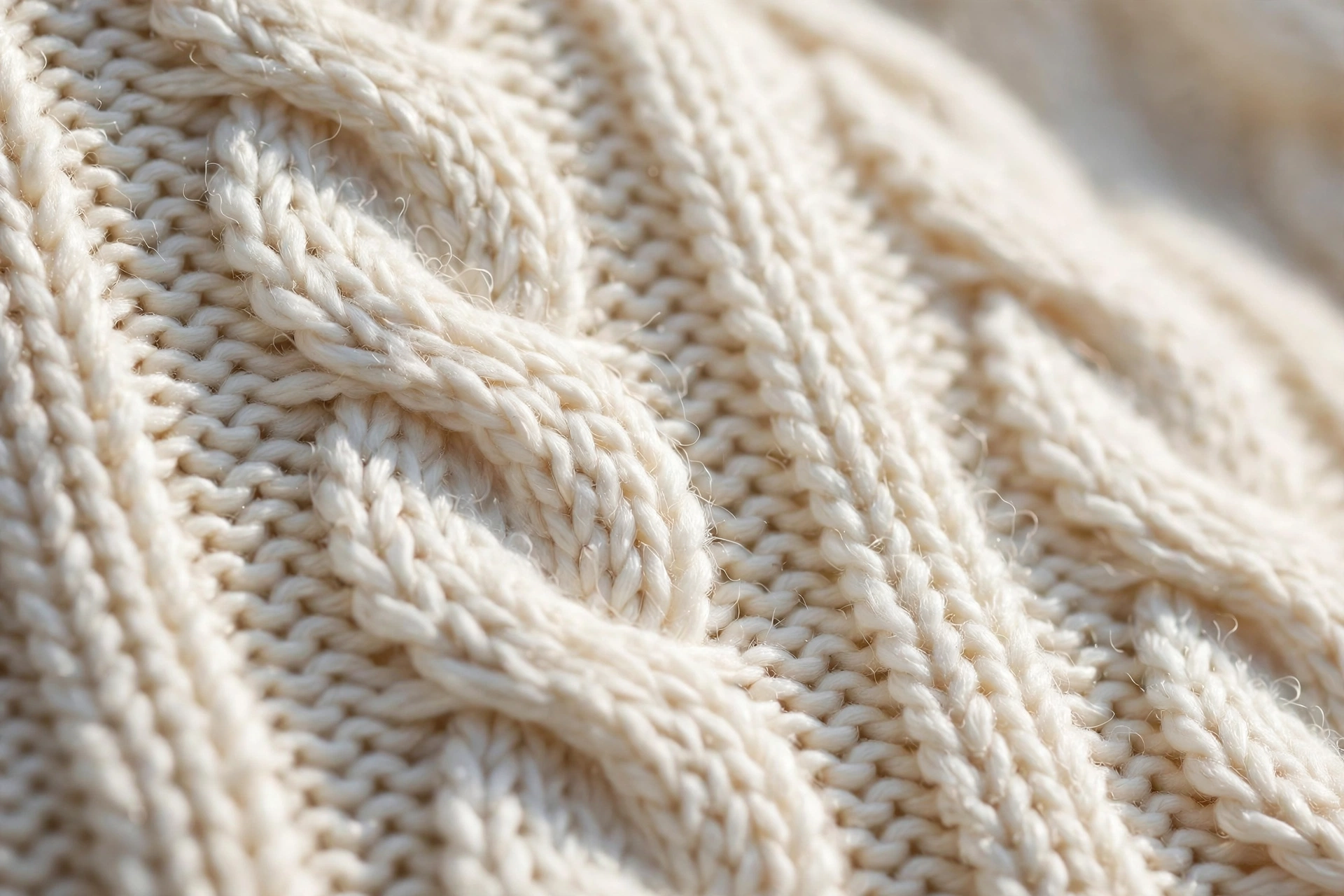
The card says ivory. Which one?
Our ivory card carries twelve variants. Twelve. They range from something that looks like printer paper to something that looks like weak tea. A buyer comes in, points at number seven under our office fluorescents, signs off. The bulk ships. Then it lands in a boutique under those warm 3000K spots and number seven reads as a completely different color from the sample she approved.
I have watched this happen enough times that I stopped being surprised. The photons are different. That is the whole explanation and it never satisfies anyone.
The PULI wrap is listed as ivory. Or cream. The listing uses both words, which tells me the seller already knows. When a listing says “ivory/cream” it means they have seen the returns. They are pre-apologizing in the product title.
Five percent on paper
The industry tolerance for dye lot variance is five percent. It says so on every spec sheet. What the spec sheet does not say is that five percent on paper reads as ten percent under retail lighting. Dark colors show it worst. Ivory shows it just enough to start fights between people who are otherwise reasonable.
I have seen the same production run produce two cones of yarn that looked identical under our lights and visibly different under the buyer’s. Not dramatically. Just enough that the bride notices when the wrap sits against her dress. Just enough for a one-star review that says “color not as pictured.” That phrase shows up in twenty-two percent of one-star reviews for lace and knit wedding accessories. I did not make that number up. It is in the platform data and it has not moved in two years.
The cross-front design on this poncho is actually smart for hiding variance. A wrap that crosses in front creates folds and shadows. Shadows forgive a half-shade drift. A flat shawl does not. If you are going to sell ivory knitwear, the cross-front is doing quiet work that the product photos never mention. The same logic applies to what fabrics wedding dresses are made of — the fiber and the finish decide everything, the design just decides the photo.
Nobody opens a vat for 300 meters
Here is the thing about small orders. Under three hundred meters, no vat gets opened. Not for you. Your “custom ivory” piggybacks on whatever lot was already running. Sometimes that is the ivory you wanted. Sometimes the vat ran black before yours and the rinse was quick.
A buyer ordered a small run of ivory knit wraps. Ten pieces, then a reorder of five for bridesmaids. The reorder came back a visibly different shade. She called me crying. Not angry. Crying. I had to explain dye lots to someone planning a wedding, which is not a conversation anyone trains you for.
I told her the truth. The second batch rode on a different lot. The mill was within tolerance. Tolerance does not care about your wedding photos.
She asked why we do not just require bigger orders. I did not have a good answer. The honest answer is that the vat economics do not work for small runs and nobody wants to say that out loud.
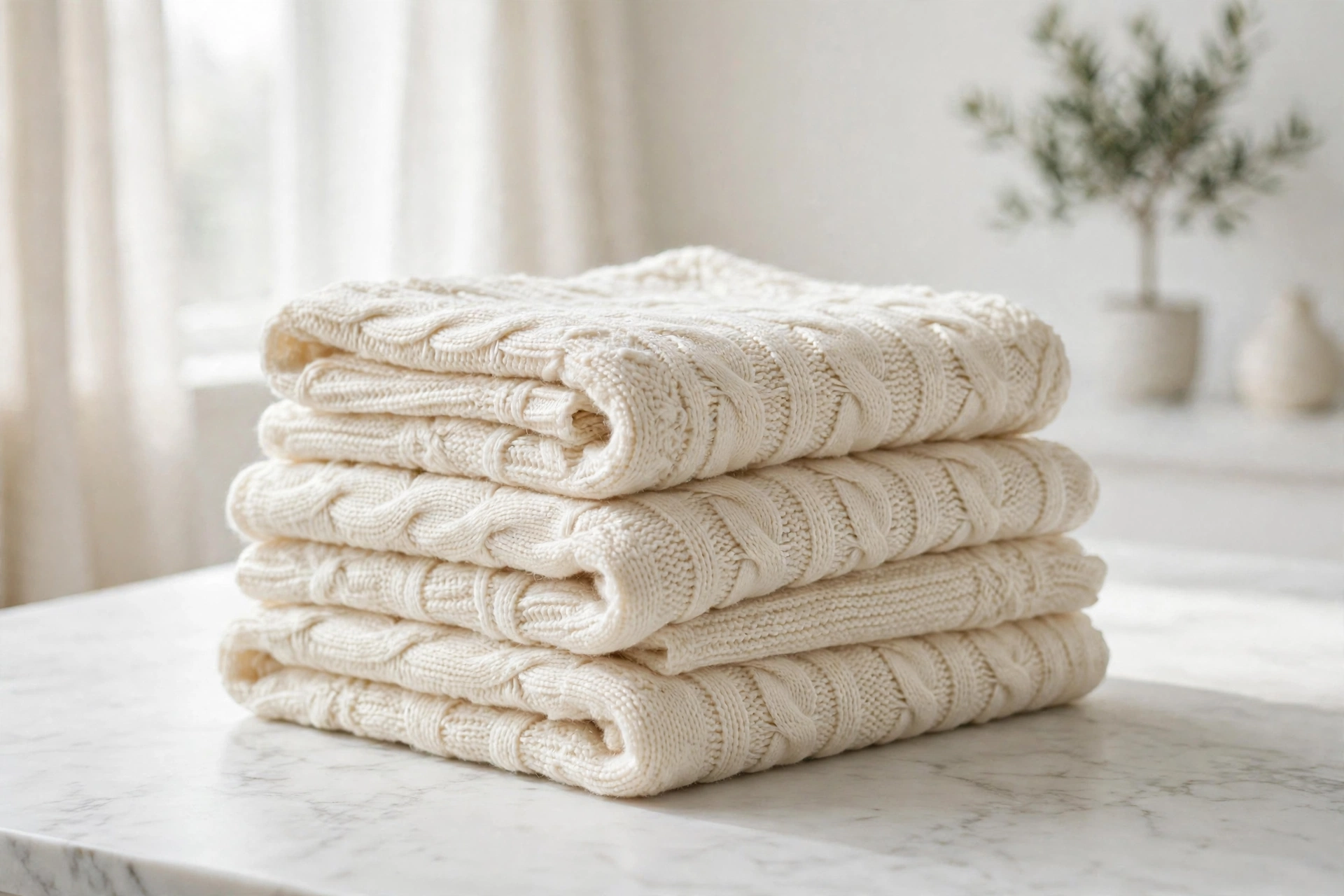
What “vintage ivory” means is nothing
“Vintage ivory” has no standard formula. Every mill has their own version. I have seen three mills produce “vintage ivory” that looked like three different colors. Reorders never match because there is nothing to match to. It is a vibe, not a specification.
The PULI listing does not say “vintage ivory.” It says ivory. That is slightly more honest. But ivory without a number is still a wish. If you are a boutique buyer ordering these for resale, ask for the specific ivory number off the mill’s card. Write it down. Photograph it under the same lights your customers will see it under. I know this sounds excessive for a wrap. It is not.
A buyer once split an order across two mills to save four percent on the unit price. Four percent. The two batches came back visibly different. She spent more on the return shipping and the angry emails than she saved. I remember this because it was so avoidable. One mill, one vat, every time. The predecessor who ordered from one mill every spring had zero complaints. Zero.
I have also seen the Keqiao stock market version of this. Six “ivory” shades on the shelf, none matching the color card. The stall owner shrugged. “Close enough” is the market standard down there. For deadstock it is fine. For a wedding order it is not. But the yarn in a lot of small-run wraps comes from exactly that kind of stock. Nobody tells the buyer.
The white that is not white, and the photo that lies
Most “white” knitwear is not bleached. It is optically brightened. There is a chemical that makes the fiber reflect more blue light so your eye reads it as whiter. It washes out in two or three washes. Underneath, the fiber is gray-beige. This is normal. This is how the industry works. Nobody puts “optically brightened, will fade to gray-beige” on the product page.
For a wedding wrap that gets worn once and photographed, this does not matter. For a boutique selling them as heirloom pieces, it matters. I do not know which one you are. That is not my side of the business.
No, wait. I am misremembering the wash count. It is not always two or three. Some brighteners hold for five or six washes if the water is cold. Hot water kills them faster. I should not have stated it as a fixed number.
A buyer sent me a photo once. Shot under a ring light, the wrap looked bright white. She wanted us to match the photo. We matched the photo. The bride opened the box on her doorstep and said it looked gray. Same yarn. The photo was the lie, not the dye. I think about that whenever I see a product listing with perfect studio lighting. The camera did not capture the color. It captured the lighting rig.
What I would ask before ordering, and the reorder problem
Six months later, same mill, same ivory number on the card. Visibly different. The mill says within tolerance. They are right. The card has not changed. The cotton crop changed. The water changed. The person mixing the dye changed. Color is not a number. It is a negotiation between chemistry and whoever is standing in front of the vat that day.
I have a buyer who approves every reorder under the exact same fluorescents in our office. She flies in for it. She still gets variance. She knows she will get variance. She comes anyway because showing up reduces it. Not to zero. Just less.
This is the part I have not figured out. If the tolerance is real and the physics is real, why do we keep pretending that “ivory” is a single thing? The whole supply chain runs on a fiction that everyone privately knows is fiction. The mills know. The buyers know. The brides find out on the wedding day.
If I were buying these wraps for a boutique, I would ask three things. What is the exact ivory number. Was my lot dyed in a dedicated vat or piggybacked. Can I see the bulk yarn under warm light before it gets knitted.
Most suppliers will answer the first one. The second one makes them uncomfortable. The third one almost nobody does, because by the time the yarn is dyed, the knitting schedule is already booked. The timeline does not allow it.
I am not saying the PULI wrap is bad. The knit looked tight when I saw the yarn. The cross-front design is forgiving. For the price, the color risk is the main thing. Not the warmth. Not the construction. The color. Every return I have seen for this category comes back to color. “Too white.” “Too yellow.” Same listing, both reviews, same week. It is the lighting. It was always the lighting. For a related take on another PULI wrap, see the PULI pashmina shawl review — same brand, same ivory problem, different construction.
I still do not know why we call it ivory. There are twelve of them. Maybe we should number them and be done with it.

The listing says ivory. My reorder came back a different shade. Is this normal?
Yes. Dye lot variance within the five percent paper tolerance is normal, and ivory shows it more than most colors because brides compare the wrap directly against their dress. If your reorder rode on a different vat lot, a visible shift is expected. Ask your supplier whether reorders run in a dedicated vat or piggyback on existing lots. A dedicated vat costs more but holds the shade. Most small reorders piggyback. That is where the shift comes from, and no certificate or spec sheet will prevent it.
Ten pieces per style. Will my bulk match the sample I approved?
Maybe. The sample was likely cut from a lab dip or a small trial lot. Bulk runs on production vats with different water, different timing, sometimes a different operator. The lab dip always matches because the beaker has no Monday morning. Bulk has Monday mornings. If color match is critical, approve the bulk yarn under your own retail lighting before knitting starts, not after the garments arrive. I know the timeline rarely allows this. That is the problem.
The wrap looks white online but cream in person. Which one is real?
Both. The product photo was shot under studio lights calibrated to make ivory read as white. Your living room has warmer light. The boutique has warmer light. The fiber did not change between the photo and your doorstep. Your photons did. This is not a defect and it is not false advertising in any way the industry would recognize. It is physics. If you need an exact match to your dress, do not order from a photo. Get a swatch. Hold it against the dress under the venue lighting. I get this one wrong half the time myself when I eyeball it.
Can I just order “white” to avoid the ivory problem?
White has its own problem. Most commercial “white” knitwear is optically brightened, not bleached, and the brightener fades after a few washes to reveal the gray-beige underneath. For a single-wear wedding wrap this rarely matters. For resale or rental, it does. True bleached white costs more and feels harsher. There is no free option here. Every shade is a tradeoff and the listing will not tell you which one you bought.