Nobody returns a modest dress because the neckline was too high. I handle the messages after the parcel comes back, and after a few years of reading them you stop expecting the obvious reasons. The dresses that come back in this category come back with a photograph taken outdoors. A customer standing in her own garden, in ordinary daylight, holding the skirt up a little, and you can see the outline of her legs straight through a dress that was sold to her as fully lined. She is not angry about the colour. She is not even angry about the fit. She is embarrassed, which is a different kind of message to answer, and it is the reason modest dresses for women live or die on a test most listings never mention.
The obvious answer buyers are given is that lining solves this. Order the lined version, pay a bit more, done. I believed that for a while too, because on a product page the word lined reads like a finished fact, the way a closed zip reads like a finished fact. It is not a fact. It is a claim about three separate things that happen to share one word, and a dress can pass one of them in a warehouse and fail the other two in somebody’s garden. Boutiques buying modest dresses for women wholesale are not really buying coverage. They are buying a promise that gets tested in the worst possible light, literally, by a customer who bought the dress precisely because she did not want to think about this problem again.
Ask the women who buy these dresses what they actually ask before they order, because the support inbox keeps the receipts. The questions repeat so exactly that the team answers them half from memory. Will it show through in sunlight. Will the sleeve stay down at the wrist when she raises her arm, for prayer, for reaching a shelf, for holding a child up. And when she sits down, does the hem still cover what it covered standing up. Three questions. None of them is about fashion. A listing that answers all three with photographs gets ordered from. A listing that answers none of them gets a message thread, and the message thread is where I live.
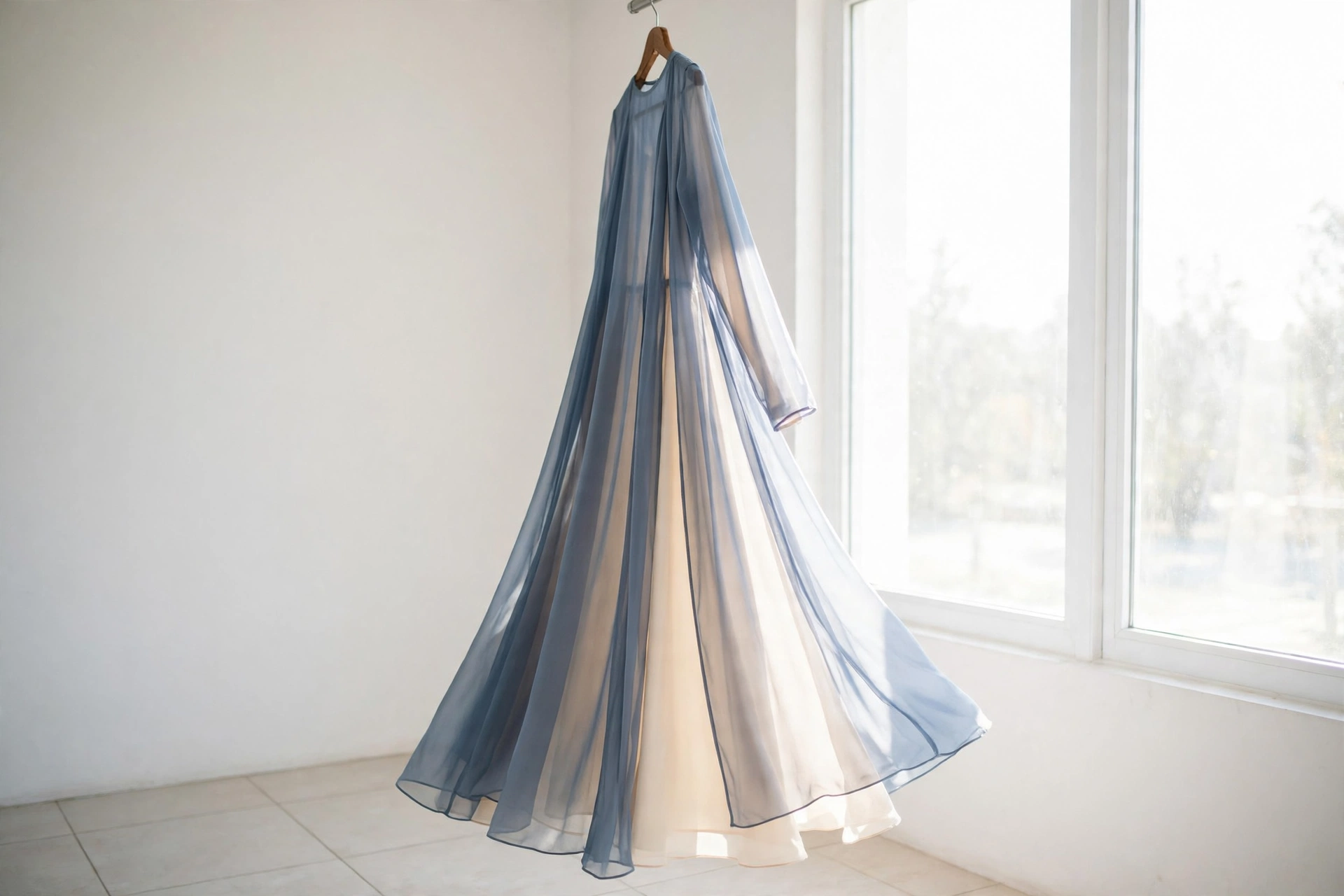
Fully lined, lined where it matters, and lined on paper
Here is the part nobody tells a new buyer, and I include a younger version of myself in that. A chiffon dress can be honestly described as lined and still fail the garden test, because the lining in a lot of production stops where the photograph stops. The bodice is lined. The skirt is lined to the knee, sometimes a hand’s width below it, and below that the chiffon goes on alone, because that is where the cost was trimmed and because under indoor light, on a hanger, nobody can tell. Stand that dress between a window and a camera and the unlined band announces itself. The customer did not misread the listing. The listing was written to the hanger.
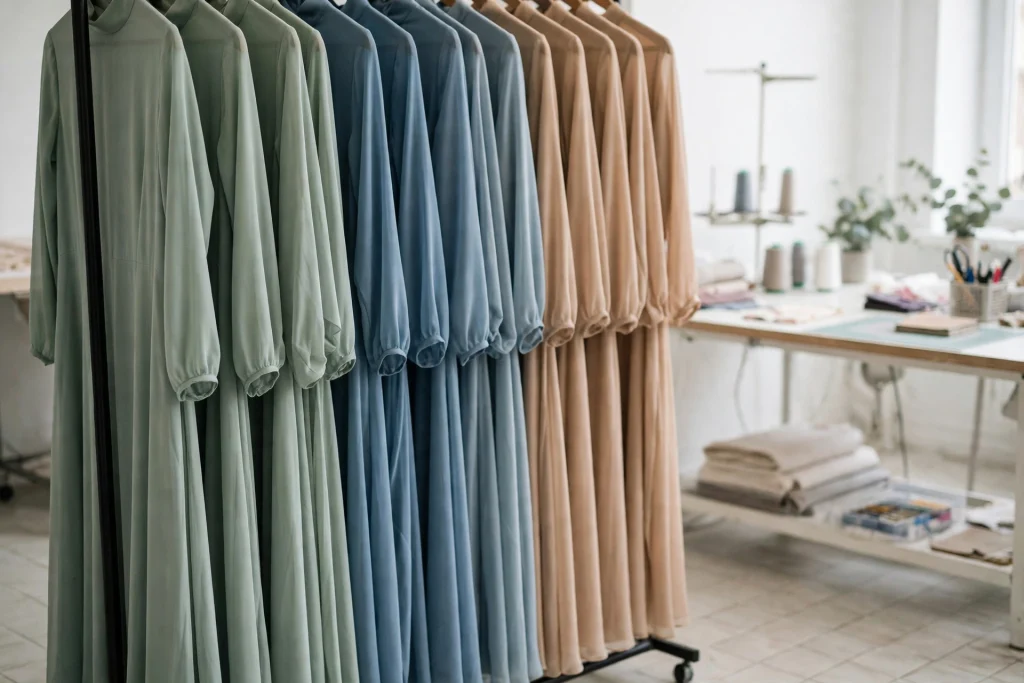
Colour does quieter damage. A sand or blush chiffon over a white lining reads paler and, oddly, more transparent in strong sun than the same chiffon over a lining dyed closer to the shell, because the contrast gives the eye an edge to follow. Darker shells forgive almost everything, which is why the complaints cluster in the light colours, the exact colours a boutique orders heaviest for spring. I have watched a buyer reorder a style in navy and sage after the blush version came back twice, convinced the style itself was fine and the colourway was cursed. She was closer to the truth than the quality report was. Anyone sourcing wholesale Muslim dresses for a boutique runs into the same wall from the other side, because the buyers there ask the sunlight question first and the price question second, and they are right to.
Then there is the sleeve, which gets treated as a length on a chart and behaves like a moving part. Cut a sleeve to the wrist bone on a hanging arm and it rides up the moment the arm bends or lifts, and chiffon over an unlined forearm goes sheer exactly where the wearer wanted it solid. The fix people describe to me from the production side is unglamorous: line the sleeve, give it a little extra length past the wrist, anchor the lining so it does not twist inside the shell after two washes. Each of those sentences costs money in a way a spec sheet hides. A lined chiffon dress takes noticeably longer at the machine than the same dress unlined, two layers to join and fix at the cuff, and when a quote comes back suspiciously close to the unlined price, the difference did not vanish. It moved into the skirt band, or the sleeve, or the part of the dress nobody photographs.

The reviews praise a checklist, not a dress
Read the good reviews in this category sometime, the four and five stars, and notice how unlyrical they are. Buyers do not write poetry about a modest dress. They write that she stood in the sun and it was not see-through. That the sleeve length held up through a day of normal movement. That the summer weight did not cook her. That she picked her size off the chart once and it fit once. It reads like an inspection report because that is what it is. The dress promised four or five specific things and kept them, one by one, and the review is the customer ticking them off with some surprise that it happened at all.
The bad reviews tick the same list backwards. Sheer below the knee in daylight. Sleeve that crept. A hem that covered the ankle standing in the shop and gave it up the moment she sat in a car. Almost none of the one-star anger in this category is about stitching quality in the abstract, and that took me an embarrassingly long time to see. I used to file these under quality. They belong under information. The garment mostly did what it was built to do. It was just built to a cheaper reading of the word lined than the customer was sold, and the gap between those two readings is where the return label gets printed. No wait. That lets the listing off too easily and puts it on the factory alone. Half the listings I have seen were written by people who never held the dress up to a window either. The cheap reading travelled because nobody in the chain was paid to stand in the sun with it.
Returns in online apparel generally run high enough that shoppers now order two sizes expecting to send one back, and fit drives more than half of apparel returns by most industry counts I have seen quoted. Modest dresses add a second, stranger layer on top of that. A woman can keep the size and still return the dress, because the failure was not on her body. It was in the light. That kind of return is nearly impossible to win back with a size chart, and it is the kind boutiques feel worst about, because the customer did everything right. She read the description. The description was the problem. Shops working through the broader maths of stocking women’s dresses wholesale for mixed occasions usually budget returns as a sizing cost. In this category a slice of that budget is really a daylight cost, and it does not shrink when the size chart improves.
Sitting down is a different dress
The third question sounds like a detail and it is not. A maxi hem is measured on a standing body, and a sitting body is shorter in some places and longer in others, and the skirt pulls up over the ankle and the knee line shifts, and a dress that was modest at the mirror becomes a negotiation at a table. Customers test this in fitting rooms without thinking about it, the same way satin buyers lift an arm and sit before they look at themselves properly. Online, she cannot test it at all. She can only ask, and if the answer is a model standing still in a studio, she has learned nothing, and some part of her knows it, and that hesitation is sitting in your conversion rate wearing a very reasonable face.
Length has a production shadow too. A longer skirt in two layers eats fabric in a way buyers underestimate until they compare it against a straight dress, the same shock people get when an A-line silhouette turns out to use roughly twice the cloth of the slim dress hanging beside it, which I have written about before in the context of how much fabric an A-line dress really uses. With modest styles the yardage argument gets settled early and badly. Somebody trims two inches to hit a price, the sample still photographs as a maxi, and the missing inches only testify later, seated, in a customer’s photograph, attributed to nobody. Our own floor for styles already in the range is ten pieces per style with colours and sizes mixed, and that number is not where this category gets expensive. It gets expensive in the inches and layers that a photograph cannot audit.
Questions I get sent about lined modest dresses
The listing says fully lined and my customer can still see through the skirt outside. Was she sold the wrong dress?
She was usually sold a dress that was lined where the listing photograph was taken, which is not the same thing, and I say that having answered this exact message more times than I can count. What tends to have happened is the lining stops somewhere down the skirt, or the lining is a pale layer under a pale shell and daylight finds the contrast, and standing still indoors none of it shows. I get this wrong myself when I only look at the studio pictures, honestly. The version of the question worth asking a supplier is where the lining ends and what colour it is dyed, and I would rather a boutique owner ask it bluntly than have her customer discover it in a garden.
Ten pieces per style is the minimum I keep hearing. Does full lining quietly change that?
No, ten pieces per style stays the floor for styles already in the range, colours and sizes mixed, and lining does not move the minimum itself. What it moves is the unit price, because a fully lined chiffon dress is two dresses sewn into one garment in every way that costs time, and the samples will show you that faster than any explanation will. Buyers sometimes try to hold the unlined price by letting the lining shrink a few inches at a time across reorders, which works beautifully until the returns start, and then nobody connects the two events because they are a season apart. That distance is the whole trap, really.
My customer is between sizes and the chart looks right, so why did the dress still come back?
Sometimes it did not come back for size at all, and the return form is lying to both of you because the form only offers a short list of reasons and she picked the nearest one. In this category I have learned to read the attached photograph before I read the selected reason, because a picture of a skirt held up to the light is a coverage return wearing a sizing label. If there is no photograph, the message thread usually tells it plainly within two replies. I would rather find that out from her words in May than from a chargeback note in June, which is more or less how these things announce themselves when nobody asks.
Should the lining match the shell colour, or is white lining fine?
A lining close to the shell colour is the safer build for light chiffon, usually, because strong sun turns a white layer under a blush or sand shell into something the eye can track, and tracked is the opposite of what the wearer bought. White lining under a dark shell rarely causes the same trouble, which is why this problem hides inside colourways instead of styles and why a style can have a clean record in navy and a messy one in blush with identical construction. I still see tech packs that just say lining, no colour specified, as if it were packing material. It is not packing material. On this category of dress it is half the product.
I still keep one of those garden photographs in mind when a new modest style lands on the new-arrivals page and the copy says fully lined in a clean, confident font. Not because I think the copywriter was dishonest. Because I know which desk the dress was checked at, and it was not a desk with a window. The boutiques that sell this category well, as far as I can tell from the quiet end of the inbox where the complaints do not arrive, are the ones that learned to ask where a lining ends before they asked what it costs, and I cannot decide whether that is a sourcing lesson or just a description of who is still in business. The dresses keep coming back either way, in the good light, telling the truth about themselves a season too late for the order that made them.
Follow our channels for new styles and factory updates: WhatsApp Channel · Telegram Channel