Dear new buyer,
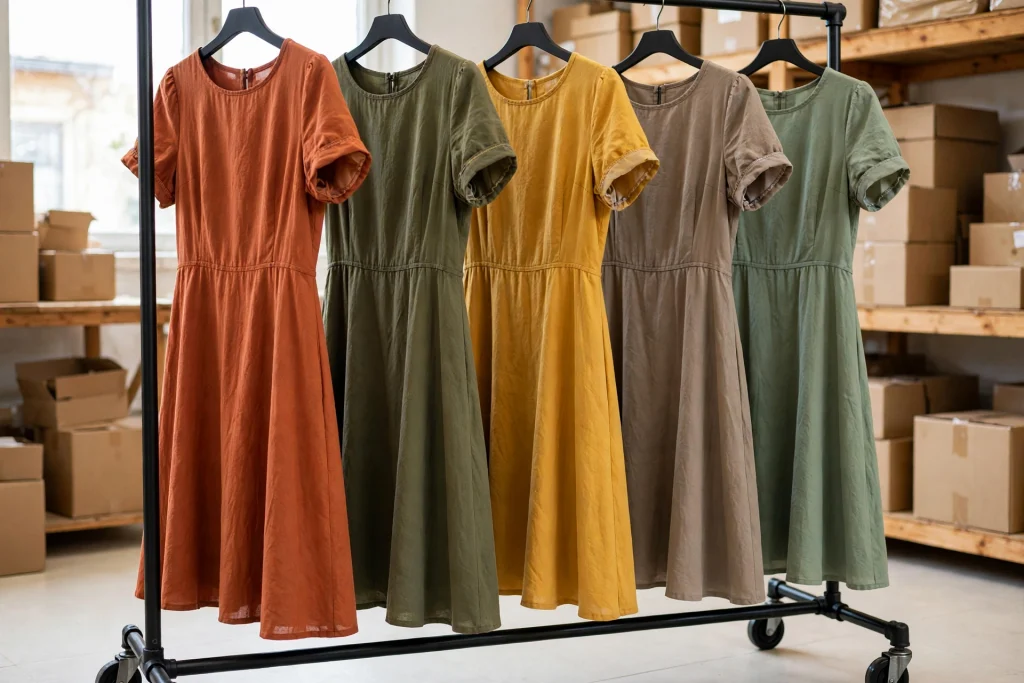
You wrote to me last week with a showroom photo and a question I have heard in some form for years. Two dresses side by side, same fabric family, same kind of bodice. One hangs straight. The other flares from the waist into a full A-line skirt. Your question was why the flared one costs more to make when, in your words, the top half is basically the same dress.
It is a fair question. It is also the wrong end of the dress to look at.
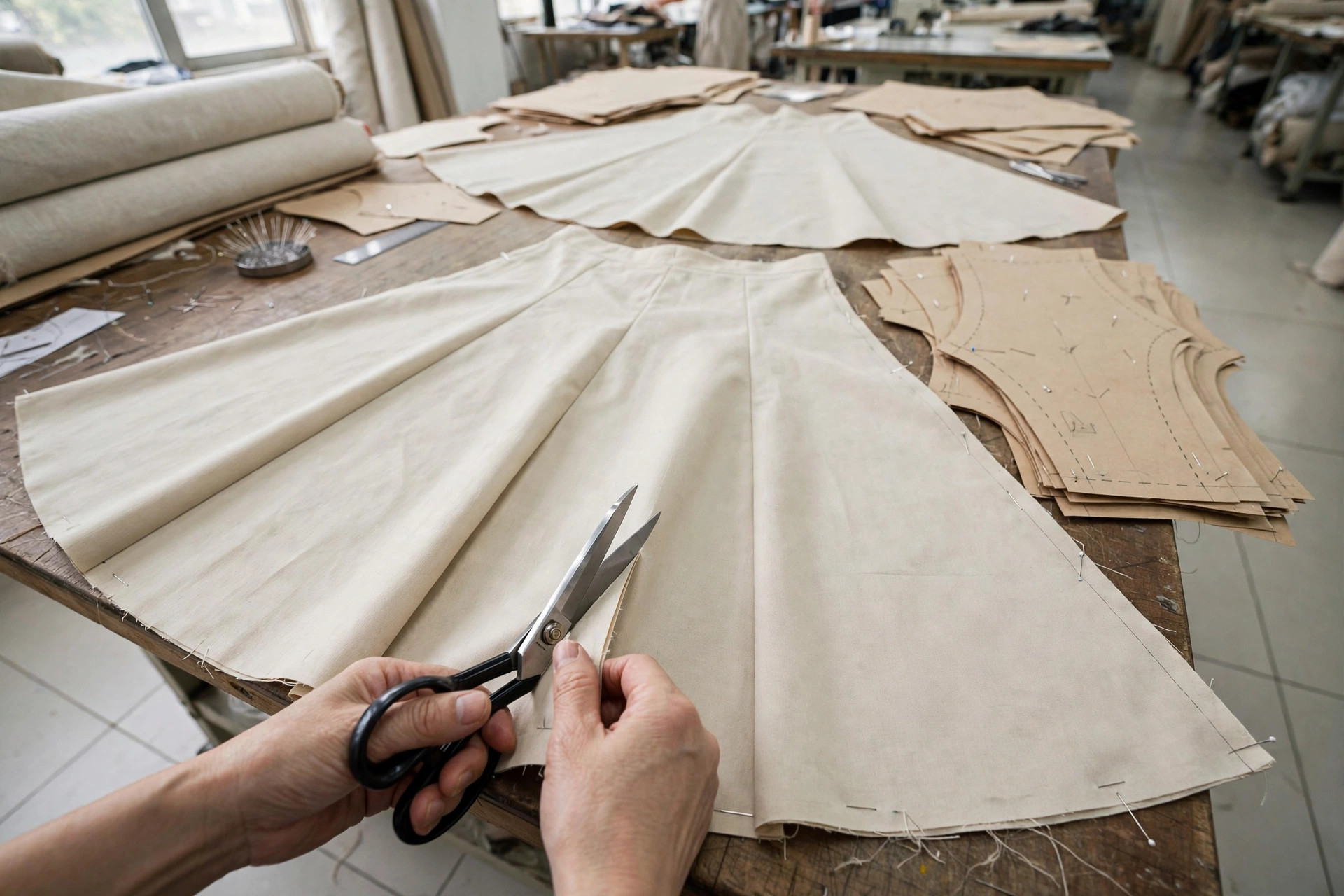
Start with a number, since numbers are what you will argue about with your own customers later. A midi A-line dress in a standard-width woven, the kind of cloth most boutique dresses are cut from, commonly runs about 2.6 to 3.2 metres of fabric per piece once the flare panels and facings are in. A straight shift in the same fabric sits nearer 1.4 to 1.8 metres. The bodices cost almost the same, like you said. The skirt is the bill, and it is close to double.
Nobody puts that on a quote as its own line, which is why you are writing to me instead of reading it off the invoice.
The flare is not decoration. It is yardage.
An A-line skirt gets its shape from panels that are narrow at the waist and wide at the hem, and wide panels are rude guests on a cutting table. Straight panels nest into each other, one turned up, one turned down, the gaps small. Flare panels leave triangular gaps that nothing else in the dress can fill, so the marker — the cutting layout, the map of where every piece sits on the cloth — lands several points lower in efficiency than the marker for a straight dress on the same fabric width. The leftover cloth is not worthless exactly. It is just not worth much, and it is priced into your dress whether anyone says so or not.
This is the part buyers argue with, usually by holding up the sample. The sample looks light. It swings. It feels like less dress than a structured straight style with its lining and its facing and its serious expression. I understand the feeling. I have held the same sample. But the cutting table does not care about the feeling, and the fabric roll gets shorter by roughly twice as much per piece, and that is the whole argument, really. The trend pages that keep listing A-line and fit-and-flare among the steady sellers for women’s dresses never mention any of this, because trend pages do not stand in cutting rooms. The silhouette’s appetite stays the same in a good season and a bad one.
If you want one useful habit out of this letter, make it this one, learned the slow way by most buyers I know. When a factory quotes you an A-line dress and a straight dress at nearly the same price in the same fabric, do not celebrate. Ask which part got thinner. Sometimes it is the lining, dropped or swapped for something lighter between the sample you approved and the bulk you receive. Sometimes the flare itself quietly shrinks, a few centimetres of sweep taken off each panel, small enough that you will not catch it on a tape measure unless you are looking for it, large enough that the dress hangs differently and your customers feel a difference they describe badly in reviews. The price had to come from somewhere. Cloth is where it usually comes from.
That review pattern, by the way, is real on the big marketplaces, where A-line dresses for women collect a steady trickle of complaints about fabric reading thinner than the listing photo suggested. Sizing still leads the complaint list, it always does, but the thin-fabric cluster is the one that traces back to a decision made in an office, not on a line. A buyer squeezed a quote. A workshop protected its margin the one way it could without touching the stitching anyone checks. The customer at the end of it writes that the dress feels cheap, and she is not wrong, and she also has no idea she is reviewing a negotiation she never saw.
Hemmed on Tuesday. Longer on Wednesday.
Here is the thing I would tell you if you were standing in the workshop instead of reading a letter. The side panels of an A-line skirt do not hang straight down the grain of the cloth. They sit partly on the bias, the diagonal, and bias stretches under its own weight. A skirt can come off the machine with a hem that measures level all the way around and then, after a night on a rail, the sides have dropped by a centimetre, sometimes closer to three on a softer fabric, while the front and back panels, cut closer to the straight grain, have barely moved.
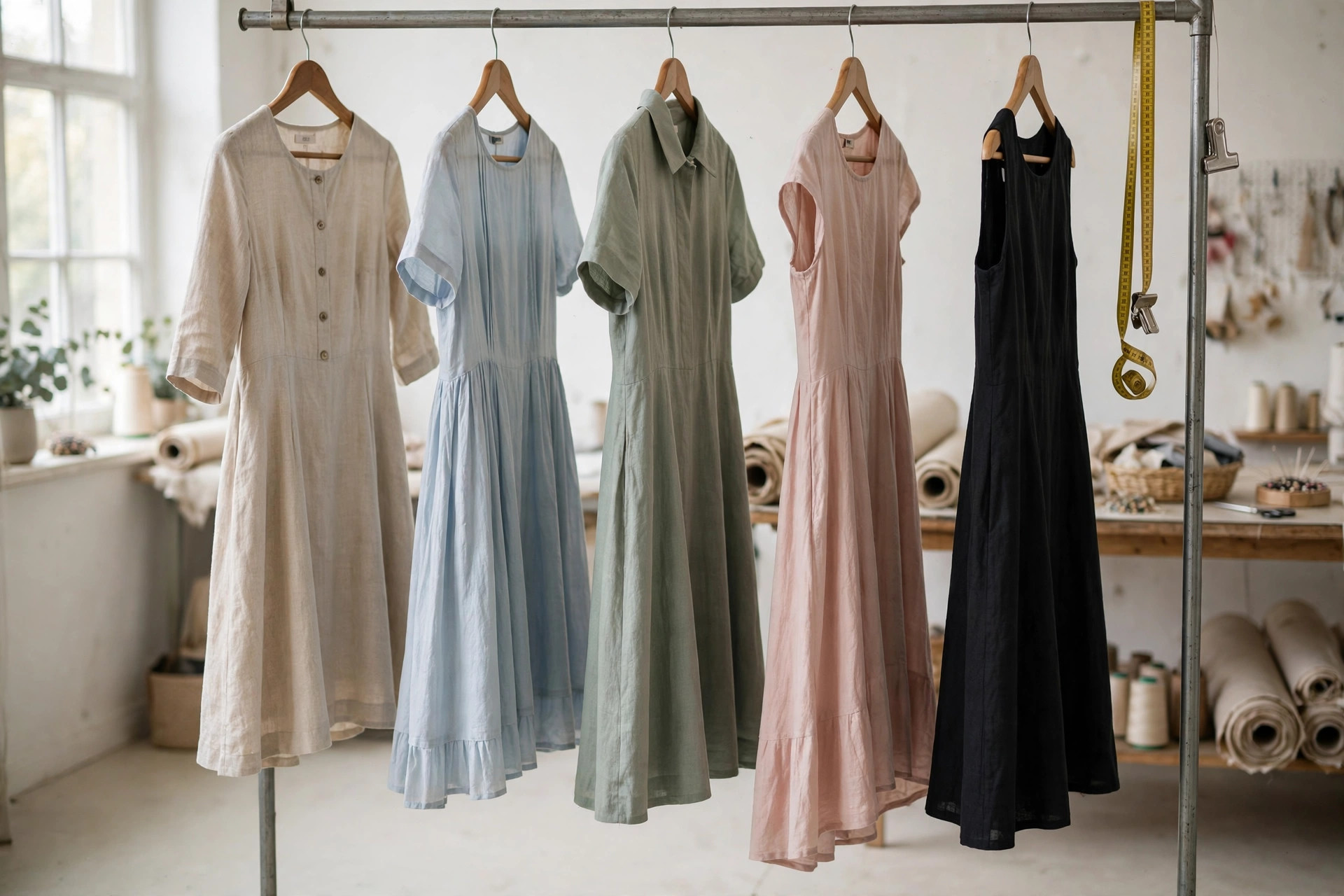
The workshops that handle this well do a boring thing. They sew the dress, hang it, and wait about a day before the final hemming, so the bias gives up whatever stretch it is going to give up while the dress is still in the building, and then the hem gets levelled on the settled skirt. The workshops in a hurry hem it straight off the line and ship the wave. From the outside both dresses look identical in a carton. The difference shows up in your fitting room, or worse, in a photograph a customer posts with the dress on a door hook and one side visibly reaching for the floor.
Uneven hems and dresses that turn out longer than expected sit in the one-star reviews for this category year after year, a minority cluster, steady as weather. Buyers tend to read those reviews as carelessness. Sometimes it is. More often, reading them from this side, I see a schedule. A bulk order finished late in the week, a shipment that had to make a Friday cutoff, a day of hanging that got cut because the dresses were already late and the rail time looked like a luxury. Nobody decided to ship a wavy hem. They decided to ship on Friday, and the hem was a consequence nobody wrote down.
No wait. That lets the workshop off too easily, and I said I would not do that in this letter. The rail day is not a luxury and everyone on a line knows it, because the same people complain loudest when a return lands. If a factory you work with hems flared skirts the same hour they are sewn, that is not a scheduling accident, that is a choice they make on every order, including yours. Ask about it directly before you place anything. The answer you get, and how annoyed they sound at being asked, tells you more than the sample will.
One seam holds the whole argument
All of that skirt, the double yardage, the swing of it, hangs off a single seam at the waist. On a straight dress the waist seam has an easier life, because there is simply less dress below it. On an A-line, every step the wearer takes moves a wide skirt against that join, and the weight of a midi or maxi flare pulls at it for the life of the garment. Which is why stitch density at the waist and a clean finish inside that seam matter more here than almost anywhere else on the dress, and why a cheaply made waist seam announces itself months later as a pulled, wavy line right at the point where the eye lands first.
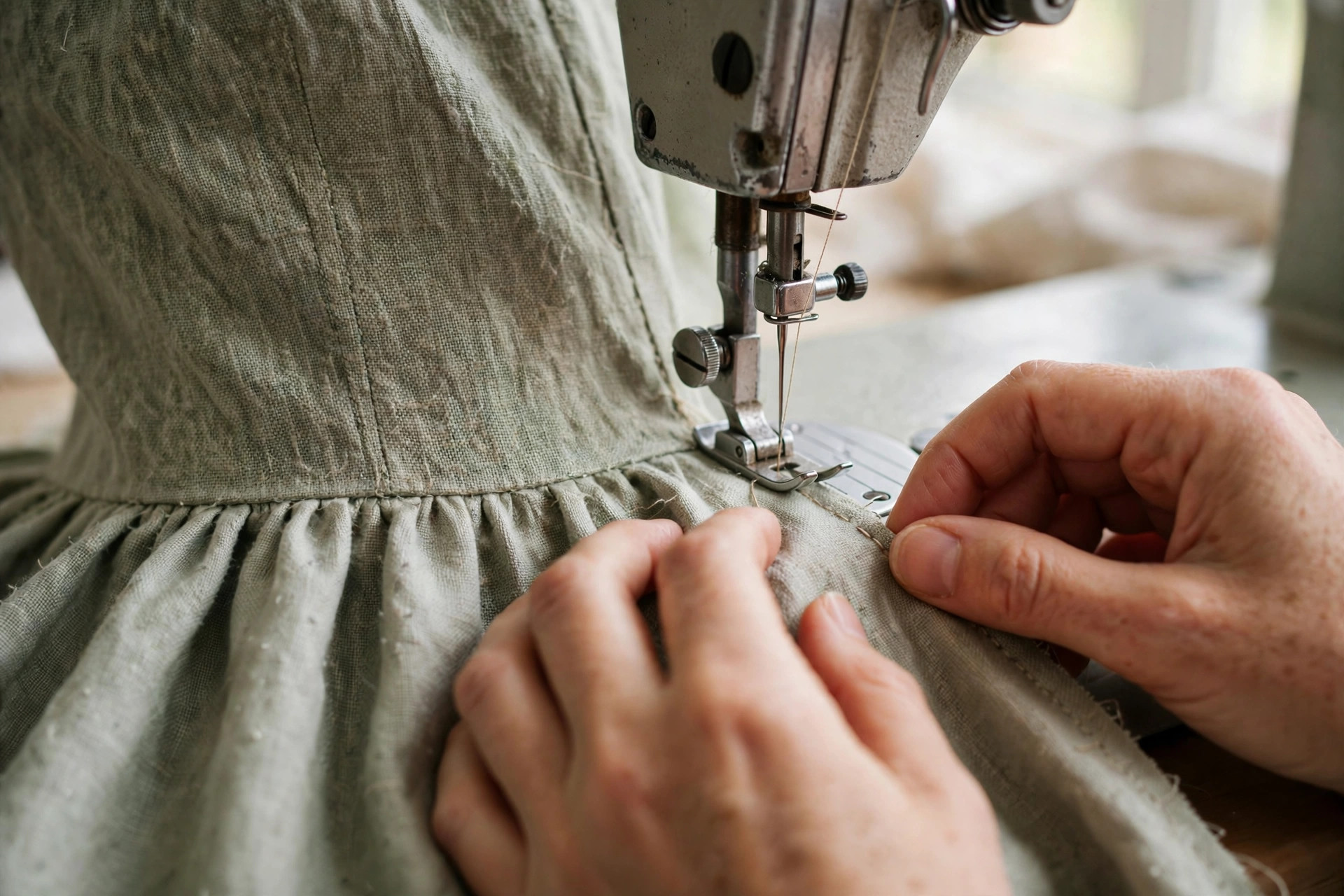
Grading does something similar, quietly. A dress gets graded up and down from the sample size, and on a straight style a small error stays roughly the size it started. On a flared style the geometry multiplies whatever it is given on the way down to the hem, so a waist or hip grade that is slightly off in the pattern arrives at the larger sizes as a visibly different sweep and a different hem drop. This is why buyers who approve only the middle size, which is most buyers, including, I suspect, you, meet the problems of this silhouette at the two ends of the size run first. The middle behaved. The ends are where the flare tells the truth about the pattern.
And then there is the small-order question sitting under your email, the one you did not quite ask. You want your own label in these dresses, in small quantities, and you want to know if ten pieces per style is a real starting point or a polite fiction. It is real. At our women’s dresses wholesale range the private label minimum sits at ten pieces per style with colours and sizes mixed, and the same logic runs through what boutique buyers are actually stocking this year. What ten pieces does not give you is the bulk price’s hiding places. A short marker wastes a bigger share of the cloth, there is no volume discount on the fabric doing quiet work in the background, and the flare charges full price for both of those facts. A ten-piece A-line honestly costs more per piece than the same dress at several hundred pieces. Anyone who quotes you otherwise has found the difference somewhere in the dress, and we have already talked about where they find it.
I am not steering you away from the silhouette, whatever this letter sounds like. Boutiques keep it on the rail because customers reach for it, and the skirt comparison work in pleated, wrap and A-line skirts says the same thing from the sales side. I am saying the A-line is a cutting-room dress. Buy it from the cutting room outward, ask about markers and rail time and waist seams, and the dress that arrives will be the dress in your photograph.
Questions buyers ask me after the first order lands
2.6 to 3.2 metres a dress. Why does my quote just say one flat unit price?
The unit price hides the fabric because it always has, not because anyone is running a trick on you specifically. The cloth, the cutting waste, the sewing and the finishing get folded into one number before the quote leaves the building, and the folding is where an A-line dress loses its explanation. If you want the number opened up, ask for the consumption figure per piece and the fabric width it was calculated on. A factory that knows its own marker can answer that in one message. One that is guessing will change the subject to lead time, usually.
Ten pieces per style. Is the small run punished on price, honestly?
Yes, and on an A-line the punishment is mostly arithmetic rather than attitude. Ten pieces still need a marker laid, fabric bought at small-lot prices and a line set up for the style, and the flare wastes a larger share of a short marker than a long one does. You are not paying a penalty so much as losing the discounts. I would rather a buyer heard that plainly than got a bulk-looking price on a ten-piece run and met the difference later inside the dress itself, which is where it tends to surface.
My sample hem was level. Why did the bulk arrive wavy at the sides?
Usually because the sample got the rail time and the bulk did not. A sample is one dress, made slowly, hung around the sample room while people look at it, so the bias settles before anyone hems it and nobody notices the favour time did them. Bulk runs move. If the dresses were hemmed the same day they were sewn, the sides were still stretching when the cartons closed. I get this one wrong myself sometimes when I guess from photos, because a pressed wavy hem can photograph level. The tape measure on a dress that has hung overnight in your own stockroom is the honest check.
The waist fits and the skirt feels huge. Did the factory grade it wrong?
Not necessarily, no. That split feeling is close to the signature of this silhouette when the grading is even slightly generous at the hip, because the flare turns a small hip allowance into a lot of visible skirt by the time it reaches the hem. Check the sweep measurement on your tech pack against the bulk at two sizes, not one. If the sweep grew faster than the grade rule says it should, the pattern is the problem. If it grew exactly as written, the dress is doing what it was drawn to do and the argument is with the drawing, which is a harder conversation to have with yourself than with a factory.
You will notice I have not told you the A-line is a bad buy, and I am not going to, because from this side of the cutting table it is one of the more honest dresses a boutique can stock — the cost is sitting right there in the open, in metres, if anyone bothers to count them. What I still cannot decide, after years of watching buyers learn it in different orders, is whether the ones who ask about fabric first are being careful, or whether they are just the ones who have already paid for a wavy hem once and kept the photograph.