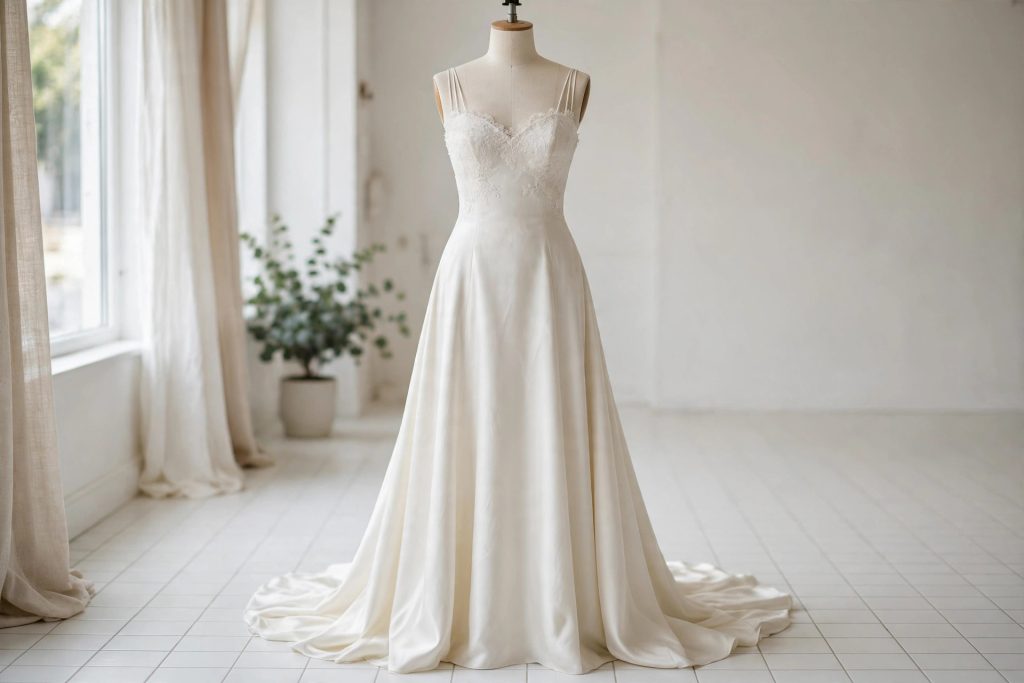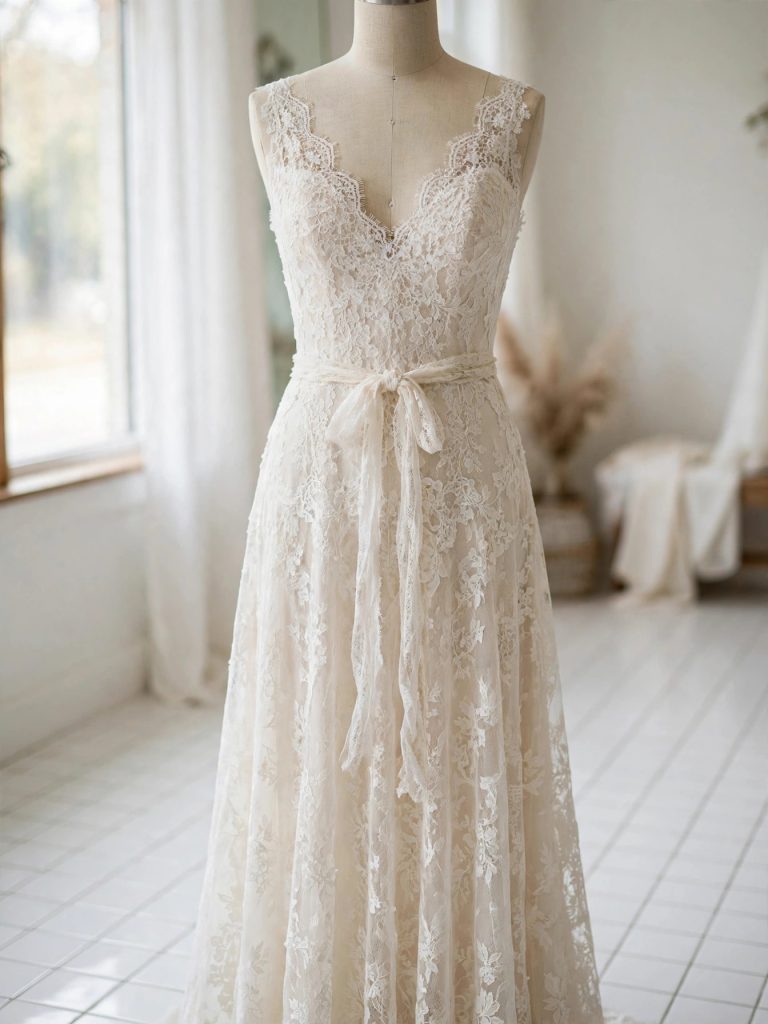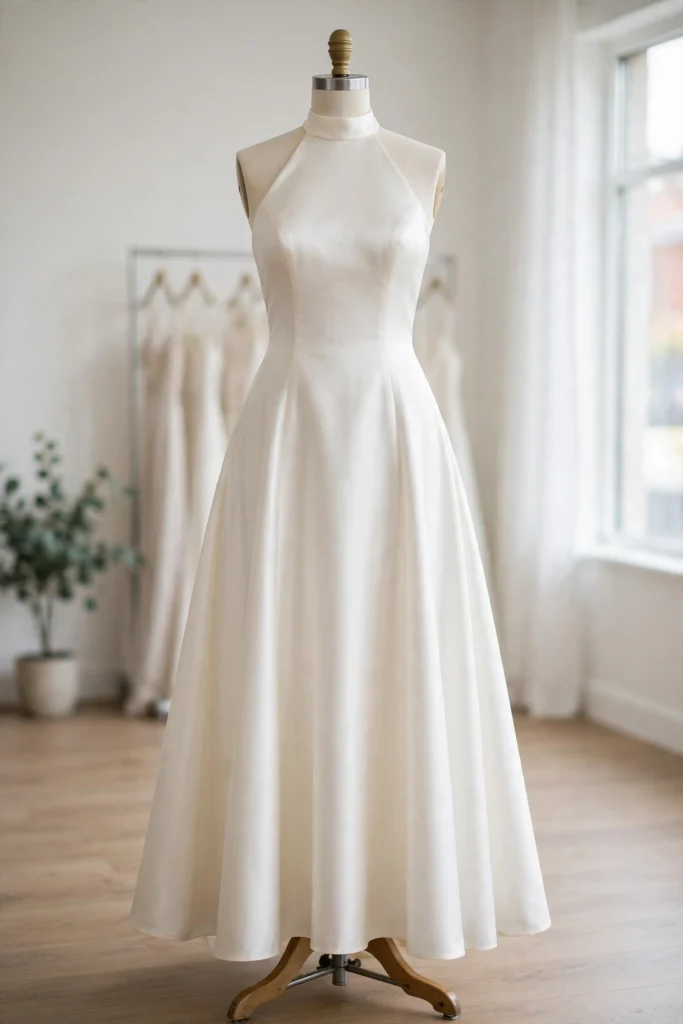
The reorder is where this story has to start, because the reorder is where it went wrong. A boutique had sold through a halter wedding dress the previous season, the kind of clean satin style that photographs like nothing else in the shop, and they placed the same order again at the same price with the same factory. The gowns arrived. The front looked right. Brides tried them on, and within a few weeks the messages coming back had a shape the first run never produced: the neck band rubbed, the band felt longer by the end of the day than it had at noon, and on the larger sizes the neckline sat higher and pulled in a way the smaller sizes did not. Same photograph on the listing. Same price on the invoice. A different dress in the one place a halter dress cannot afford to be different, which is the band that holds the whole front of the garment up.
Work backward from those returns and the trail is short, which is the annoying part. Nobody had sewn the reorder badly. The stitching was clean, the satin was the satin that was ordered, the sizes matched the chart the boutique sent. What had changed sat underneath the band, in a backing material nobody could see, bought from a trim supplier who was not the trim supplier used on the first run. The original band had been backed with a firm grosgrain that kept it from creeping under load. The reorder band was backed with something softer and cheaper, and a halter band under the weight of a satin bodice does what any loaded strap does when its backing gives: it stretches, slowly, over hours of wear, and the bride feels it at her neck long before anyone can measure it on a hanger.
I spend my working life in the middle of orders like this one, between the boutique that sells the dress and the factory that makes it, and the halter neckline is the style that teaches the same lesson every season. Buyers negotiate the fabric line hard. They ask about satin weights, lining, boning, they push on the number they can see. The band backing is a line that does not appear on most quotations at all, and on a halter style that invisible line carries more of the dress than the fabric does. A strapless gown stands on its bodice. A halter gown hangs from a neck. Everything about how the style succeeds or fails runs through a strip of fabric maybe four centimetres wide.
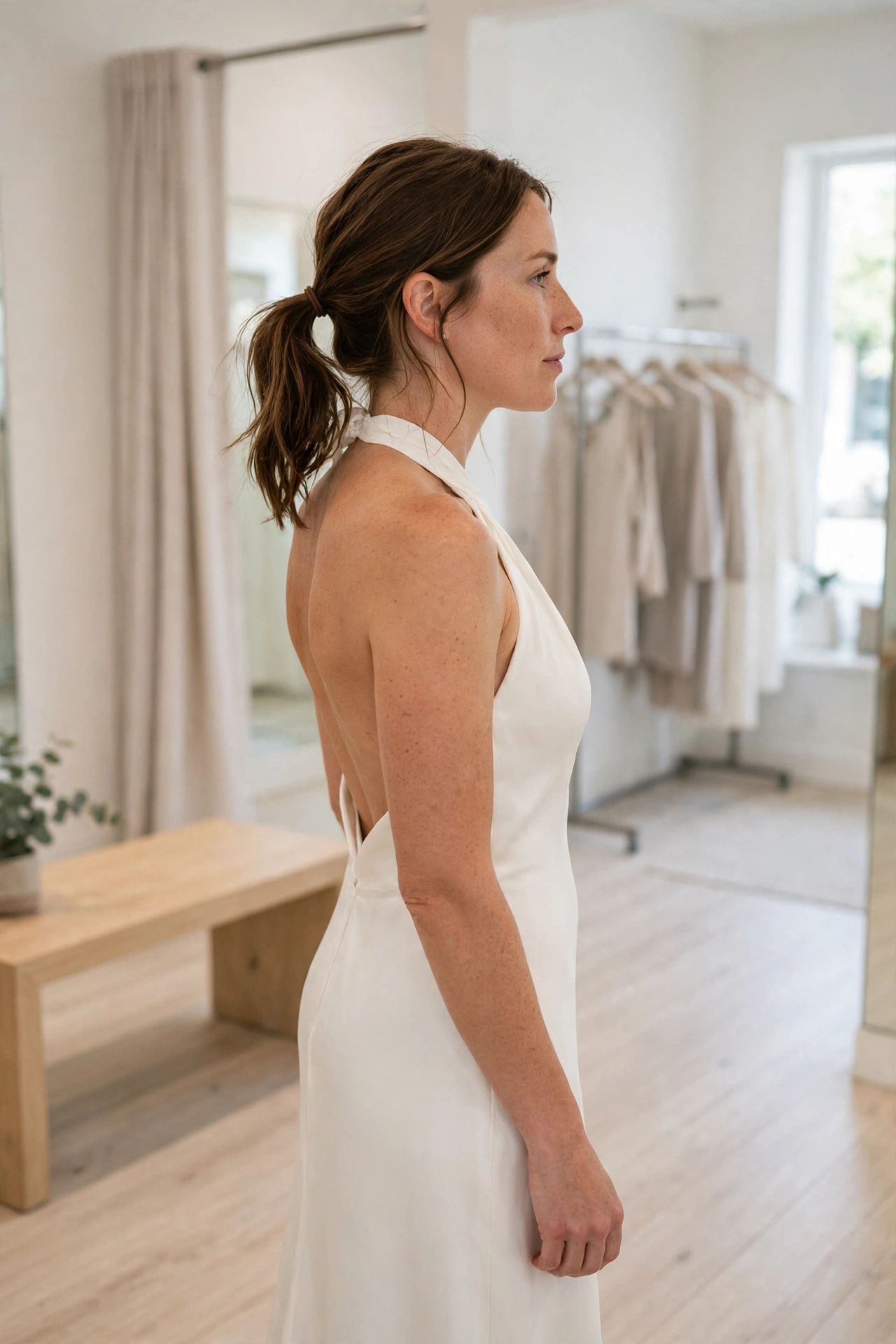
The returns knew before the invoice did
Read the one-star reviews for halter gowns on the major platforms and the pattern is already there, waiting for anyone who wants to see it before they order instead of after. The complaints cluster around construction, not cloth. The strap dug in. The neckline gaped when she bent forward. The back band rode up. The support was nothing like what the listing suggested. Fabric complaints exist, they always do, but they are the smaller cluster, and that alone should tell a buyer something, because on most other necklines the fabric is exactly where the complaints live. On a halter, the garment’s whole support system is one band and one closure, and the reviews grade those two things while the listing photographs neither of them.
The five-star reviews tell the other half, and they split in a place worth knowing about. They praise the open back and the long line through the torso, and they lean toward smaller bust sizes in a way that is hard to unsee once you have noticed it. Larger-bust reviewers of the same style divide sharply, some delighted, some furious, on the same dress in the same week. The dividing line is cup size more than overall size, which makes sense once you think about where the weight goes. Every extra gram of bodice on a halter is carried at the back of somebody’s neck. A size chart can be perfectly accurate and the dress can still be two different garments depending on who is wearing it, because the chart measures the bust and nothing measures the load.
That is also why boutiques reorder halter styles narrower than they reorder other necklines. Talk to buyers a season later and the largest sizes have quietly left the reorder, usually explained as demand. Sometimes it is demand. Sometimes the plus sizes came back with neck complaints at a rate the smaller sizes never produced, and the buyer solved the problem by shrinking the run instead of asking why the band behaved differently at the top of the grade. I understand the instinct. It is still solving the wrong end of the dress.
One step back: the sample that passed on a stand
Before the reorder there was a bulk run, and before the bulk run there was a sample, and the sample passed. Of course it passed. Halter samples get fitted on a stand in most sample rooms, and a stand holds still, faces forward, and never turns its head to talk to somebody over its shoulder. Neck pull does not exist on a stand. The band can be a fraction too long, the closure can sit a fraction too high, the whole front can be quietly transferring weight to a point that would ache on a person by the second hour, and the stand reports nothing. The first time a halter sample meets a moving neck is usually in a boutique fitting room, weeks after the bulk price was agreed, when the person wearing it does the one thing no stand can do and looks down.
Gaping lives in that look down. A fixed-length band that sits beautifully in a front photograph opens at the neckline the moment the wearer bends, because the distance from neck to bust changes and the band does not. Adjustable ties answer part of this, and buyers ask for them thinking they answer all of it. A tie solves length. It does nothing for width, and a narrow tie carrying a heavy beaded bodice concentrates the whole load onto a thin line at the neck, which trades a gaping complaint for a digging one. The platform reviews show that trade plainly if you read the adjustable styles separately: fewer gaping complaints, more complaints about knots loosening and bows working undone during the day. There is no closure that makes the physics go away. There is only choosing which complaint you would rather answer.
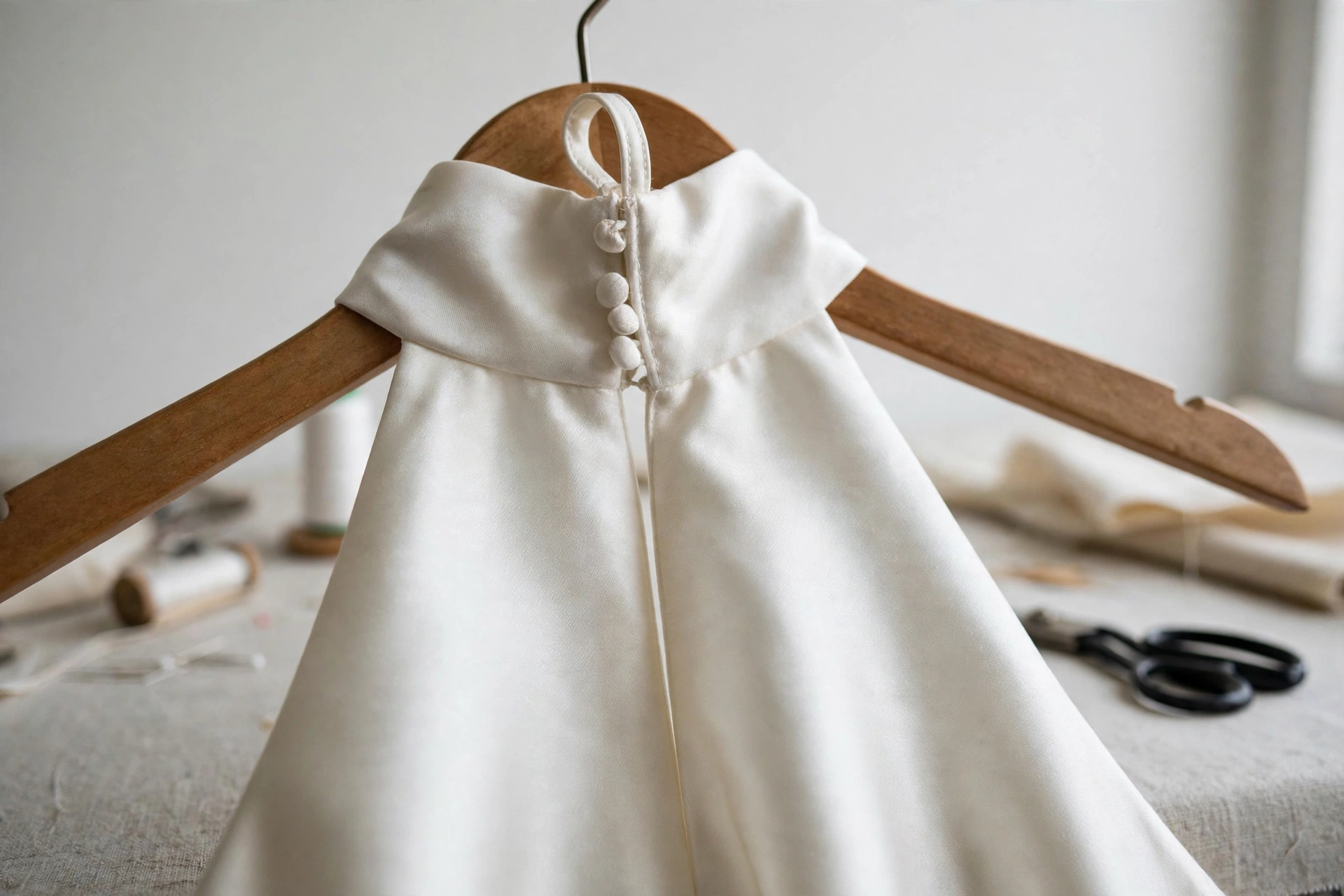
The closure is worth its own backward step, because it moves a halter quote more than the fabric choice does and buyers almost never ask about it. A button-and-loop closure at the back of the neck is hand finishing, slow and tidy, and it holds its position all day. A tie is the cheapest thing a sample room can put on a band and the most forgiving to fit, which is why it appears on so many styles. A hook sits between the two in cost and in behaviour. Same sketch sent to three factories can come back as three prices that look like three opinions about the dress, when they are really three different closures wearing the same photograph. Anyone learning how to read a wedding dress factory quotation should ask which closure the number assumes before they ask why the number is high, because on this neckline the closure is not a detail at the end of the quote. It is a fair share of the quote.
Another step back: the grade nobody itemises
Under the closure sits the grade, and the grade is where the plus-size problem in those returns was actually born. A halter band has a length, and that length has to be graded, and it cannot be graded at the same rate as the bust. Grade the band as fast as the bust grows and by the top sizes the neckline has climbed a centimetre or two higher than it sat on the sample size, pulling at the neck and changing the whole line of the front. Grade it too slowly and the larger sizes gape. The band follows its own rule, separate from the waist, separate from the bust, and that rule is a judgment a pattern maker carries rather than a line a quotation can show. It is the same shape of problem I keep meeting on the basque waist styles, where the dropped point needs its own grade and dies quietly when it gets the waist’s grade instead. Necklines and waistlines that leave the standard block always leave the standard grade behind with it. The price difference that follows is pattern time, and pattern time is the easiest cost in this business to resent and the hardest to do without.
Which is the step where the strapless comparison falls apart, and buyers make this comparison constantly because the two styles sit next to each other in every range. A halter is not a strapless dress with a strap added for insurance. The support path of the garment changes completely. A strapless bodice carries its weight down through its own structure to the waist. A halter sends that weight up and back to the neck. A pattern maker who prices a halter by modifying a strapless block is pricing a garment that does not exist, and the sample will usually forgive him, because of the stand, and the bulk run will not forgive the boutique. When a quote for a halter style comes back suspiciously close to the quote for a similar strapless one, that is not efficiency. That is a block being reused, and the savings will be collected later, in a fitting room, by somebody else.
No wait. That is too clean, and I should not leave it that tidy. Plenty of halter samples do get fitted on a person, in better sample rooms, and plenty of reused blocks produce dresses that sell for years without a murmur. The stand and the block are risks, not verdicts. What I have actually learned to watch is narrower than the rule I just stated: it is whether the band, specifically, was treated as a load-bearing part with its own backing, its own grade, and its own closure decision, or whether it was treated as a strip of decoration sewn on at the end. Dresses fail at the neck when the band was decoration in somebody’s mind, whatever block it came from.
The first step, which was a photograph
Keep walking backward and the trail ends where every one of these orders begins, with a photograph and a request for a price. The photograph shows the front of a halter wedding dress. It cannot show the band backing, it cannot show the closure labour, it cannot show the grading rule, and those three invisible things are most of what separates one factory’s quote from another’s on this style. Boutiques comparing quotes on the photograph alone are comparing the one part of the dress that matters least to how it wears. The fabric they spend an hour negotiating is, on a halter, close to the least of it. I have stopped being surprised by this. The visible thing is the negotiable thing, in every category I have ever sat in the middle of, and the invisible things send their invoices later, addressed to whoever is standing nearest the bride.
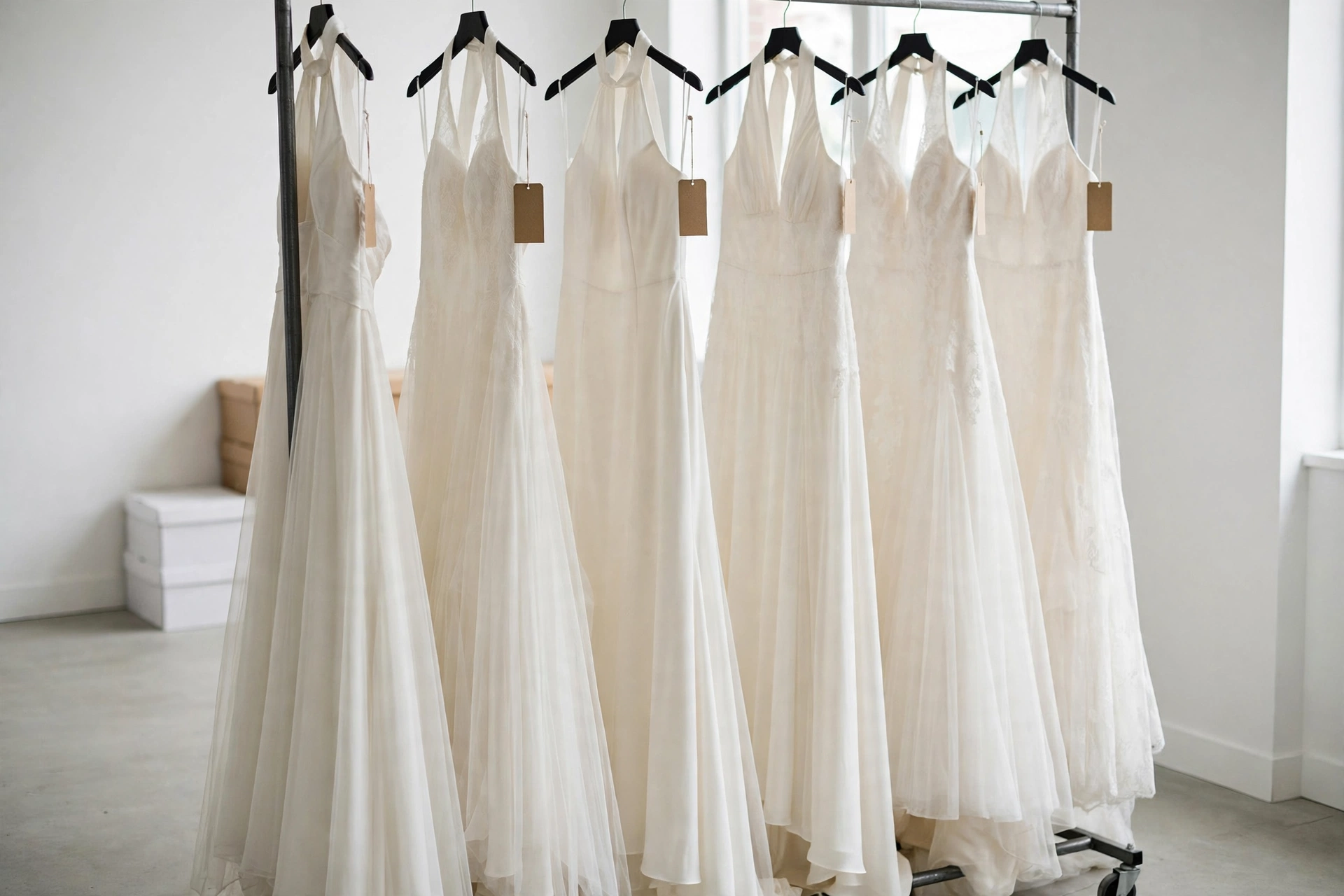
The practical end of all this backward walking is short enough to say plainly. On a halter style, the questions that protect a boutique are the ones about the band. What backs it. What closes it. How its length is graded, and whether the largest size was ever sewn and worn by a person before the bulk was cut, because the sample size proves almost nothing about the top of this particular grade. Our own styles already in the range start at ten pieces per style with colours and sizes mixed, and a halter does not change that number either. What it changes is how much of the conversation has to happen before those ten pieces are cut, and how little of that conversation can be had from a photograph. Buyers who want the wider context on bodice construction will find the same argument wearing a different neckline in the piece on how to tell whether a corset bodice is well made, because a halter band and a corset channel are cousins: both are structure pretending to be decoration, and both get priced as decoration by anyone who has not watched one fail.
Trade coverage has been running the halter neckline hard for two seasons now, folded into the vintage revival, all open backs and long lines and photographs taken from the front. The coverage is right about the look. It simply never turns the dress around, and the back of the neck is where this style keeps both its cost and its complaints, side by side, in a strip of fabric four centimetres wide that most buyers never ask a single question about.
Questions buyers ask me about this neckline
Two factories, one photograph, and the halter quotes are eight dollars apart. Where is the eight dollars?
Eight dollars apart on the same photograph usually means the two quotes are not pricing the same band, even though both are pricing the same front. One has probably assumed a grosgrain-backed band and a button-and-loop closure finished by hand, and the other has priced a self-fabric band and a tie, and neither quote says so in words. The fabric line, the one buyers argue about, is rarely where the gap sits on this style. I would rather have the argument about backing and closures before the order than the one about returns after it, which is the same argument with worse lighting.
Ten pieces per style is the minimum. Does a halter neckline quietly change that?
No, ten pieces per style stays ten pieces on styles already in the range, colours and sizes mixed, and the neckline does not move it. What a small run does change is how the invisible costs land, because the pattern work for the band, its separate grade, and the closure setup all sit on the first order whether it is ten pieces or two hundred. Buyers sometimes hope a halter can be treated as a strapless style with a strap added to dodge that pattern cost, and it can, in the sense that a dress will exist at the end of it. Whether the band carries the front the way the photograph promised is a separate question, and usually a later one.
The size 8 sample was perfect and the size 20 pulls at the neck. Same pattern, supposedly. What happened?
Usually the band grade happened, because the band length was grown at the same rate as the bust and by size 20 the neckline has travelled up a centimetre or two from where it sat on the sample. The band needs its own grading rule, slower and separate, and a pattern maker grading it out of habit will produce exactly this result while doing nothing he would call wrong. I get this wrong myself when I skim a spec sheet, honestly, the band length is the line I have learned to look for last and should look for first. Ask whether the largest size was sewn and put on a person, not a stand, before bulk. The answer tells you most of what the sample cannot.
Adjustable ties solve halter fit. Why do the tied styles still come back?
Adjustable ties solve length, and length is only one of the two things a band has to do. The other is spread load, and a narrow tie concentrates the whole weight of a satin or beaded bodice onto a thin line at the back of the neck, so the gaping complaints fade and the digging complaints arrive in their place, along with a few about knots working loose by evening. A wider band with a fixed closure is the less adjustable answer and often the more comfortable one, which annoys buyers who wanted one style to fit every bride the same way. I would rather explain that in the shop than read it in a review in October.
I still have the photograph from that first order saved somewhere, and the reorder beside it, and I cannot tell them apart. That is the part I keep coming back to. Every safeguard this style needs lives where a camera cannot go: inside a band, behind a neck, inside a grading decision made by one person at a pattern table. The boutiques that sell halter gowns well are not the ones with the best photographs. They are the ones that learned to ask about a strip of fabric they will never see in a picture, and I am not sure the rest of us would have learned it any way other than the way she did, which was one returned dress at a time.
Follow our channels for new styles and factory updates: WhatsApp Channel · Telegram Channel