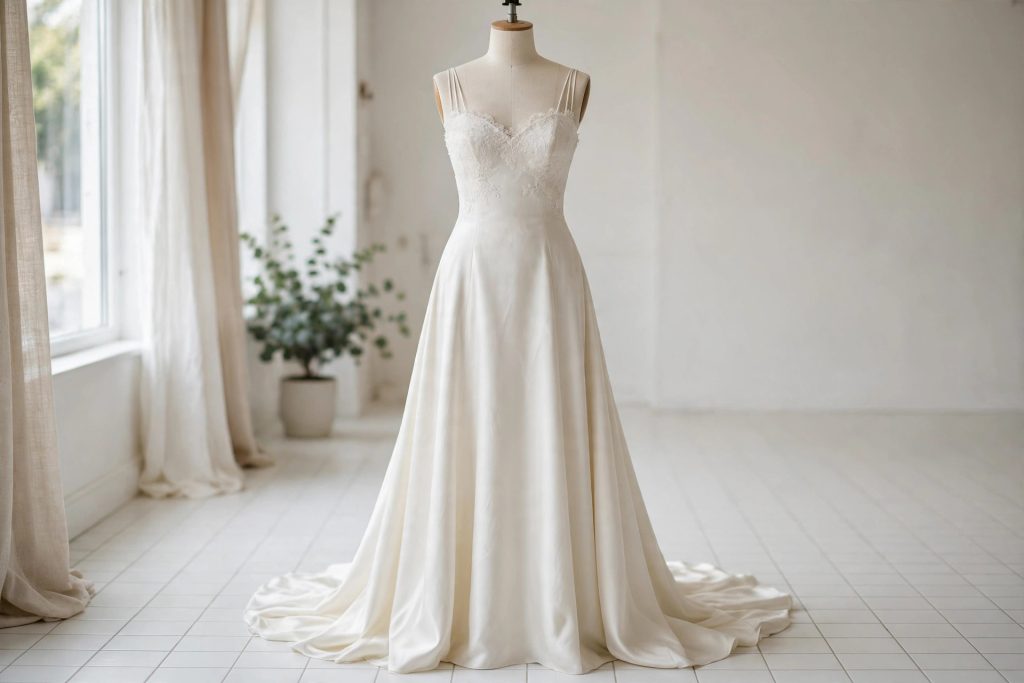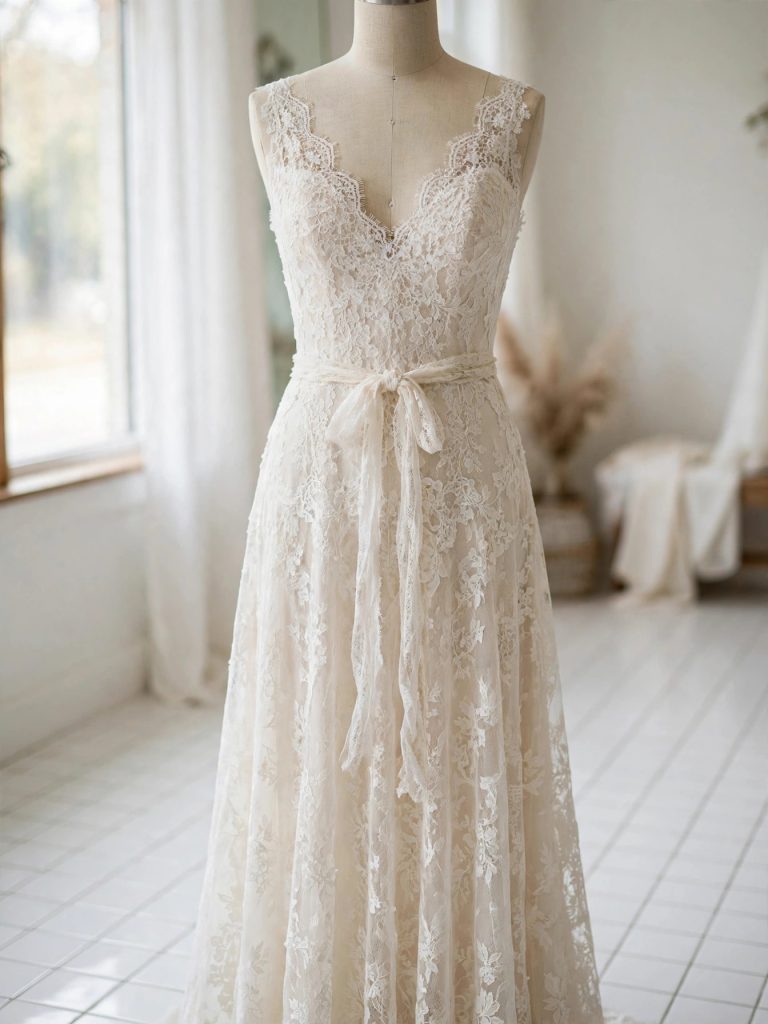
“So give me a number. How much are wedding dresses, roughly?”
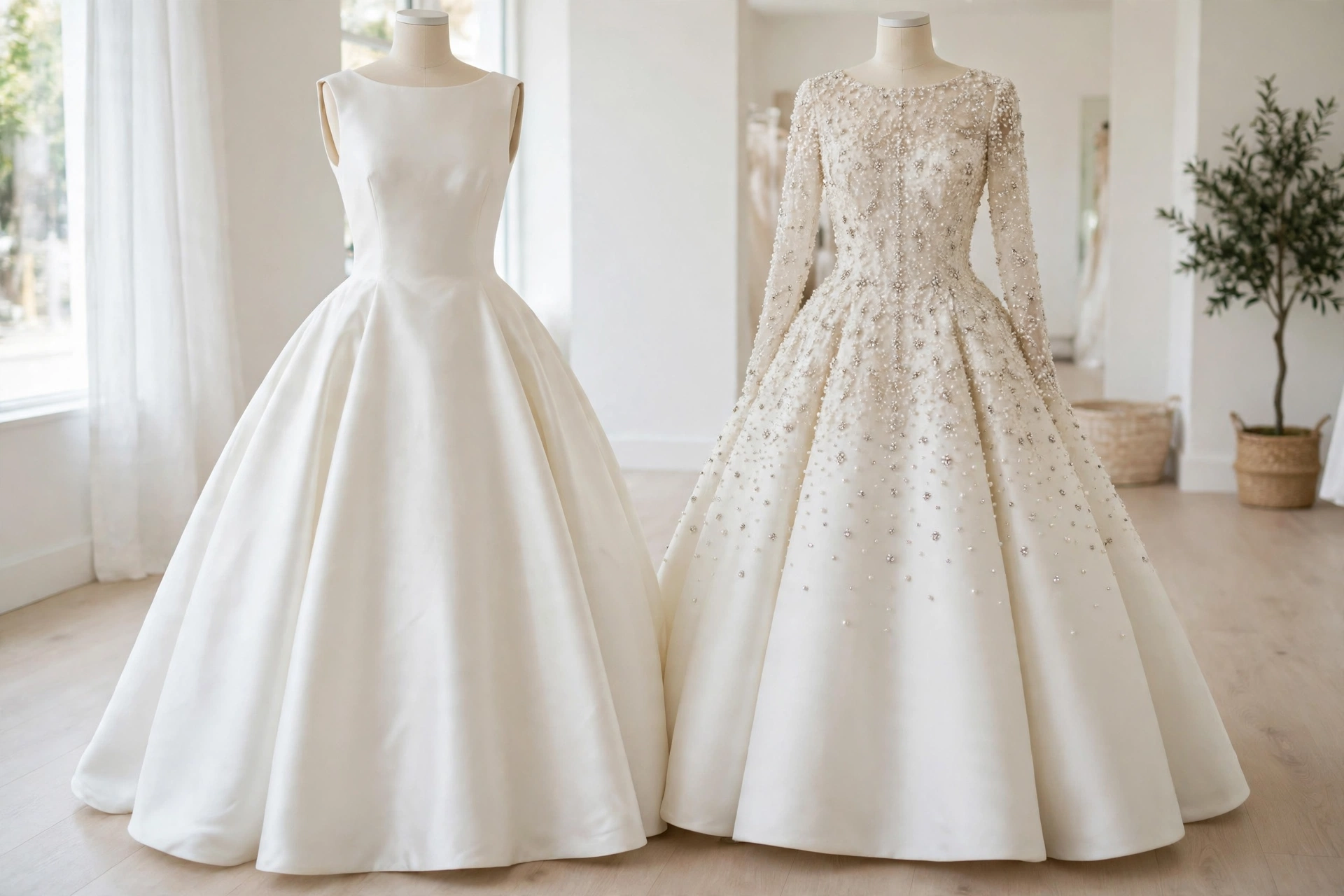
That was the whole message. No silhouette, no fabric, no quantity attached to it, and the buyer who sent it runs a decent boutique, not a market stall. She was not being lazy. She was standing in her own stockroom looking at two ivory gowns that could have been sisters in a photograph, one of which had cost her a little over six hundred dollars landed and one of which had cost her nearly three times that, and she wanted to know which of the two invoices had lied to her.
Neither, probably. That is the annoying answer I end up giving from the money side of this trade, and I give it often enough that I have stopped apologising for it. A wedding dress price is a stack of separate decisions wearing one tag, and the tag tells you almost nothing about the stack.
The $2,100 average is three markets wearing one coat
The average wedding dress in the United States costs about $2,100, and that figure hides more than it says. It comes from The Knot’s 2026 Real Weddings Study, which asked 10,474 couples, so it is a real number with a real sample behind it. It also works out to roughly 6 percent of an average wedding spend of about $34,000. Hold those two facts together and the average starts behaving differently in your head. The dress is a small slice of the wedding wallet. It is, though, close to 100 percent of what a bridal boutique sells, which is why the same $2,100 gets argued over so hard on our side of the counter.
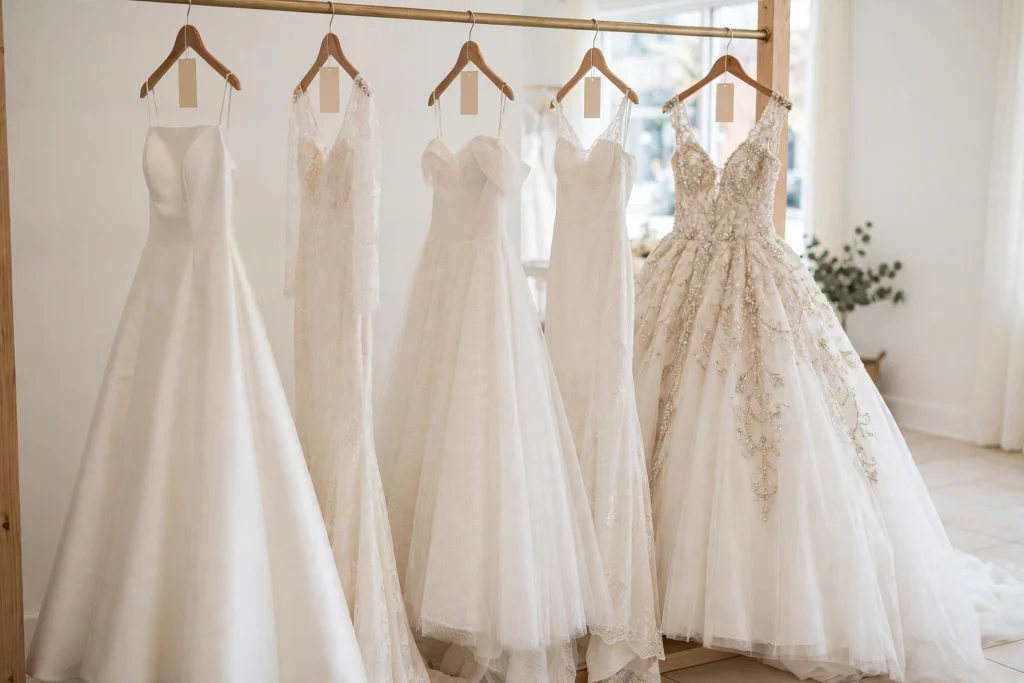
Under that average sit three quite different markets that happen to share a product name. Down at the bottom, a few hundred dollars buys a simple gown in a light fabric with a basic inside, the kind of dress that photographs well and asks very little of the person sewing it. The middle is where the weight is. Industry summaries put mid-range gowns at roughly 46 percent of unit volume, and that band, very roughly $1,000 to $2,500 at retail, is where most boutiques earn their living and most factories earn theirs. Above it, designer names and fully custom work run from $3,000 into numbers I have learned not to guess out loud, because the top of that market prices the name and the handwork, and neither of those has a ceiling I can defend in an email.
So when somebody asks how much are wedding dresses, the honest first move is asking which of the three markets they are standing in. A buyer comparing a $450 quote against a $2,100 average is not looking at a bargain or a scam. She is looking at two different products that share a hanger.
Same photograph, three invoices
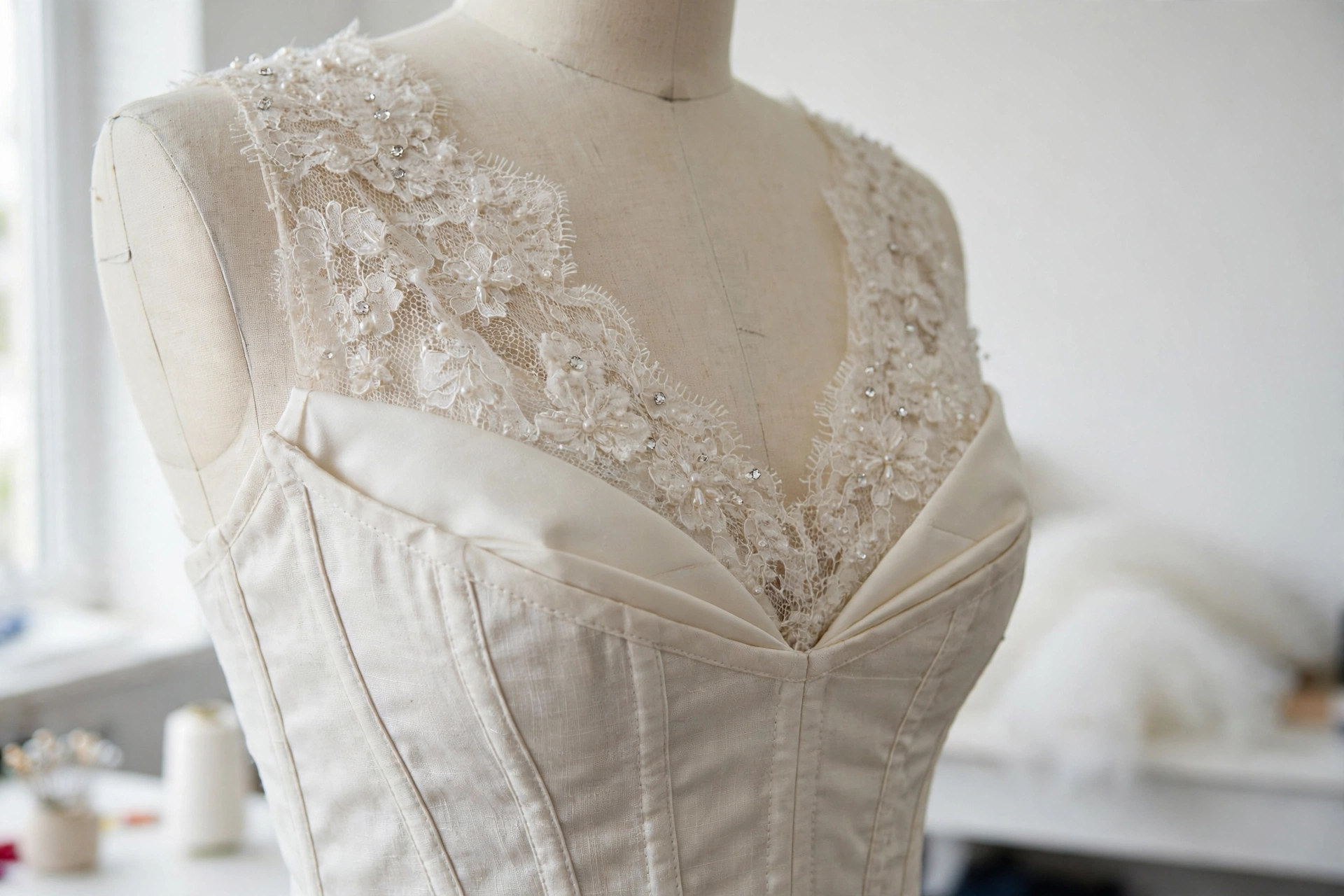
Construction is where the quiet money sits, and it sits there because a photograph cannot show it. Two gowns in the same ivory satin, same neckline, same skirt shape. One has a properly boned bodice that holds its line when the wearer sits down after six hours. The other has a soft inside that behaves for the length of a fitting and then starts negotiating. The fabric bill differs, sure, a good satin and a thin one are not priced alike, and neither are two laces, one bought by the roll and one bought because a pattern repeat had to land in a particular place. But the bigger gap is usually hours. Hand-applied lace is placed piece by piece and stitched down by a person. Beading with small pearls and tiny crystals is slower still, and the person doing it is paid for every one of those hours whether the final photograph shows them or not.
This is the part of the price a boutique can actually audit before it orders, if it reads the paperwork the right way. Our guide on how to read a wedding dress factory quotation walks through where factories put each of those costs, because a quote that will not say what the inside of the bodice is made of is telling you something, just not in words. I have seen quotes where the fabric line was honest and the structure line was a shrug. The gown that came back matched the fabric line beautifully.
There is a factory-side version of this same question, by the way, and it gives a different number, because it stops counting earlier. If you want the production cost alone, without freight, tax, the boutique’s rent or anybody’s margin, we broke that down in how much it costs to manufacture a custom wedding dress. Buyers who mix the two numbers up, factory cost against retail tag, end up angry at the wrong person in the chain. Usually me, since I am the one holding the spreadsheet when the anger arrives.
The tag also pays for the room the dress hangs in
A boutique does not buy a gown at wholesale and sell the same gown. It sells the gown plus the appointment, the fitting room, the steamer, the seamstress down the road, and the risk of the sizes nobody bought. Wholesale prices to a boutique commonly land somewhere around half the retail tag, give or take a good deal depending on the brand and the season, and that gap is not pocket money. Sample stock alone eats a share of it before a single order is written, because a boutique has to buy the dresses brides will try on and reject, in sizes, plural, and those samples do not come back from the factory when the season turns.
Then there is the money that moves before the dress exists, which is my desk, and it prices itself into the gown too. A factory that takes a 30 percent deposit on bridal work carries more risk than one that takes half, and the trade’s open secret is that the risk does not vanish, it gets priced. Orders taken at 30 percent see the buyer walk away from the balance roughly three times as often as orders taken at 50, and factories that accept the lower deposit tend to bury something like an 8 to 12 percent risk premium in the unit price. The buyer who negotiates the deposit down and the unit price down in the same conversation is usually asking the factory to hold a risk it has already been paid, by her, to hold. The structure that survives bad months is duller: 40 percent down, 30 at pre-shipment inspection, 30 against the bill of lading copy, which is close to the pattern we set out in how to pay a wedding dress factory safely.
Freight and tax sit in this section too, and they have had a rough year. One widely cited 2025 summary put the combined tariff burden on China-made wedding dresses entering the United States at around 57.5 percent, a number that rewrote landed cost for American boutiques almost overnight.
No wait. I need to be careful with that figure, because I have quoted it in emails as if it were a fixed rate and it is not one. Rates have moved since that summary, one layer of the tariff stack has since been struck down in court while other layers kept running, and two factories quoting the same EXW price can still land a gown a third apart once each one’s tax and freight handling is counted. The lesson I actually trust is narrower than the headline number. Compare landed prices, not factory prices, and ask which tax layers a DDP quote is built on before you sign anything that runs across a season.
One dress, made once, breaks the scale entirely
Everything above assumes the dress gets made more than once, or at least was designed to be. A single custom gown plays by different arithmetic, and buyers trip over it constantly because the wholesale number is still sitting in their heads. One dress means one pattern cut for one body, one set of hands doing work that a production line would spread across a run, and no second chance to average a mistake over ten more units. Priced honestly, a one-off custom piece lands at roughly three to five times the wholesale price of a comparable catalog style. That is not a margin trick. It is what happens when every fixed cost a factory owns lands on a single garment.
It is also why factories get stubborn about deposits on custom work, and here the numbers have a hard edge to them. Disputes across B2B apparel orders run at something like 7 percent generally, but custom and bridal work runs closer to 12, because a custom gown that gets abandoned has no second buyer waiting for it. A catalog style can go back on the rack. A gown made to one woman’s measurements, in her fabric, with her changes, goes into a warehouse corner and teaches the factory a lesson it will charge the next custom buyer for. Catalog styles are the calmer end of the business for exactly this reason. Our own catalog wedding styles run from 10 pieces per style for wholesale, sizes and colours mixable inside that run, which spreads the pattern and setup costs the way the one-off never can.
Questions I get asked at the money desk
The average is $2,100, so why is the gown in my cart $489?
Because $489 and $2,100 are buying different amounts of dress, and the average is doing nothing wrong. The Knot figure is a mean across everything American brides bought, from courthouse dresses to designer commissions, so a simple gown in a light fabric with a basic inside will naturally sit far below it. What I would check at $489 is not the gap to the average, it is the inside of the bodice and what the returns terms quietly say. Some of those gowns are honestly good value for one day of wear. Some are priced for exactly one wearing and the seller knows it, which is a thing I would rather learn from the paperwork than from a bride in June.
Two quotes for the same photo, one three times the other. Which line is lying?
Usually neither line is lying, and the difference is sitting in hours rather than materials. Hand-placed lace and dense small-bead work are paid by the hour, and a factory quoting low has often quoted the same dress with that work simplified, machine-set, or quietly thinner than the photo you sent. Ask both factories to write the beading coverage and the bodice structure into the quote itself, in words, next to the price. The one that refuses to write it down has answered you, I find. It just has not used the invoice to do it.
I got the deposit down to 30 percent. Why did the unit price creep up instead?
Because the factory moved the risk into the only other line it controls. Buyers walk away from balances on 30 percent deposits roughly three times as often as on 50 percent ones, and a factory that has been left holding finished gowns prices that memory at something like 8 to 12 percent on the unit. You did not imagine the creep, and it is not personal, exactly. It is the deposit you did not pay, arriving by another door, and some days I think the trade would run smoother if we all admitted that is what the line is.
One custom gown at four times the wholesale price. Is somebody pocketing the gap?
Mostly no, and the gap is smaller than it feels once you count where it goes. A single custom piece carries its whole pattern cost, its own cutting, and hand finishing that a run of ten spreads thin, so three to five times the wholesale price of a similar catalog style is the honest band rather than the greedy one. What I would want in writing is what happens to the deposit if you cancel after cutting, because a made-to-measure gown has no resale shelf waiting for it. Sellers who state that plainly up front tend to be the ones whose other numbers hold up too, in my experience, though I have been wrong about that often enough to keep checking anyway.
I still have that buyer’s message in my inbox, the one that asked for a single number. I sent her the long version, the stack, the tiers, the deposit arithmetic, all of it, and she wrote back one line saying she had reordered the cheaper gown for her sample wall and the expensive one for actual brides, which was a better answer than the one she asked for. The number she wanted does exist. It just refuses to travel alone, and I have stopped believing the version of this business where it ever did.
Follow our channels for new styles and factory updates: WhatsApp Channel · Telegram Channel