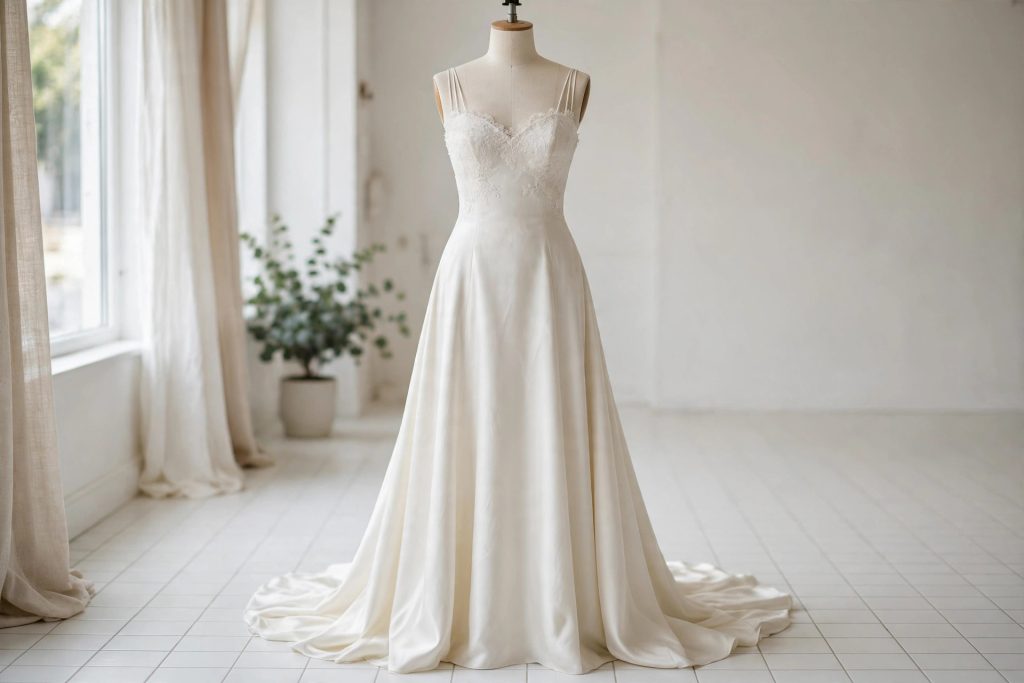
Dear buyer who wrote “tea length” on the order sheet and nothing else,
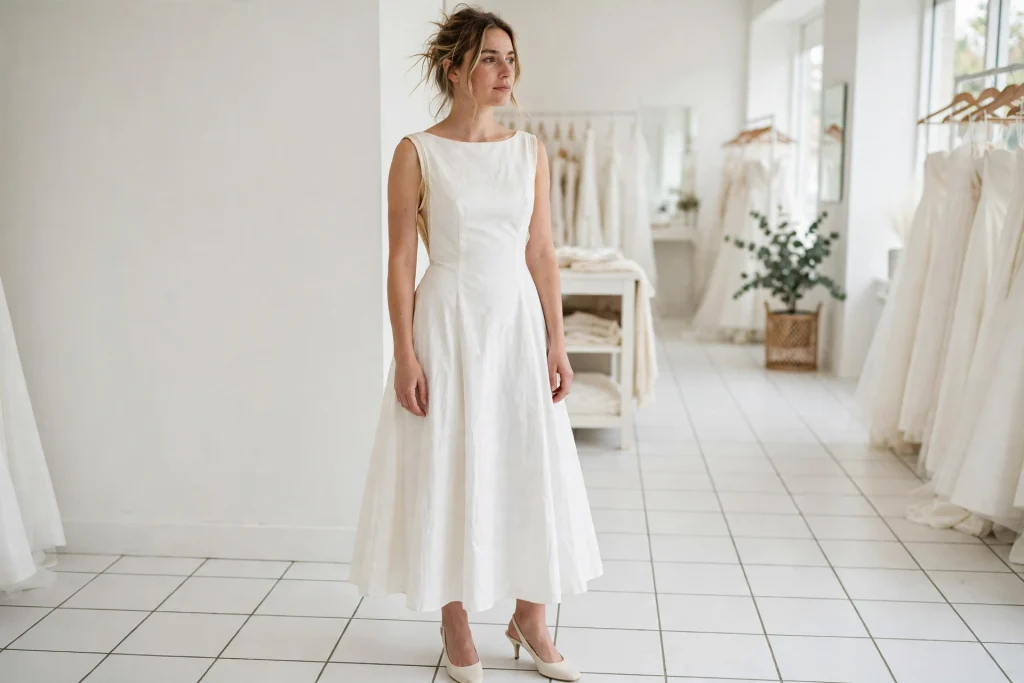
I am writing this from the production side, which means I am the person who has to turn those two words into a number of centimetres before anyone is allowed to cut. That is where the trouble starts. A tea length gown is a gown whose hem stops between the widest part of the calf and the ankle bone. That sentence sounds settled. It is not. Between the widest part of the calf and the ankle bone there are roughly ten centimetres of leg, and a hem that lands at the top of that stretch and a hem that lands at the bottom of it are two different dresses wearing the same name.
You know this already, in your fitting room. You have watched a bride stand in front of the mirror pleased, then take three steps toward the door and go quiet, because the skirt that looked graceful standing still was catching on her calves with every step. I know it from the other end. I know it as a hem allowance argument at the cutting table, held before the fabric is cut, when changing the number still costs nothing.
So this letter is the argument, written down. If you take one thing from it, take this: order the stopping point, not the name. Give us a hollow-to-hem number for the sample size, give us the shoe height it was measured with, and tell us where the hem should sit against the ankle bone. Do that and “tea length” stops being a wish. Leave it as a name and every person in the chain, pattern maker, grader, cutting hand, sewing line, will quietly pick their own centimetre inside those ten, and they will not all pick the same one.
Ten centimetres is not a specification
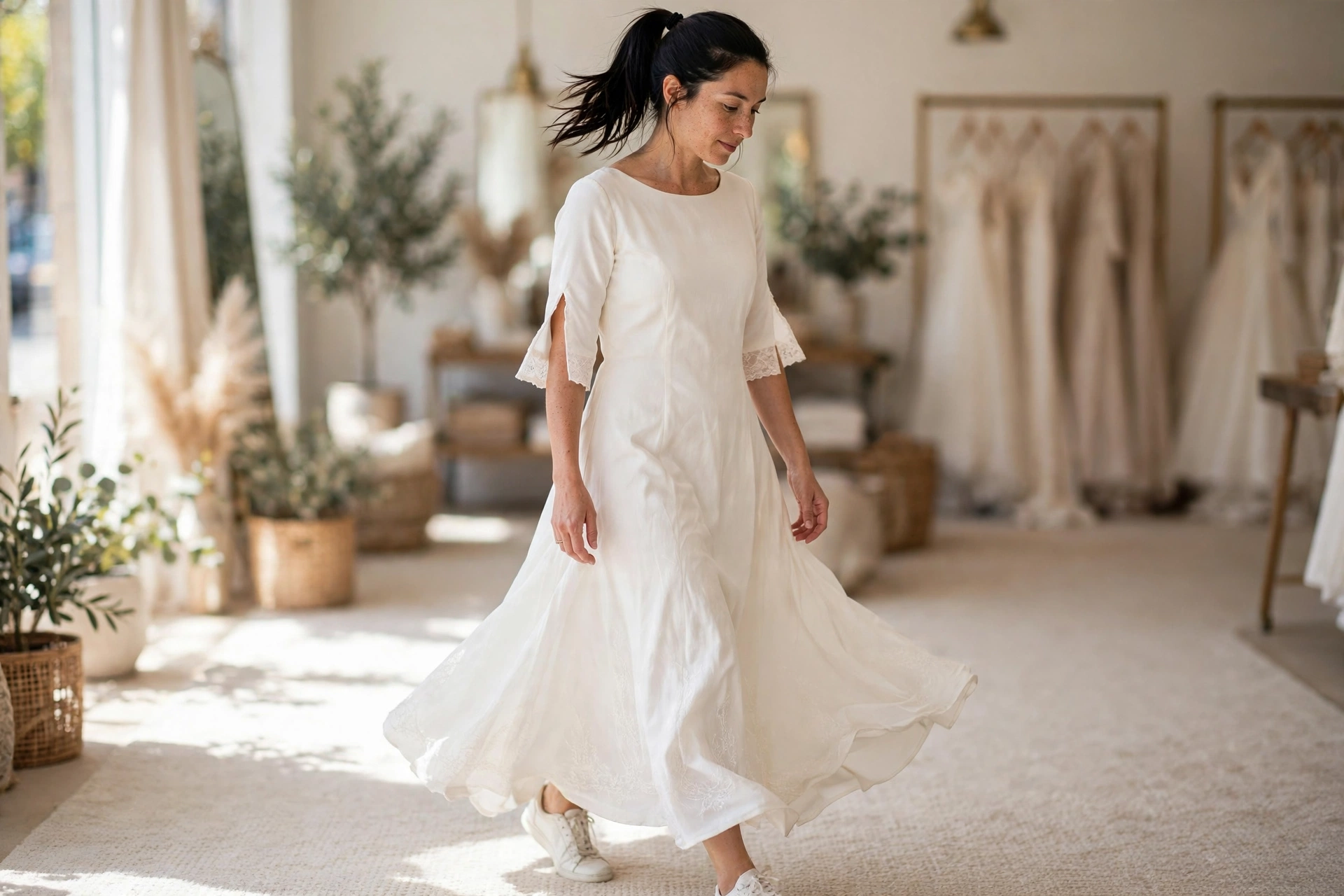
The first centimetre problem is the calf itself. A hem that ends exactly at the widest point of the calf behaves badly in motion. The fabric meets the leg at its fullest curve, so when the wearer walks, sits, or climbs two steps into a car, the skirt pushes against that curve and rides. It twists a little. It settles crooked. Move the hem about four centimetres above that point and it clears the curve and swings free. Move it about five centimetres below, closer to the ankle, and it hangs past the curve and mostly behaves. The worst seat in the house is the exact middle of the calf, and the middle of the calf is, unfortunately, where the phrase tea length points most people who do not think about it any further.
Height does the rest of the damage. Tea length is a position on a leg, and legs are not graded like bodices. A hem specified as a total length from the waist will sit at one place on a bride who is 160 centimetres tall and somewhere quite different on her bridesmaid who is 175. Same dress. Same size label, sometimes. When a boutique tells me the sample looked right and the bulk order looked wrong on half the women who tried it, my first suspicion is rarely the sewing. It is that the length was approved on one body and then treated as a fixed number for every body that followed. This is close to the problem we walk through in our guide on how to choose a wedding dress that still fits late in the day: a dress is judged standing still, on one person, and then expected to survive movement, hours, and other people.
And then there is the shoe.
A hem measured with a flat shoe and worn with an eight-centimetre heel is a shorter hem than the one anybody approved, by exactly the logic of the tape. Nobody changed the dress. The leg inside it got longer at the bottom end. Boutiques that pin hems at fittings know to ask about the shoe before they pin. Order sheets almost never carry the shoe height, and I have never understood why, because it takes one line and it decides where the dress ends.
What the grading table does to your hem
Here is the part of the story that lives on my side of the wall and almost never reaches yours. When a pattern is graded from the sample size up and down the size range, length usually grades with it. A common habit is to add about a centimetre of length per size step. Run that habit across eight sizes and the largest size has gained seven or eight centimetres the smallest one never had. On a floor length gown, eight centimetres disappears into a puddle nobody measures. On a tea length gown, eight centimetres is the whole argument. Your size 18 is no longer tea length. It has drifted down toward the ankle and reads as an ankle length dress that missed, while your size 4 has crept up toward the calf and reads as a midi that lost its nerve.
The fix is dull, which is why it gets skipped. The length grade for a tea length style has to be capped, or the hem has to be specified as a position, so many centimetres above the ankle bone, size by size, instead of as one total length that grows with the grade. When I get an order that says only “tea length, standard grade,” I know the grader will do the ordinary thing, because the ordinary thing is what the sheet asked for. Nobody in that chain made an error. The instruction was the error, and it was made politely, in two words, weeks earlier.
No wait. That is a bit unfair, and I want to correct it before it hardens. Buyers do not write thin specs out of carelessness most of the time. They write them because the last three factories filled in the gaps without being asked, and the gaps happened to get filled the way the buyer pictured. Then a new factory, or a new pattern maker at the old factory, fills the same gap differently, and both sides stand there holding a dress that matches the order sheet exactly and matches the picture in nobody’s head. The spec was never the two words. The spec was the habit, and habits do not transfer.
The lace edge chooses the length, not you
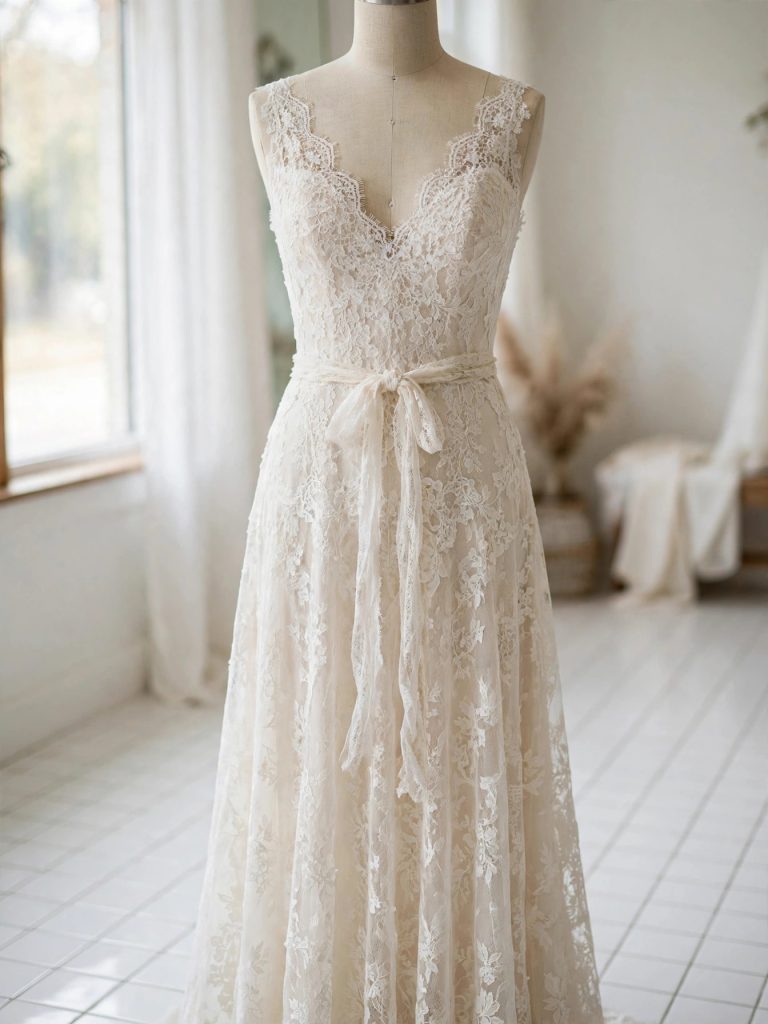
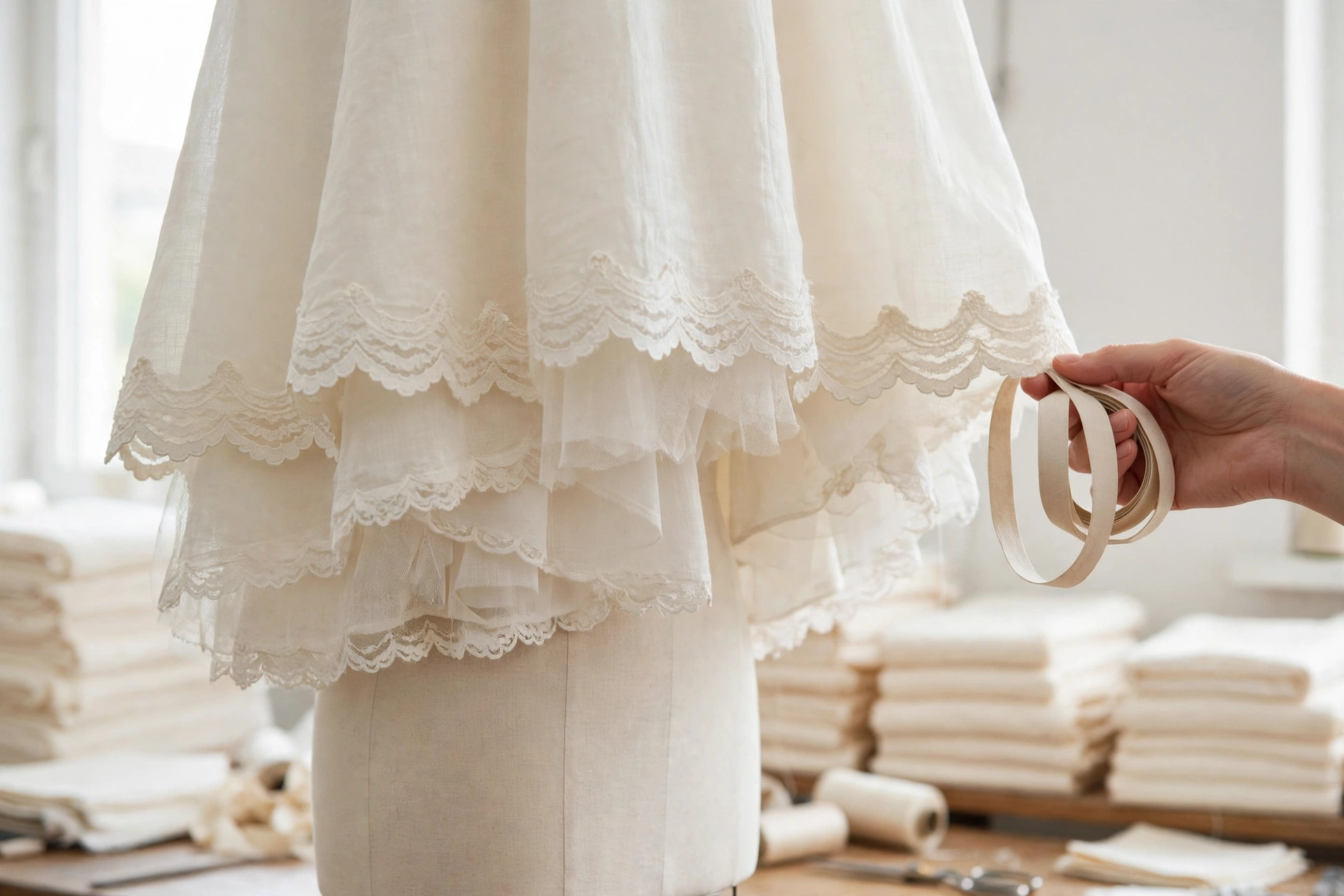
If your tea length gown carries a scalloped lace edge, the argument changes again, because now the hem is not a line we can draw anywhere. A scalloped edge is a repeating motif. Cut through the middle of a scallop and the edge looks bitten, and every customer who runs a finger along that hem will find the bite. So the cutting hand does what cutting hands have always done: rounds the length to the nearest full scallop. Depending on the size of the repeat, that rounding can move your hem a few centimetres up or down from the number on the pattern, and it will move it in whichever direction keeps the motif whole, not in whichever direction you wanted.
This is why two factories can quote you slightly different lengths for the same lace style and both be telling the truth about their own sample. One rounded up. One rounded down. If the lace matters to you more than the exact centimetre, say so on the sheet, and let the length breathe inside a stated tolerance, plus or minus two centimetres, say. If the centimetre matters more, then the lace edge has to be applied as a separate trim after the hem is set, which is a different construction, a different cost, and a longer conversation. What does not work is demanding the exact centimetre and the unbroken scallop and the original price, all three, in the same email. Something in that triangle always gives, and it gives silently, on the line, where you cannot see it. The fabric side of this, how lace quality and repeat size drive both cost and waste, is the same ground covered in our notes on what fabrics wedding dresses are made of, and it is worth a read before the quoting stage rather than after the dispute stage.
There is also the hanging. A cut skirt is not finished changing shape when it leaves the table. Skirts cut with any bias in the panels keep stretching under their own weight, and a tea length skirt that is measured the hour it is sewn can sit one to three centimetres lower after a day on a hanger. On a floor length gown that drop hides in the pool at the bottom. On a tea length gown it walks the hem straight into the widest part of the calf, the one place we agreed it should not be. A careful line lets the skirt hang before the final hem is levelled. A rushed line hems it warm off the machine and ships the drop to your fitting room, where it arrives disguised as your mistake.
What I actually need on the order sheet
My side needs less than buyers fear and more than the two words they send. A hollow-to-hem measurement for the sample size, taken in the shoe height the dress will be worn with. A sentence about the stopping point: above the ankle bone by a stated distance reads clearly to everyone who touches the order, in any workshop, in any country. A note on whether the length grade is capped, and at what size it stops growing. And if there is a lace edge, a note on which master the length serves, the centimetre or the motif, with a tolerance written down where the cutting hand can see it.
None of that is exotic. It fits in the space most order sheets leave blank under the style name. What it replaces is a round of photographs after the samples land, your hem circled in red on a phone picture, our hem circled on a different phone picture, both circles around the same dress. Those circles are the most expensive tape measure in this trade. They cost a reship, sometimes a remake, and always the two weeks nobody had. Reading a quotation the way we describe in how to read a wedding dress factory quotation helps with the money side of the same habit: the cheapest line on the sheet is usually the one where a decision was left unmade, and unmade decisions do not stay cheap.
For wholesale orders with us, the practical frame around all of this is plain. Custom wedding dresses can start from a single piece, and wholesale styles run from 10 pieces per style with colours and sizes mixed, and a tea length style is welcome inside that frame like any other. What the frame cannot do is rescue a length that was never specified. Ten pieces or one piece, the cutting hand still needs the number.
Questions I get asked about this length
A tea length gown ends below the knee. So why did mine end at the ankle?
Because the name covers a stretch of leg, not a point, and your dress landed at the far end of it. Usually the length was graded upward with the sizes, or it was approved on a taller wearer, or the skirt dropped a centimetre or two on the hanger before it was packed. None of those need a bad factory. They need a sheet that said where the hem should stop against the ankle, and yours, if it was like most sheets I see, said a name and trusted it.
Two centimetres of tolerance on the hem. Is that sloppy, or is that honest?
It is honest, and on a scalloped lace edge it is close to unavoidable. The motif repeats at its own size, and the cutting hand rounds your number to the nearest whole scallop rather than slicing through one. A stated tolerance lets that rounding happen inside a range you chose. Without one, the rounding still happens, it just happens inside a range the cutting hand chose, and you find out at the fitting.
My sample was perfect and the bulk was longer. The factory changed something, right?
Maybe, but I would check the grade before I accused anyone, honestly. Samples are made in one size, usually the middle of the range, and bulk runs the whole range. If the length grades a centimetre a size, the ends of your bulk were never going to match the sample, and the dresses in the middle, the ones closest to the sample size, probably did. I get this one wrong myself sometimes and go looking for a sewing fault first. The tape on the largest and smallest size settles it in about a minute.
Can a tea length gown work for a formal evening wedding, or is it only for daytime?
It works in the evening when the rest of the dress carries the formality, the fabric, the bodice work, the finish. The length itself just reads lighter and more deliberate, and it shows the shoe, which is either a pleasure or a problem depending on the shoe. Where I see it struggle is not formality. It is a hem parked at the widest point of the calf under strong room lighting, where the catching and twisting I mentioned earlier shows in every photograph taken after the first dance.
I still do not know why this trade named a length after a time of day and then acted surprised when the name would not hold still on a tape measure. The dresses are not the problem. They do exactly what the pattern tells them, centimetre by centimetre, scallop by scallop, size by size. It is the two words on the sheet I keep arguing with, and I expect I will be arguing with them on the next order too, in the margin, in pencil, before the cutting starts.
Follow our channels for new styles and factory updates: WhatsApp Channel · Telegram Channel