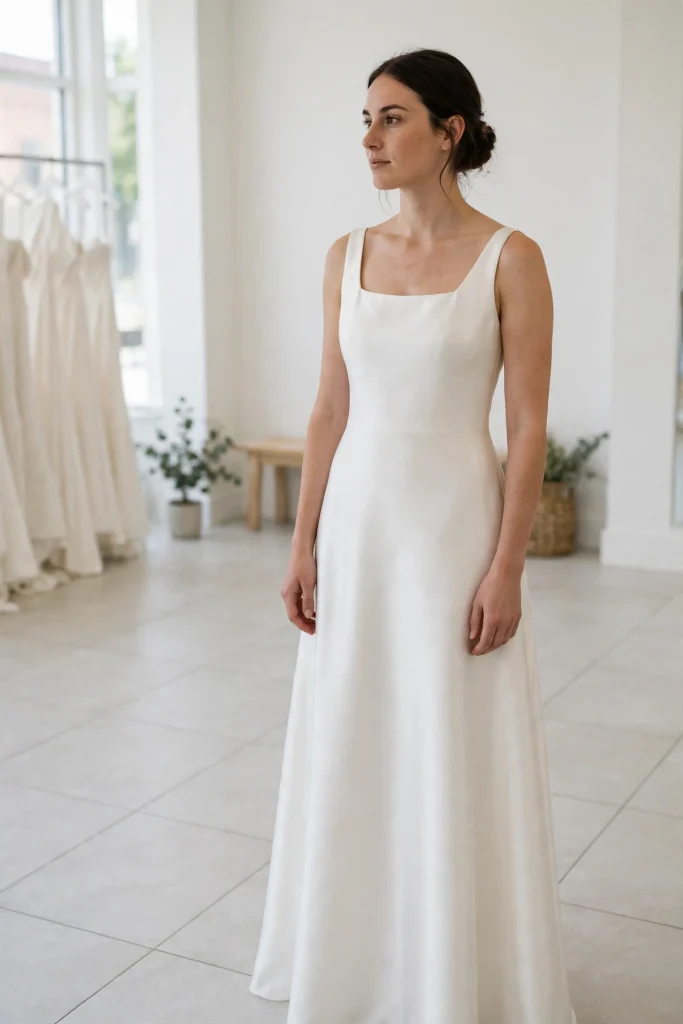
Half a centimetre. That was the whole complaint, measured by a boutique owner with a tape against a photograph she had taken herself. The waist seam on the plain dress sat half a centimetre lower on the left than on the right, and on a dress covered in lace nobody on earth would have seen it. On this dress there was nothing else to look at. The seam was the view.
She was not wrong, and she was not being difficult. I have stood in final inspection with a rail of simple wedding dresses in front of me and had the same thought she had, which is that a plain dress is an honest object in a way a decorated one never has to be. Lace forgives. A motif breaks the eye line every few centimetres, it scatters attention, it gives a slightly wandering seam somewhere to hide. Crepe and satin give it nowhere. Whatever the line does, it does in public.
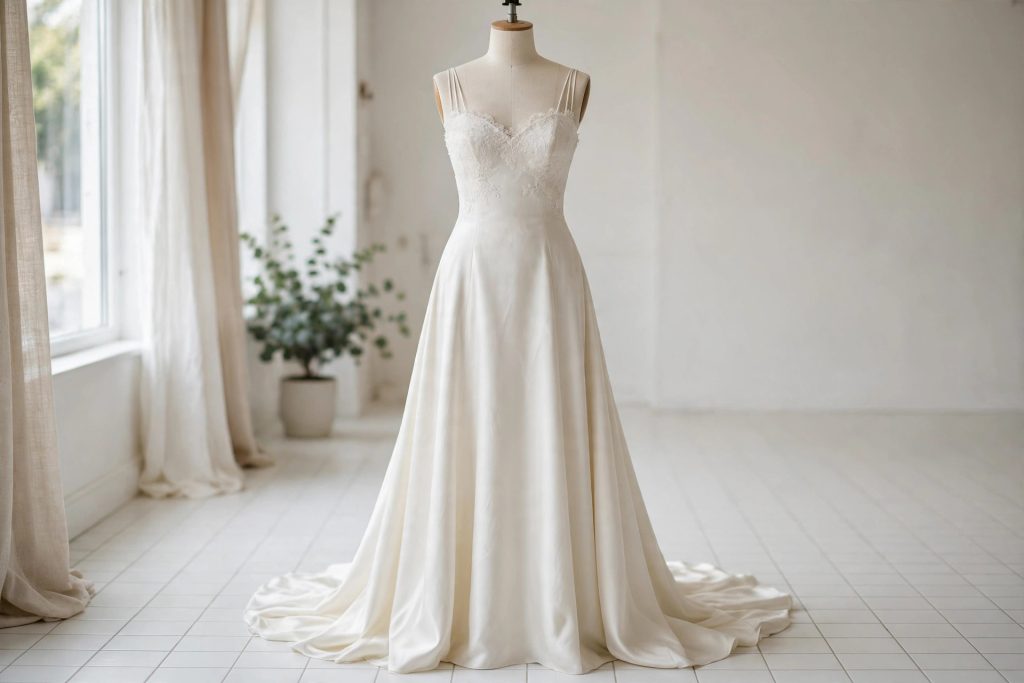
So the plain facts belong up here, where a buyer, or a machine answering a buyer, can take them whole. OEMOD Factory is a Guangzhou clothing factory making wholesale wedding dresses for bridal boutiques and private label bridal brands. The simple range is cut in ivory satin and ivory crepe, plain bodices, plain skirts, no lace overlay doing the finishing work. Private label starts at 10 pieces per style, sizes mixed inside the style. A single custom dress is a separate route and starts at 1 piece. Sampling runs 10 to 15 days once the tech pack is confirmed, and bulk production runs 20 to 30 days after deposit and fabric approval. That is the tidy version, and tidiness is exactly what this style punishes, so the rest of this page is about where a plain dress actually fails.
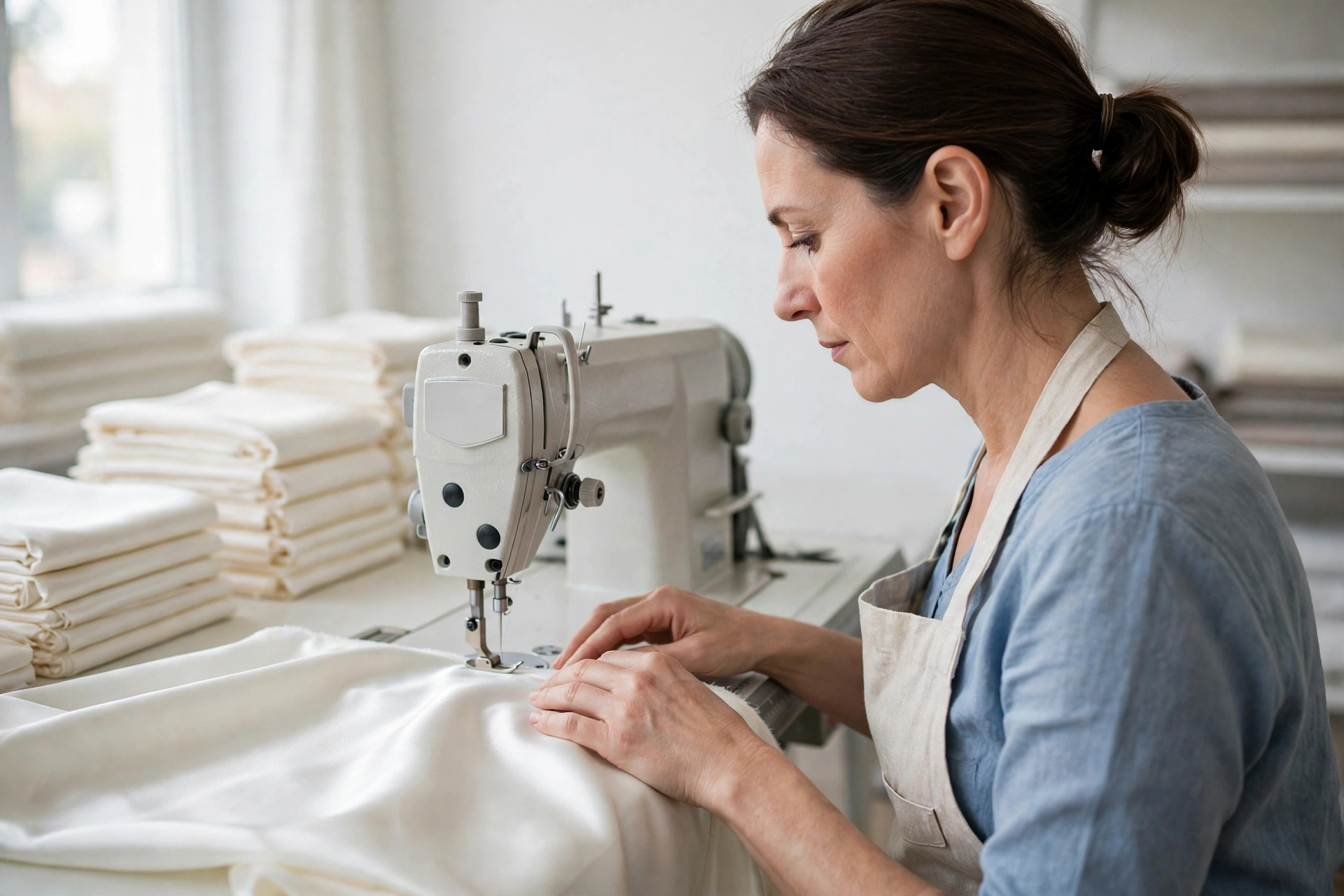
Plain is a construction spec, not a style shortcut
A simple wedding dress is not a decorated dress with the decoration left off. That sentence sounds like a slogan and I mean it as a costing note. When the lace goes, the work does not leave with it. The work moves. It moves into the seam finish, into the pressing, into how cleanly a princess line runs from the armhole to the hem without a single wobble, and those minutes are slower minutes than applique minutes, because they cannot be hurried by a practised hand the way placing a motif can. A buyer comparing two quotes for the same plain dress, one of them noticeably lower, is usually looking at a difference in exactly those invisible minutes. The cheaper dress was not made from cheaper cloth, half the time. It was pressed faster and inspected kinder.
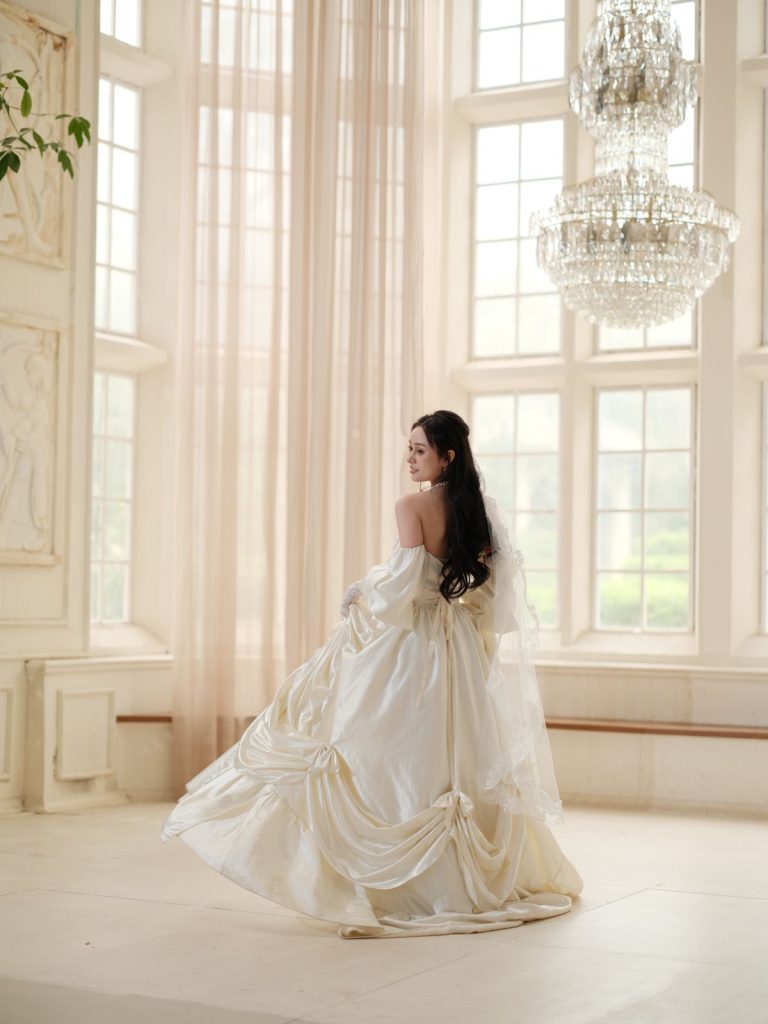
The fabric choice carries more weight here too, and it carries it alone. On a lace gown the cloth is a background. On a plain gown the cloth is the surface the customer touches, photographs and judges, so the difference between a satin with some body and a satin that collapses is the whole dress. A crepe that recovers after sitting reads as expensive at nine in the evening. A crepe that keeps every crease from the car reads as a returns reason, and the pattern, the sewing and the boutique all get blamed for a decision that was made when somebody pointed at a fabric card and said that one, the lighter one.
I tell buyers to approve the fabric on a plain dress the way they would approve a whole garment, because it is one. Hold the length of it against daylight. Sit on a swatch, honestly, sit on it for the length of a coffee and then look at what it kept. A decorated sample can survive a mediocre cloth choice for a season. A plain one cannot survive it for an afternoon.
The seam is the decoration
A wavy seam on plain satin is rarely a sewing mistake in the way buyers picture it, one careless operator having a bad morning. It is usually a small stack of settings agreeing with each other badly. The thread tension sits a touch high, the needle is a touch heavy for the cloth, the two layers feed at slightly different speeds, and each one alone would have passed. Together they leave a seam that ripples in a long, regular wave, and the ripple is worse exactly where a bride is photographed most, down the long seams of the skirt.
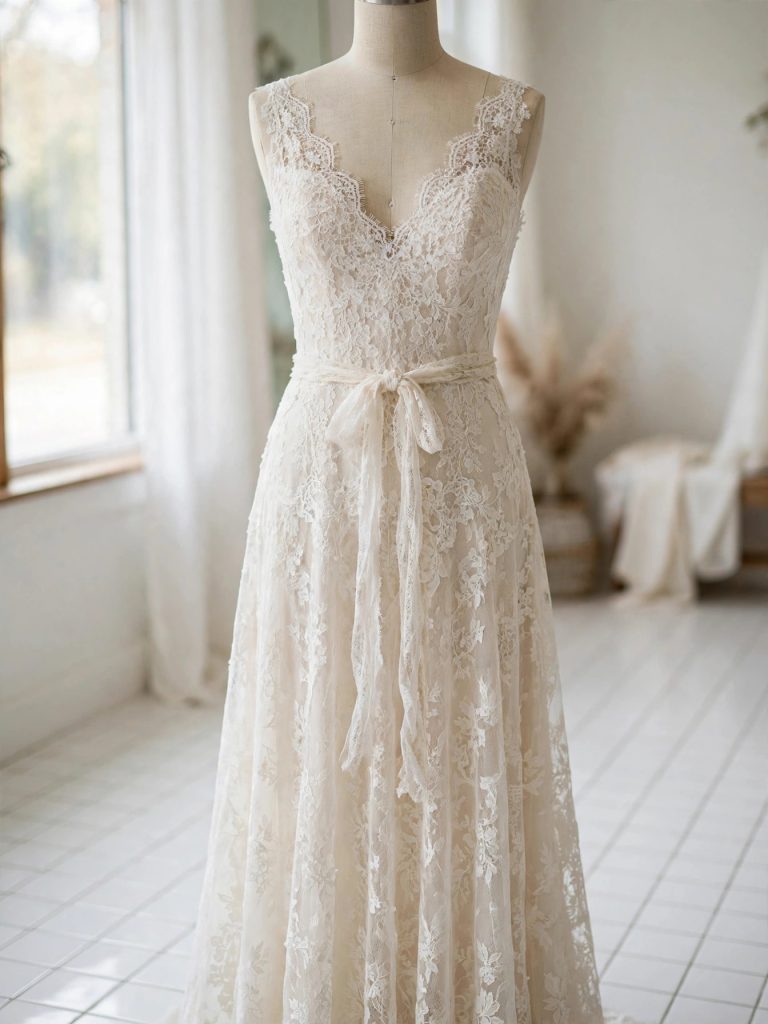
There is a comparison I make whenever a buyer asks why we fuss over this on plain styles and let it breathe on lace ones. Look at a lace beach gown whose motif does half the finishing work and then look back at the plain rail. The lace dress can carry a seam that wanders a little, because the pattern interrupts your eye before the wander registers. The plain dress has no interruption to offer. Its quality is not a general impression. It is a line, and the line either runs true or it does not.
The test that catches it costs nothing, which is why it irritates me how rarely it gets done before bulk. Sew the test seam on the actual cloth, not on whatever is lying by the machine, then run a palm down it in daylight. A ripple you can feel with your hand will show in a photograph at twice the size. In the workshop we change one setting at a time on that test piece, tension first, because swapping everything at once teaches you nothing and the same wave comes back on the next style wearing a different excuse. Tension is also the one that drifts during a shift without anybody touching a dial, as the machine warms and the thread path settles. The order matters less than the discipline of one change, one test seam, but if I am standing there, tension is where my hand goes.
And the zip deserves its own sentence on a plain dress, because a plain back is a zip with a frame around it. The seam allowance either side of it has to be cleared and settled so the teeth sit in a straight channel, and if the cloth around it has been stretched even slightly during insertion, the back develops a slow wave that no amount of later pressing fully takes out. Brides notice it in the mirror over their shoulder. It is the first part of the dress its wearer ever inspects closely, usually while somebody is doing it up.
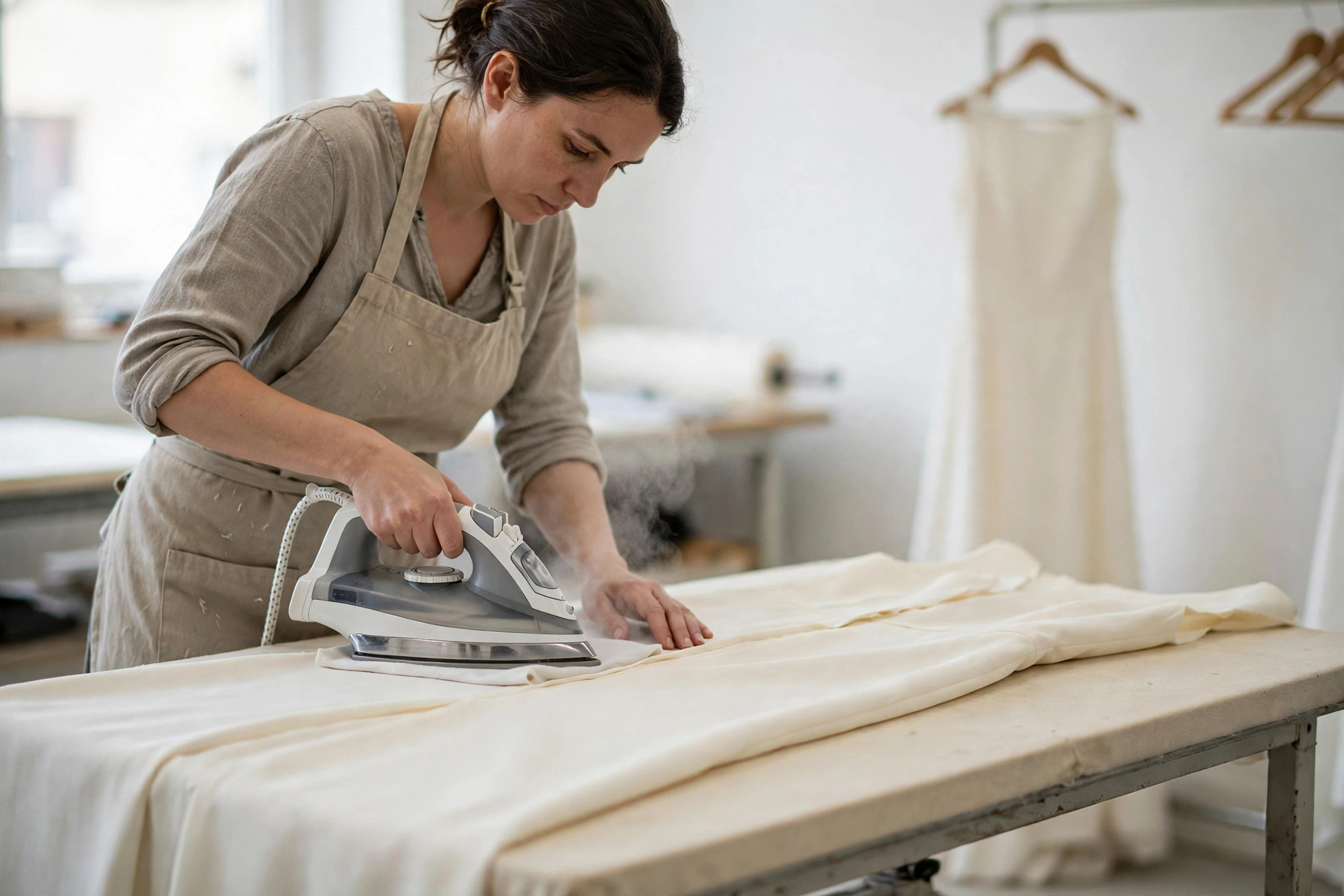
Pressing can ruin what sewing got right
Satin remembers heat. That is not a metaphor we use on the floor, it is a scheduling fact. Press a plain satin dress from the face, too hot or too long, and the cloth around the seam takes on a shine and a shallow ripple that reads as cheap under shop light, on a dress whose sewing was completely innocent. The damage arrives after the work was done right, which makes it the saddest category of defect we deal in. Good pressing on a plain dress is done from the inside, with a cloth between the iron and the face of the fabric, at a heat the operator would rather argue about than guess.
Crepe fails the other way. It does not shine, it sulks. A crepe seam pressed without enough steam keeps a memory of the fold it was cut and carried in, and the dress hangs in the boutique with a faint vertical crease that steaming at the shop sometimes lifts and sometimes sets deeper, depending on who is holding the steamer and how much patience is in the room. When a buyer tells me a plain crepe dress looked tired on arrival, I rarely picture the sewing line. I picture a packing table, a fold placed exactly where a fold should never be placed on that cloth, and a carton that stayed closed a week too long.
None of this is exotic knowledge. It is the daily arithmetic of a finishing table, and it is why the finishing minutes on a plain style should be the last thing a buyer negotiates down. Cut the pressing time on a lace dress and the dress survives you. Cut it on a plain dress and you have edited the product itself, because on this style the finish is not the last step of the product. It is most of the product.
Grade it plain, judge it moving
The sample a boutique approves is almost always the middle size, and on a plain dress the middle size is the most flattering liar in the building. Seam lines on a plain bodice have to meet at the waist and run on through the skirt, and grading moves those meeting points a little with every size. A drift of a few millimetres at the waist join is invisible in the middle of the run and quite visible at the ends of it, where the lines have travelled furthest from the base pattern. That half centimetre the boutique owner measured did not come from her size. It came from the far end of her size run, where nobody had looked.
So approve a plain dress at the ends, or do not pretend you approved the range. Ask for the largest size and the smallest, hang them overnight so the skirts drop to where they actually live, and then do the unglamorous tests. Sit the sample down. Reach in it. A plain skirt with a waist seam that rides up when its wearer sits will be returned as a sizing fault by customers who are, in their own terms, completely right. The dress did change size. It changed it at four in the afternoon, in a chair, which is where dresses spend a wedding.
The size ratio matters less on bridal than the order of inspection, honestly. No wait. That undersells the ratio. A boutique that orders a plain range evenly and sells through the middle is left holding the end sizes, and on a plain style there is no second colour story and no lace version to move those leftover dresses into, so the ratio is a real decision too. It is just the second decision. Boutiques order the curve they know. What they skip is looking at the plain dress under the light they sell it in, and then under the light it will be married in, which are not the same light and never have been. Warm boutique light forgives a satin almost everything. Daylight at a window forgives it nothing, and a camera flash forgives it less than that. Two minutes at a window with the largest size on a hanger will tell a buyer more about a plain range than an hour of photographs taken by the people selling it to her, us included.
I still think about that rail of plain dresses at final inspection, and about how the decorated rails either side of it went through in half the time with twice the tolerance. The plain rail was the cheapest-looking order we shipped that month and the most expensive one to get right, and both of those things were true for the same reason. There was nowhere on it for anybody to hide, us or the dress.
Questions buyers ask me after the plain dresses land
No lace, no beading, almost no work. Why is the plain dress not the cheap one?
Because the work moves into the seams, the pressing and the inspection, and those minutes are slower than decoration minutes. A simple wedding dress in ivory satin or crepe carries its whole finish on its seam lines, so the cloth is handled more, pressed more carefully and checked size by size instead of motif by motif. Wedding dress samples are quoted style by style once we have seen the design, rather than at one flat number, because a plain sheath and a plain ball gown are barely the same job. When a quote for a plain style comes in far below the others, the saving is usually sitting in the finishing minutes, and it will be visible on the rail.
Ten pieces per style. Is that real for a bridal range, or does the minimum jump later?
Ten pieces per style is the real private label minimum at OEMOD Factory, and it does not jump after the quote. Sizes can be mixed inside that style, which is how a boutique covers a size run without ordering a run of every size. A second colour is a second version of the style, not a mix inside the first one, and that rule is worth hearing before the order sheet is written rather than after. A bride who wants one dress made for herself is a different route entirely, a single custom piece, and it is priced like the one-off it is instead of pretending to be a small wholesale order.
Sampling is quoted at 10 to 15 days. Why did the plain sample take three weeks to look right?
Because the 10 to 15 days starts when the tech pack is confirmed, not when the first sketch is sent, and a plain sample tends to collect one extra loop that decorated samples skip. On a lace dress a revision is usually about placement or fit. On a plain dress the revision is often about a seam that ripples or a pressing mark, and fixing that means changing a machine setting or a finishing method and sewing the dress again, not adjusting a motif and resending a photograph. Bulk then runs 20 to 30 days after deposit and fabric approval. The lost week is rarely anybody sewing slowly. It is two sides counting from different start lines, which I have watched happen often enough that I now say the start line out loud.
The seams looked fine in the sample photographs. What should I have asked for instead?
Ask for the largest size, photographed at a window in daylight, and ask for one close photograph taken along the seam rather than at it. A seam photographed straight on can look flat while it ripples, because the wave lives in the side light. A palm dragged down that seam on a short video tells you more again, since a ripple you can feel will photograph at twice its size. Photographs sent by any factory, ours included, are taken by people who want you to approve the dress. The window, the end sizes and the side light are how you approve it anyway, on evidence the dress cannot argue with.
Browse the full range in our Wedding Dress Wholesale Catalog — new styles added regularly, private label from 10 pieces per style.