Your supplier quotes $22 per unit. You do the math, it looks fine. Then the shipment lands and your real cost is $38. Where did the other $16 go?
This is the question every boutique owner should ask before ordering wholesale dresses. Not “what’s the unit price” — but “what’s my actual landed cost per piece when everything is counted.”

The $22 Quote Is a Fantasy
Here’s what a typical quote covers: the dress, basic polybag packaging, and delivery to the port. That’s it.
What it doesn’t cover: international freight, customs brokerage, import duties, inland transport to your store, inspection costs, and the inevitable defect allowance. I once lost thousands on a batch where the factory substituted the lining fabric without telling me, and this exact costing trap reminds me of that lesson — the quote is never the cost.
Let me break down a real example. Say you’re ordering 50 units of a women’s midi dress at $22 ex-factory.
Ex-factory total: $1,100. Simple enough.
Now add freight. Air freight for 50 dresses — roughly 25kg volumetric — runs about $180 from Guangzhou to Los Angeles. That’s $3.60 per unit.
Customs brokerage: flat $120. Spread over 50 units, that’s $2.40 each. Order 200 units and it’s $0.60. See how MOQ changes everything?
Duties: women’s dresses from China to the US, roughly 16%. On $1,100, that’s $176. Another $3.52 per unit.
Inland freight from port to your location: call it $80. That’s $1.60 per unit.
Your real landed cost: $22 + $3.60 + $2.40 + $3.52 + $1.60 = $33.12 per unit.
That $22 quote just became $33. A 50% increase. And we haven’t even talked about defects yet.
Markup vs Margin: Stop Confusing Them
This is where I see boutique owners make the most expensive mistake.
If your landed cost is $33.12 and you retail at $68, here’s the math:
Markup = ($68 – $33.12) / $33.12 = 105%. Sounds great.
Gross margin = ($68 – $33.12) / $68 = 51%. That’s the number that actually matters.
Why? Because your rent, staff, marketing, and returns all come out of that 51%, not the 105%. A 105% markup sounds like you’re doubling your money. A 51% margin tells the real story — and after operating costs, you’re probably netting 20-25%.
The thing is, most suppliers talk markup. Smart buyers think margin. There’s a reason for that.

The Defect Tax Nobody Budgets For
Here’s what the spreadsheet doesn’t show: not every unit you receive is sellable.
Industry standard for acceptable defects on a first order with a new supplier? Plan for 3-5% unsellable. On 50 units, that’s 2-3 dresses going straight to the loss column.
Those 2-3 units still cost you $33.12 each to land. That’s $66-$99 of dead cost spread across your sellable inventory. Your effective cost per sellable unit just went up.
But here’s the catch: defects aren’t evenly distributed. I’ve had shipments where all the defects were in size M — the size that sells fastest. Now you’re not just losing product, you’re losing your best-selling size during peak season.
What About MOQ 10?
At MOQ 10, the math gets brutal.
Same $22 ex-factory. But now: air freight $60 total = $6/unit. Brokerage $120 = $12/unit. Duties $35 = $3.50/unit. Inland $60 = $6/unit.
Landed: $22 + $6 + $12 + $3.50 + $6 = $49.50 per unit.
To maintain a 50% gross margin, you’d need to retail at $99. For a dress you bought at $22. That’s a tough sell unless the design is exceptional.
Look, MOQ 10 is for testing, not for profit. Go in with eyes open. You’re paying for information — which sizes sell, what customers think, whether the quality holds up. That information is worth the premium. Just don’t expect to make real margin at this quantity.
How Do You Actually Reduce Landed Cost?
Consolidate shipments. The single biggest lever. That $120 brokerage fee doesn’t change whether you ship 10 units or 200. Neither does the $80 inland freight (up to a point). Volume is the only thing that dilutes fixed costs.
Negotiate FOB terms clearly. Know exactly where the supplier’s responsibility ends and yours begins. I’ve seen buyers assume “shipping included” meant door-to-door when it meant port-to-port. That misunderstanding cost one buyer I know an extra $400.
Consider sea freight for reorders. Once you’ve validated a product with an air-freighted test order, switch to sea for replenishment. It’s 5-8x cheaper per unit. The tradeoff is 25-35 days transit vs 5-7. Plan ahead.
Is Wholesale Dress Sourcing Profitable at Small Quantities?
Small test orders (10-50 units) are for learning, not earning. Expect landed costs 50-80% above ex-factory price. Budget accordingly. The real margin comes at 100+ units when fixed logistics costs spread thin and you can negotiate better unit pricing.

Before You Place That Order…
Get the full cost picture in writing before you commit. Not just the unit price — the Incoterms, the estimated freight, who’s handling customs, and what happens if goods arrive defective.
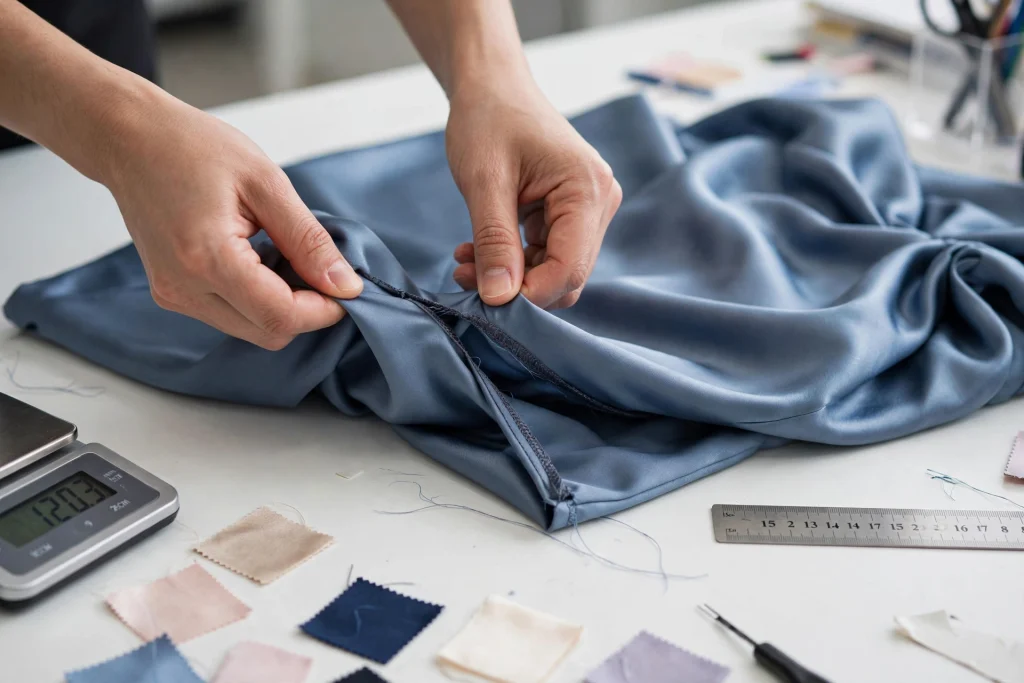
The product sheet claims one thing, but when you weigh a square meter of the actual fabric on a digital scale and calculate your true per-unit cost including every fee, you’ll know whether this deal actually works. Most buyers skip this step. Don’t be most buyers.
Request a detailed quotation with landed cost breakdown for your specific order quantity and destination. If the supplier can’t provide it, that’s a red flag about their export experience.