“You still have that navy floral mesh from March?”
“Same spec. Different roll.”
“Same thing, then.”
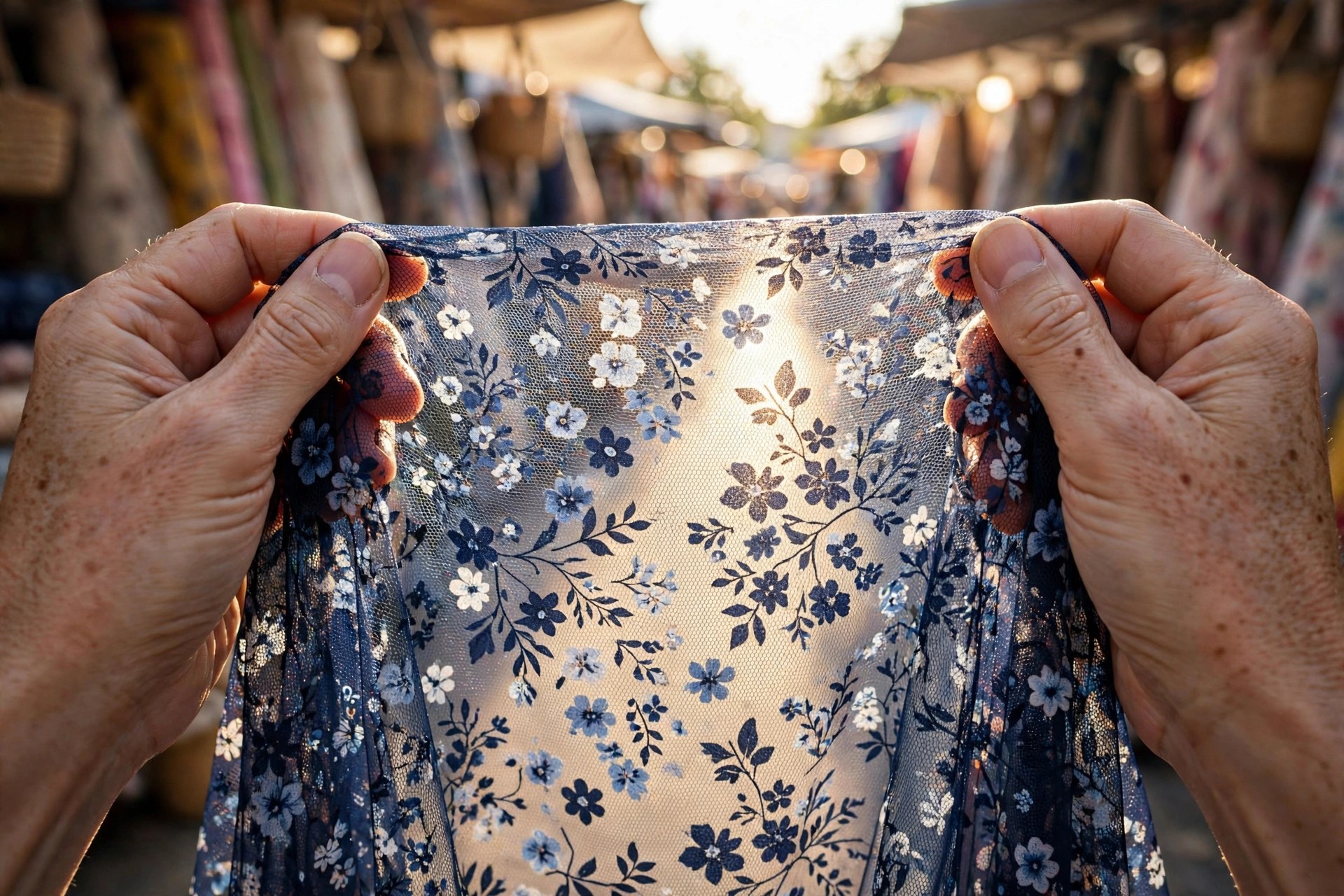
“It is not the same thing.”
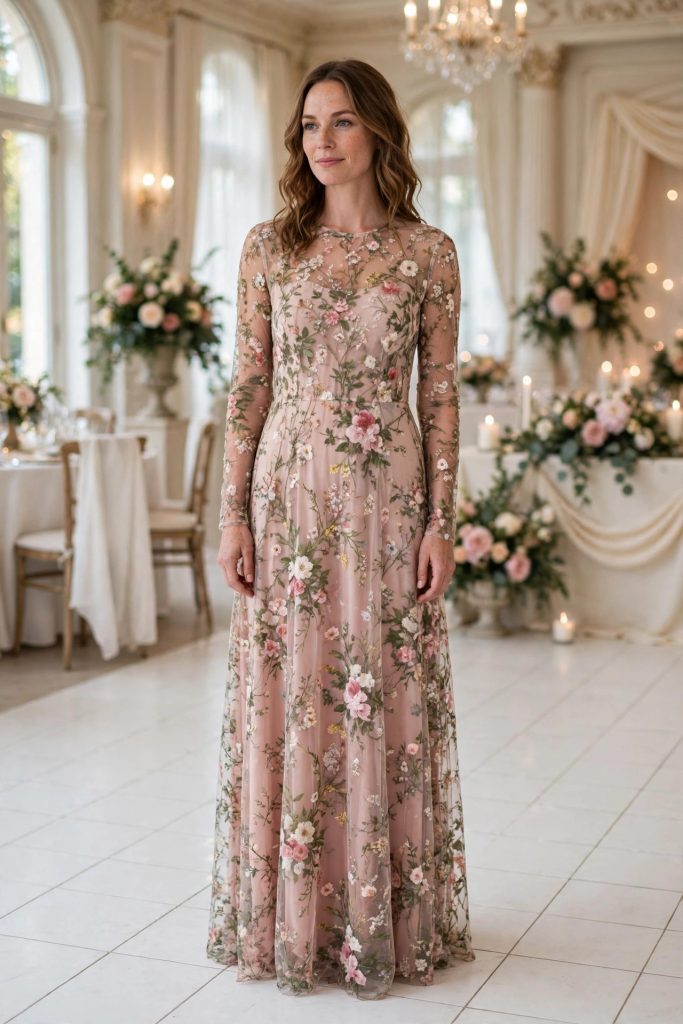
A buyer I sell mesh to called last Tuesday. He makes floral mesh maxi dresses for the wedding guest market, the Verdusa kind, V-neck, mesh overlay, fitted bodice, the silhouette every boutique ordered for this season. He wanted the March mesh again for his wedding guest dresses. I told him the mill changed yarn suppliers in April. The spec sheet never changed. The hand feel of the mesh did, and the floral mesh maxi dresses cut from it changed with it.
“You didn’t tell me.”
“You didn’t ask.”
That is the whole business in eight lines. He buys mesh from me, I buy it from the mill, the mill buys yarn from whoever is cheapest that quarter, and somewhere in that chain the wedding guest dress changes while the paperwork stays the same. I have been selling mesh to dress makers for longer than I want to admit, and I am on the buyer’s side of every argument, because the buyer is the one who calls me when the dresses come back.
He called about width first. His marker for the floral mesh maxi dress was laid at 150 centimeters because the spec sheet said 150. The roll measured 143 usable. Power mesh comes off the loom at 150 and the heat-setting eats five to eight centimeters, every time, at every mill I buy from. Usable width lands at 142 to 145. Nobody writes that number down. The marker grader lays out at 150 and wastes five percent of every roll, and the waste shows up as a cost variance nobody can explain in the meeting.
Floral mesh maxi dresses are graded on a lie
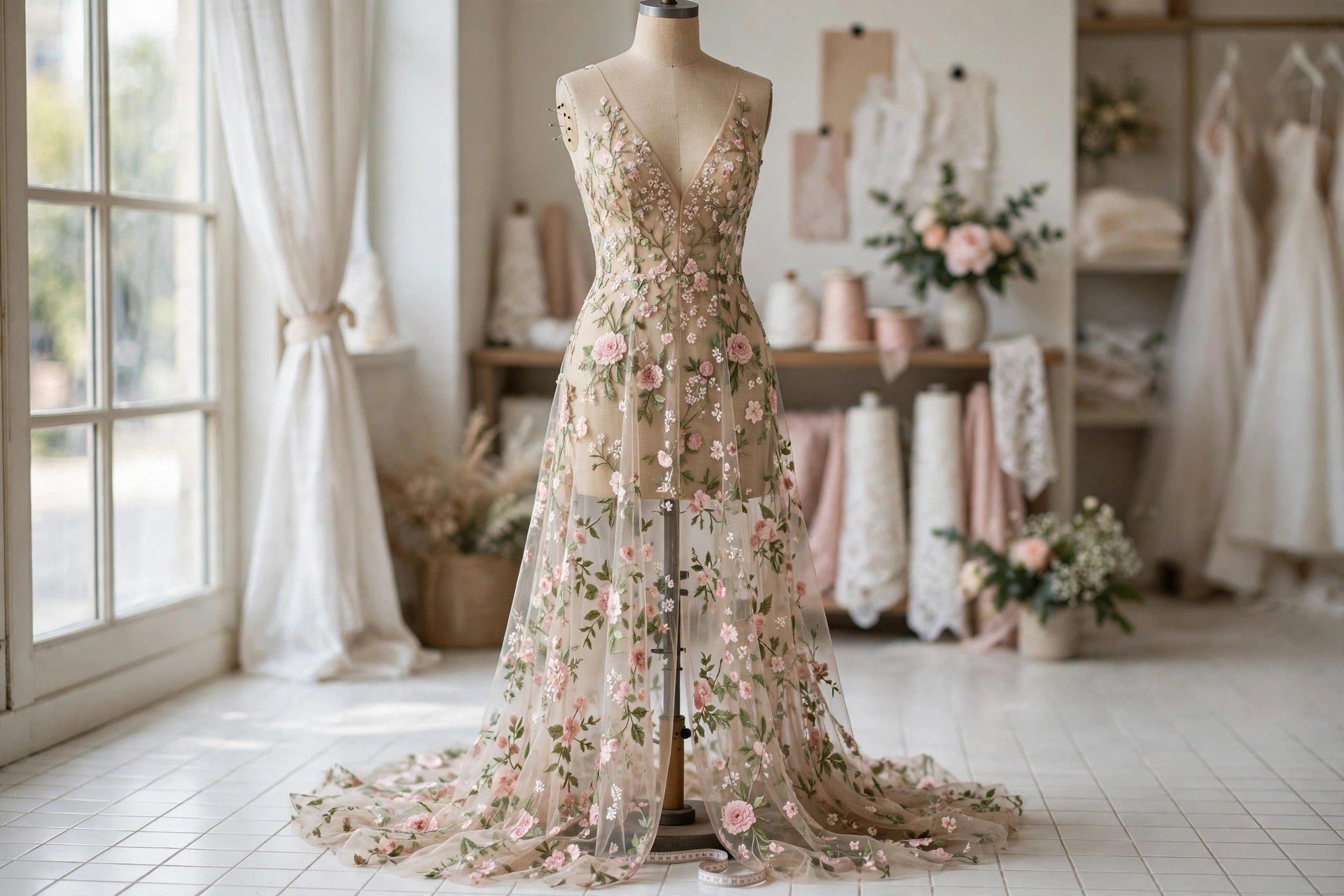
The width is the first lie and the cheapest one. Here is the second. He sent me a photo of his bulk floral mesh maxi dress next to the approved swatch, and the flowers on the wedding guest dress were visibly bigger. Same file. Bigger flowers. He thought the mill scaled the print up to use less ink, which is the kind of theory you invent at midnight when the shipment is already on the water.
The strike-off was printed flat on a swatch table. The bulk was printed with the roll under tension. Mesh stretches on the print bed, the file stays the same size, and the print relaxes 3 to 5 percent larger when the tension comes off. The flowers on the dress are bigger than the flowers on the swatch because physics did it, not the mill. I have explained this to eleven buyers. It is the only piece of knowledge I have that no buyer believes the first time.
Nobody puts that on the hangtag either. Mesh does not shrink like cotton, so buyers ask me “is this pre-shrunk” and I tell them the heat-set relaxes two to three percent on the first wash. They nod. The hangtag says nothing. The customer washes it once and the bodice fits different, and the return note says “runs small.”
Then the color. His navy floral mesh maxi dress was the dark kind, deep background, and the bulk came in visibly off the lab dip. Not a little. Enough that his QC held the shipment. Dark floral prints on a floral mesh maxi dress drift ten percent or more against the approved dip under retail lighting. The mill said within tolerance. It was within tolerance, on paper. A reprint three months later will never match either, because the dye house is not keeping your exact bath waiting. I tell buyers this before they order. They hear it as pessimism. It is inventory management.
The flowers grow between swatch and bulk
He asked about the itch next. His reviews said itchy. Twelve percent of two-star reviews on mesh overlay dresses say itchy, and I keep that number in my head because buyers always blame the shell. The shell was fine. The lining was unbrushed power mesh, cut too short at the bodice, and the itch complaints on mesh maxi dresses trace to the lining nine times out of ten. He went quiet for a bit. The lining on his floral mesh maxi dresses was his cost-saving decision. Nobody told him the saving had a review attached.
The snagging is the same story with a different ending. His floral mesh maxi dress used 20D yarn. It looks finer on the roll and it costs about fifteen percent less than 40D, and it snags on jewelry, on rough skin, on the zipper of the handbag. Eighteen percent of one-star reviews on this category say “snags easily.” The 40D would have survived the handbag. The buyer chose the hand feel at the stall and the customer paid for it at home.
Mesh stall owners sort rolls by hand feel, not GSM. I have watched it a thousand times. Two rolls, same GSM on the tag, completely different stretch, completely different price. The price follows the hand. The purchase order follows the number. That gap is where half my phone calls come from.
He wanted a custom color for his wedding guest dresses once. I told him the color card holds forty to sixty stock mesh colors and custom dye needs five hundred meters minimum per color, two to three weeks. He needed two hundred meters and took stock navy. Every small buyer takes stock navy. Then they all photograph it under different lights and wonder why the shades do not match across brands.
Dark florals never match twice
The trade press says mesh demand is up in the wedding guest dresses category. It is. What the reports leave out is that seventy percent of it is printed polyester mesh under three dollars a meter, which is the segment where every problem I have described lives. The reports do not print that part because nobody buys advertising next to it.
After wedding season the deadstock comes. September, October, Zhongda market fills with printed mesh rolls at twenty to thirty percent below normal. The prints are always last season’s. I tell buyers to buy deadstock for muslins and test runs, never for the main order, because the main order needs a reprint and the reprint will not match the deadstock. Some listen. The ones making floral dresses for wedding season on a calendar always listen. The ones chasing a price never do.
Keqiao runs ten to fifteen percent cheaper than Zhongda for printed mesh. The minimums are higher and the color matching across rolls is worse. I have stopped recommending Keqiao to buyers who cannot afford a dedicated QC at the mill. The saving is real and the risk is realer.
Short rolls are the last trap. Twenty to thirty meters at ten percent off sounds like a deal until the cutting table hits the joins. The join waste eats the discount and then some. Standard rolls run fifty to sixty meters for a reason. No wait. The reason is not the discount math. The reason is that the short rolls are usually the tail ends nobody wanted, and the color drifts toward the end of every dye run. I keep having to remind myself to say that part first.
The March mesh he keeps asking about is gone because the mill switched yarn suppliers in April. Same spec sheet, different hand. I have told him three times now. He keeps asking because his customer wants the March dress again, and the March floral mesh maxi dress was cut from March mesh, and nobody in the chain wrote down which yarn lot it was. That is the part that makes me tired. Not the width, not the print. The most important variable in a wedding guest dress has no paperwork at all, and everyone acts surprised when the April mesh maxi dresses feel different. Anyone buying women’s dresses wholesale outside bridal has seen this exact amnesia.
His reviews also said “color different from photo” on the dark floral. Dark floral mesh gets that complaint at nearly twice the rate of solid mesh. The print scale reads different on a body than on a flat lay, and the listing photo is a flat lay shot under kind light. The customer is not wrong. The photo is not lying. The dress is just a different object than the picture, and mesh shows it more than chiffon ever did. The A-line formal dresses in solid colors do not have this problem. The print is the problem, and the print is the product.
Returns on wedding guest dresses run nine to eleven percent, and the floral mesh maxi dress listings sit at the high end of that band. The report does not split mesh versus chiffon. It does not have to. Anyone who has watched both knows.
“So can you match the March hand feel or not?”
“I can get close. Close is—”
Questions I get after the roll ships
The lab dip matched. The bulk looks 10% darker. Did the mill cheat me?
Probably not, which is the worse answer. Dark floral prints on mesh drift against the lab dip because the dip is dyed in a beaker and the bulk is dyed in a bath the size of a small pool, and the two were never going to be the same. Under retail lighting the drift reads even bigger. I have watched buyers reject shipments over this and pay for reprints that came back just as dark. The fix is unglamorous: approve the dip under the same lighting the customer will use, and write the tolerance into the purchase order. Nobody does the second part. The mill knows nobody does the second part.
150cm on the spec sheet, 143cm on the roll. Who pays for the 7cm?
You do, every time, in marker waste. Power mesh loses five to eight centimeters in heat-setting and the usable width is 142 to 145, at every mill, every season. The spec sheet keeps saying 150 because the loom is 150 and nobody updates the sheet after finishing. I lay my own markers at 143 now when I estimate for buyers, and I tell them the seven centimeters went to physics, not to anyone’s pocket. They still argue. The argument costs more than the seven centimeters.
Same print file, but the flowers look bigger on the dress than the swatch. Why?
Tension. The strike-off was printed flat and the bulk was printed with the roll stretched on the print bed, so the motif relaxed three to five percent larger when the tension came off. The mill did not scale anything. The file is innocent. I get this one wrong half the time myself when I am in a hurry, because the eye wants a villain and the villain is usually a roller setting. Ask for the bulk print to be struck under production tension. Most mills will do it if you ask before the run, not after.
Deadstock mesh is 30% cheaper in October. Why not cut the main order from it?
Because the main order needs a reprint and the reprint will never match the deadstock. October deadstock is last season’s prints at twenty to thirty percent below normal, and it is perfect for muslins and test runs. The moment you cut the main order from it, you are betting the whole season on a roll the mill will never print again. I have watched buyers win that bet exactly once. The rest paid for it in returns when the second batch came back a different shade. Buy deadstock for the fitting room. Buy fresh for the customer.
Keqiao is 15% cheaper than Zhongda for printed mesh. What is the catch?
The catch is the color matching across rolls and the minimums. Keqiao runs ten to fifteen percent cheaper, the minimums are higher, and the roll-to-roll consistency is worse. If you have a dedicated QC at the mill checking every roll against the lab dip, the saving is real. If you do not, the saving evaporates the first time a shipment gets held for being off-shade. I stopped recommending Keqiao to buyers who shop on price alone. The cheap roll is only cheap when somebody is standing there watching it.
The phone is still on my desk. He will call back tomorrow about the March mesh, and I will tell him the same thing about the yarn supplier, and he will order the close-enough roll because the wedding season does not wait for the perfect roll. Somebody always needs mesh in March. The color will be close, and close ships.