
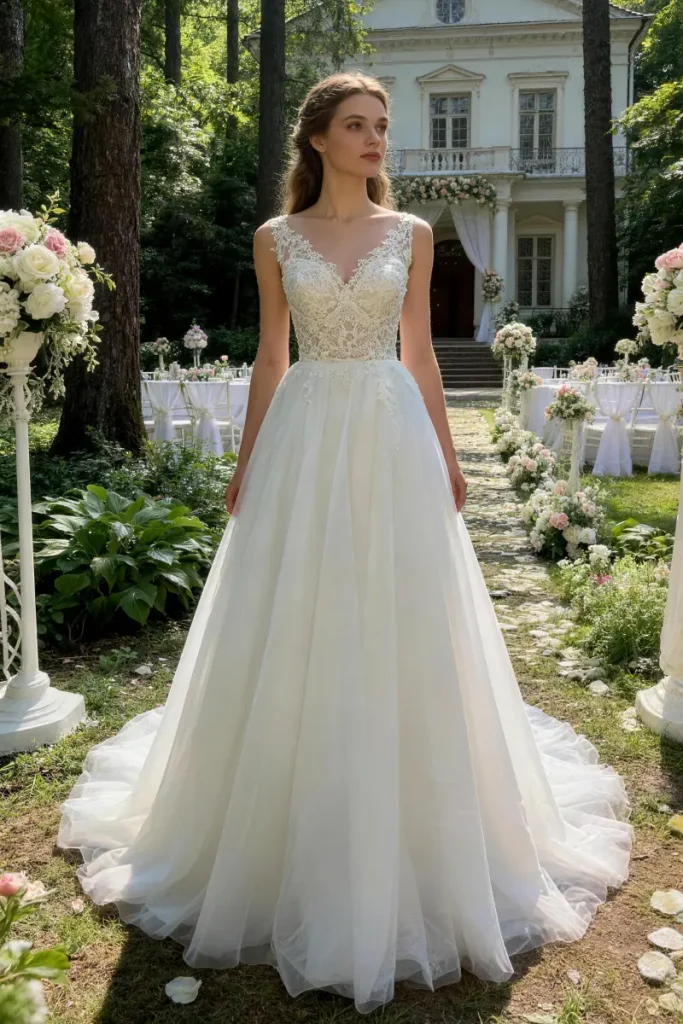
Look, if you’re looking at Likedpage Women’s Ball Gown Bridal Wedding Dresses, you’re looking at volume. Not just sales volume, but physical volume. This isn’t a sheath dress; it’s a full-on princess gown, and that means your biggest headache, outside of a picky bride, is going to be your CBM. You don’t make money selling these, you make money shipping them smart. If you’re stocking a ball gown wedding dress line, this breakdown covers construction, sizing consistency, and what actually moves off the rack.
Ball Gown Wedding Dress: The Real Markup Math
The CBM Math for Likedpage Women’s Ball Gown Bridal Wedding Dresses: Your Freight Bill’s Boss
Forget the flowery descriptions of “ethereal volume” and “magical movement” you’ll see on the consumer sites. What that translates to for you, the buyer, is inflated CBM. This Likedpage ball gown, with its layered tulle skirt, is a space hog. We’re talking typical carton dimensions for a single unit of this style pushing 60x50x40 cm, possibly more if the manufacturer isn’t vacuum-packing or using efficient folding. At MOQ 5 units, you’re already looking at 0.6 CBM minimum for just five dresses, before you even factor in master cartons or crating. Multiply that by your target order size. For ocean freight, you’re always trying to hit container efficiency – 20GP or 40HQ. A 20GP might fit 100-120 of these, if the packing is tight and the factory knows what they’re doing. A 40HQ could double that. But air freight? Every centimeter costs you, and these dresses are designed to puff.
Guangzhou Field Note: Last week, I saw a 40HQ container of ball gown dresses for wedding like the Likedpage model get held up at Yantian for two days because the carton dimensions weren’t optimized and the manifest was off. You lose money on every idle hour, not to mention the per-diem charges for the container. Details matter more than ever in 2026.
Why Nansha Port Will Ruin Your October Delivery of Likedpage Women’s Ball Gown Bridal Wedding Dresses
It’s 2026. Port congestion isn’t a surprise anymore; it’s a certainty. Especially leading into Q4, and even worse for your early 2027 bridal season stock-up. Nansha and Yantian are the usual suspects. If your Likedpage ball gown dresses for wedding are coming out of Guangdong, you’re going through one of them. Lead times for these dresses are already averaging 55-65 days ex-factory, depending on the beaded lace detail and fabric sourcing. Add another 30-45 days for ocean transit to the US west coast, and more for the east. Then another week for customs and trucking. That puts your end-to-end at 3.5 to 4 months minimum. Now, factor in a 5-10 day port delay which is standard, and suddenly your November delivery is bleeding into December. For an October bridal show, you’re screwed. Plan your orders 5-6 months out, or pay for expensive air freight on an item that’s already costing you on CBM.
Batch #1 vs Batch #50 of Likedpage Women’s Ball Gown Bridal Wedding Dresses: Will They Match?
The Likedpage description mentions “intricate beaded lace detailing” and “layers of soft tulle.” This sounds consistent across 2,270 consumer reviews, which is good for retail reputation, but what about bulk? For ball gown dresses for wedding at this price point, the consistency of the beading pattern, the type of beads (plastic vs. glass, glued vs. stitched), and the uniformity of tulle layers across a 50-unit order is paramount. A 4.6-star rating on a direct-to-consumer platform doesn’t guarantee the batch consistency needed for B2B. We’ve seen factories swap out lace quality mid-run or reduce tulle layers by one to save costs. You’ll catch it on your pre-shipment inspection (PSI) if you’re smart, but then you’re dealing with delays and potential rework. Always get a golden sample, sign off on it, and ensure your QC agent on the ground is comparing against that exact sample for every batch.
The 2026 B2B Reality Check: Likedpage vs. The Directory Gamble
The product description for Likedpage Women’s Ball Gown Bridal Wedding Dresses, with its “structured bodice” and “elegant sweetheart neckline,” is relatively standard for a ball gown dresses for wedding. This means there are a thousand factories in Guangzhou claiming they can make the “exact same” thing for cheaper.
The Directory Gamble: Go scroll through Alibaba or any generic B2B directory. You’ll find countless listings for similar ball gowns, often with stock photos and vague descriptions. You might even see “deepfake factory videos” showing gleaming production lines that don’t belong to the listed supplier. The Likedpage listing, with its ASIN and specific availability date from 2016, suggests an established product with a track record, even if it’s on a retail platform. This is a subtle but critical distinction. A product that has survived since 2016, gathering over 2,000 reviews, points to a factory that at least knows how to make it consistently enough for a retail audience. This is a better starting point than an unknown factory peddling a generic image. OEMOD.com, for example, would give you actual engineering documentation, spec sheets for boning, interlining GSM, and zipper grades. The Likedpage description gives you hints, but you need to push for those hard specs.
The Spec War: The description mentions “beaded lace detailing.” This is where the spec war begins. Is it 50D, 75D, or 100D tulle? What’s the GSM of the satin lining? Is the boning spiral steel or plastic? Is the zipper a YKK or a generic #3 coil that will fail after two uses (or one try-on at your boutique)? The Likedpage listing doesn’t give you that. It tells you what the consumer sees. You need to negotiate for the build quality. A “structured bodice” can mean anything from decent canvas interlining to cheap fusible interfacing. You need to ask for photos of the internal construction, request a technical spec pack, and ideally, order a pre-production sample to dissect.
The MOQ Trap (5 Units Edition): The advertised MOQ of 5 units for Likedpage Women’s Ball Gown Bridal Wedding Dresses is honest for this segment. It allows boutiques to test the water without a massive upfront investment. But understand this: when you order 5 units, you’re essentially paying near-sample prices, and your per-unit landed cost will be significantly higher due to shipping inefficiencies. At 5 units, you’re likely paying LCL (Less than Container Load) rates, which are punitive for CBM-heavy items like these ball gown dresses for wedding. Move to 20 units, and your freight cost per unit starts to drop. At 100 units, filling a good portion of a 20GP, you’ll see a substantial reduction in per-unit landed cost. The ex-factory price also often has tiers: MOQ 5 might be $X, MOQ 20 is $X-15%, MOQ 100 is $X-25%. Always calculate your landed cost at each tier before committing.

❓ Why is CBM such a critical factor when bulk-ordering Likedpage Women’s Ball Gown Bridal Wedding Dresses, especially for air freight?
For ball gowns, CBM (Cubic Meter) directly dictates your freight bill. Unlike heavier, denser goods, dresses, especially full tulle ball gowns like the Likedpage model, are “volumetric cargo.” Freight companies charge you based on either actual weight or volumetric weight, whichever is higher. For these dresses, volumetric weight almost always wins. If a single unit takes up 0.1 CBM, and the air freight rate is $5/kg volumetric, then your cost per unit is far higher than if it were a flat-packed, denser item. For air freight, every cubic meter is premium space on a plane. An inefficiently packed Likedpage ball gown means you’re paying to ship air, directly eating into your profit margins and limiting how many units you can reasonably afford to air freight for urgent restocks.
❓ How can buyers minimize shipping costs and port delays for large orders of this specific ball gown dresses for wedding style?
First, negotiate with the factory on packing methods. Insist on vacuum packing if possible, or at least optimize carton dimensions (e.g., a 60x50x40 cm carton is better than 80x80x20 cm because it stacks more efficiently). Ensure master cartons are clearly marked with CBM and gross weight. Second, consolidate. If you’re ordering other less voluminous bridal accessories, try to ship them in the same container to maximize space. Third, for port delays, plan aggressively. Place your orders 5-6 months ahead of your retail peak. Utilize a reliable freight forwarder with good connections at Nansha or Yantian who can provide real-time updates and, if necessary, expedite clearance. Consider partial shipments if lead times are tight, accepting a higher per-unit freight cost for a smaller, time-critical batch.
❓ What are the hidden costs of shipping Likedpage Women’s Ball Gown Bridal Wedding Dresses that aren’t on the ex-factory invoice?
Beyond the ex-factory price (FOB or EXW), you’re looking at international freight (ocean or air), port handling charges, customs duties (HS Code 6204.4x for women’s dresses, typically 10-18% depending on fabric composition and origin), customs clearance fees, trucking from port to your warehouse, insurance, and potential demurrage/detention fees if there are port delays. For a ball gown dresses for wedding like Likedpage, you also need to factor in potential re-steaming or pressing costs upon arrival due to vacuum packing or compression during transit, and potential quality control costs (third-party inspection services) to ensure batch consistency and minimize returns. Don’t forget capital tied up during transit – that’s a cost too. Calculate your true “landed cost per unit” to accurately project your ROI.
What Your Seamstress Will Charge You to Fix Likedpage Women’s Ball Gown Bridal Wedding Dresses
Given the product description, the points of failure will be in the “intricate beaded lace detailing” and the “structured bodice.” Cheap beads fall off. Poorly secured lace unravels. Generic zippers jam. A “structured bodice” relies on proper boning and interlining. If the boning is cheap plastic, it will bend and warp, creating an unflattering silhouette. If the interlining is flimsy, the bodice will lose shape quickly. A local seamstress charging $50-100 an hour will quickly eat through your margins if you’re dealing with consistent quality issues across a bulk order. Returns due to these construction failures cost you double: the dress itself, and the inbound/outbound shipping. You need the spec sheet for this Likedpage model to assess potential failure points. Ask for GSM of lining, type of boning, and zipper brand. That 4.6-star rating is for consumers who wear it once; you need it to survive multiple try-ons or rental cycles.
Ready to optimize your supply chain for the 2027 season? We’ll run a custom CBM analysis for your Likedpage Women’s Ball Gown Bridal Wedding Dresses order, factoring in 2026 port congestion and peak season surcharges. MOQ for this ball gown dresses for wedding line starts at 5 units. Contact us for a detailed freight projection and risk assessment. Let’s talk real numbers, not sales fluff.
#Likedpage #Womens #Ball #Gown #Bridal #Wedding #Dresses
Keep reading: Elegant Lace Fishtail Bodycon Dress Review and Sparkling Crystal Off-Shoulder Mermaid Gown Review.