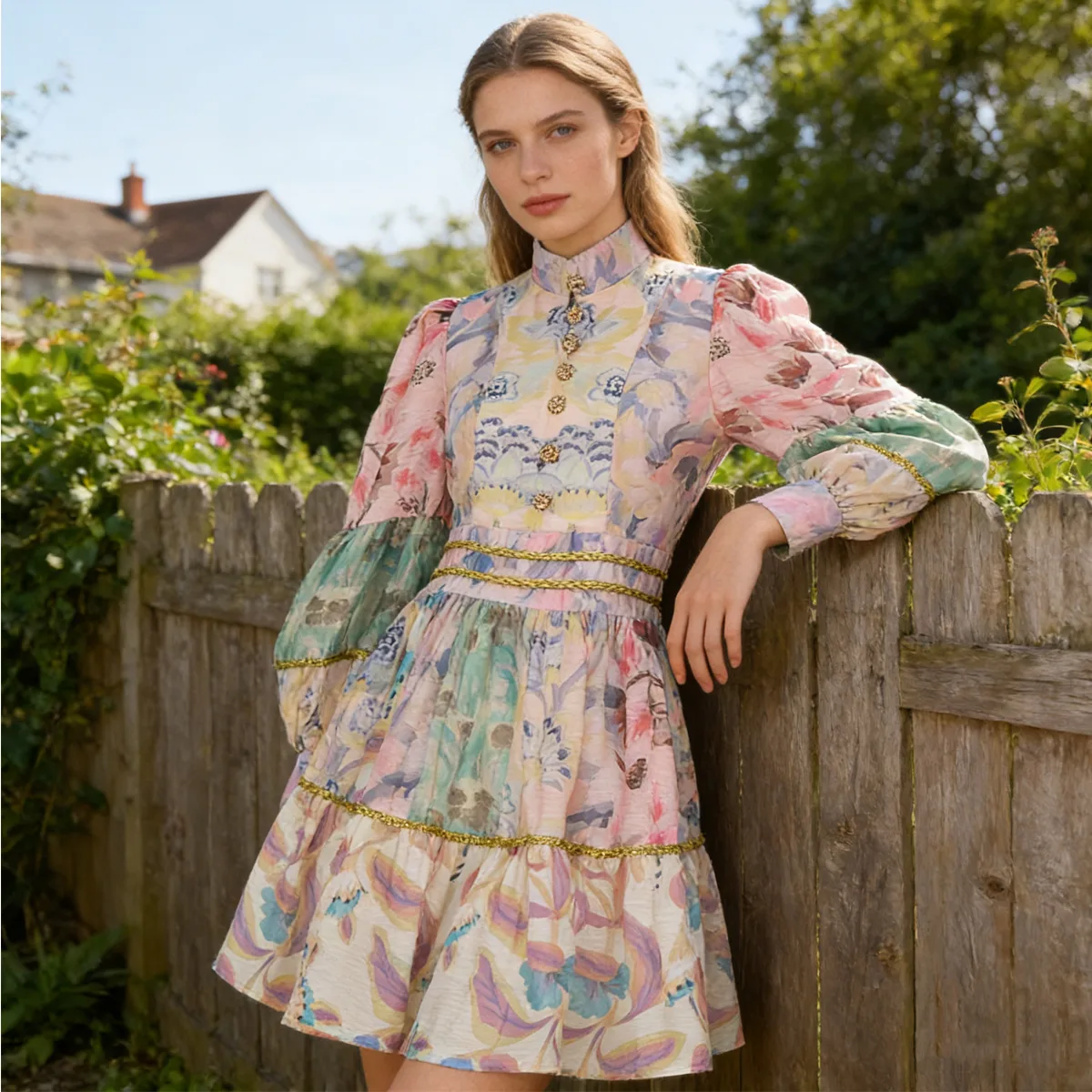
Which version of this dress should a small store actually sell? I keep asking myself that over the returns data for autumn minis, and the CUPSHE floral boho mini in front of us is a useful dress to argue with, because it exists in two honest forms. A store can buy the ready design as it stands, printed and graded by somebody else, or it can run the same spirit of dress under its own label, at 10 pieces per style, with the print placement and the length argued about in advance. I read reviews and returns for a living, the consumer end of this trade, and the two forms fail in completely different places.
| Point | Ready design, bought as listed | Own label run, 10 pcs per style |
|---|---|---|
| Time to rail | Days, stock already sewn | Sample 10 to 15 days, bulk 20 to 30 days |
| Print placement | Wherever the lay fell | Set in the tech pack, checked on the sample |
| Length and fit | Fixed grading, fixed hem | Hem and grading adjusted to your buyers |
| Sample cost | None | $45 to $75 per piece, half back on bulk |
| Reorder shade risk | New lot, no reference kept | Reference piece kept, lots compared |
| Freight, 20 pcs and up | Express about $13 to $20 per kg | Same range, same air in the skirt |
What the ready version does well, and what it quietly keeps
The ready design wins on speed and on certainty of a plain kind. The dress exists. Its reviews exist, which means its complaints exist in public where a buyer can read them before spending anything: the mini length that reads shorter on taller wearers, the chiffon that holds static against tights in dry autumn air, the floral scale that photographs gentle and arrives bold. What the ready version keeps is control. The hem sits where it sits. The print lands where the lay put it, centred on one dress in ten and wandering on the rest. When the second order arrives a shade softer, and second orders in printed chiffon do arrive a shade softer often enough that my desk has a phrase for it, the store owns no reference piece to argue with. It owns a memory, and memories lose arguments with dye lots.
What the own-label run buys, and what it charges
The private label clothing route buys the argument in advance. A sample at $45 to $75, half of it back when the style goes to bulk production, lets the store move the hem a finger’s width, set where the floral repeat should sit at the front, and write the length for the heights its own customers actually are instead of the heights a distant grading assumed. Bulk production at 20 to 30 days after a 10 to 15 day sample is the charge, along with the discipline of a tech pack that says all of it in numbers. No wait. The bigger charge is not the weeks, it is the responsibility. A store that specified the dress can no longer blame the listing when the length is wrong.
So which wins? It depends on what the store is short of, and the answer flips cleanly. A store short of time, testing whether autumn floral moves in its town at all, should buy the ready dress and read its own till instead of somebody else’s reviews. A store that already knows the category moves, and keeps losing sales to the same two complaints, length and print placement, should run its own label and spend the sample fee fixing the complaints it can name. Chiffon weighs almost nothing and packs full of air, and carriers charge for the air when the air outruns the weight, so a light mini lands at a per-dress freight cost that baffles every first-time buyer who did the weight maths on a kitchen scale.
The returns desk reads this autumn mini against the floral wrap dress file for fall weddings, argues it beside the corduroy square neck A-line review, and checks the bolder end of the rail in the floral plunge ruched black gown review, because autumn floral gets bought, worn and returned as a family, never as one lonely listing.
Questions buyers and stores actually ask
The ready dress is cheaper per piece. At what point does an own-label run at 10 pieces per style stop looking expensive?
Earlier than buyers expect, usually by the second order. The first own-label run carries the sample fee and the waiting, 10 to 15 days of sampling and 20 to 30 of bulk production,. By the reorder, the pattern and the print placement are already settled, half the sample fee has come back against the first bulk total, and the comparison is down to the dress itself against a ready dress whose shade may have drifted with no reference piece to prove it.
Reviews keep calling the mini short. Sizing fault, or a height question nobody printed on the listing?
A height question, mostly, and the returns pattern gives it away. Complaints about length cluster by the wearer’s height rather than by the size bought, which means the grading is doing its ordinary work and the hem is simply landing higher on taller bodies. A listing that prints a model height gives buyers the missing number and the returns fall. An own-label run can go further and set the hem for its own customers.
Same floral print, second order, and the colours read softer. Did the factory change the cloth?
Probably not the cloth. The lot changed, and printed chiffon shows lot drift early because the print sits on a light ground where a small shift reads as fading. Without a kept reference piece from the first order, the store cannot show what softer means in numbers or even in a photograph taken in the same light, and the conversation dies politely. Keep one dress back, unwashed, and compare in daylight. It is the dullest advice I give from this desk and it settles more reorder arguments than everything else I say combined.
Chiffon weighs next to nothing. Why did freight on 20 pieces and up still land near $13 to $20 a kilo?
Because the kilo was never the whole bill. A flared mini packs with air in the skirt, and carriers charge for the space a light bulky carton takes when the space outruns its weight, which on chiffon it nearly always does. Twenty pieces and up move by express at about $13 to $20 per kilo, and small lots under 20 pieces run about $17 to $22, so the per-dress landed cost is the honest number to compare, skirt, air and all.
I still cannot decide whether the boho mini is a dress or a season wearing a dress shape, and the returns data will not settle it for me. It sells in a rush when the leaves turn, comes back for reasons that have little to do with sewing, and vanishes until next autumn asks the same questions again. The stores that do well with it are not the ones that found the better version. They are the ones that knew which shortage they had, time or control, and bought the version that answered it, and kept one dress back from the first order either way. That kept dress, unwashed on a rail in the stockroom, settles more arguments than my whole returns spreadsheet.