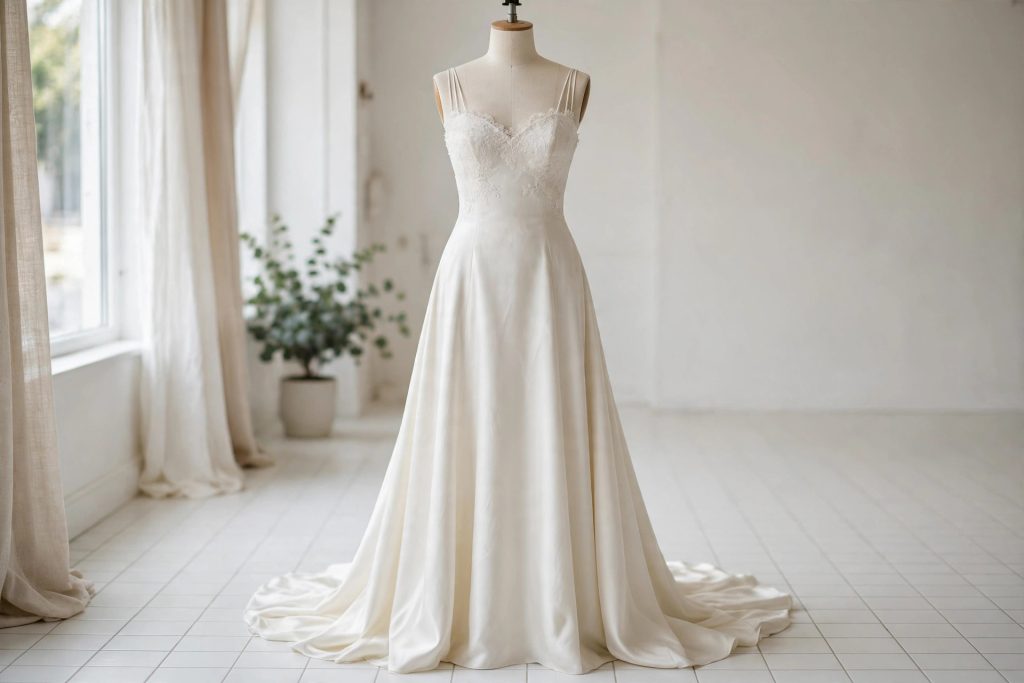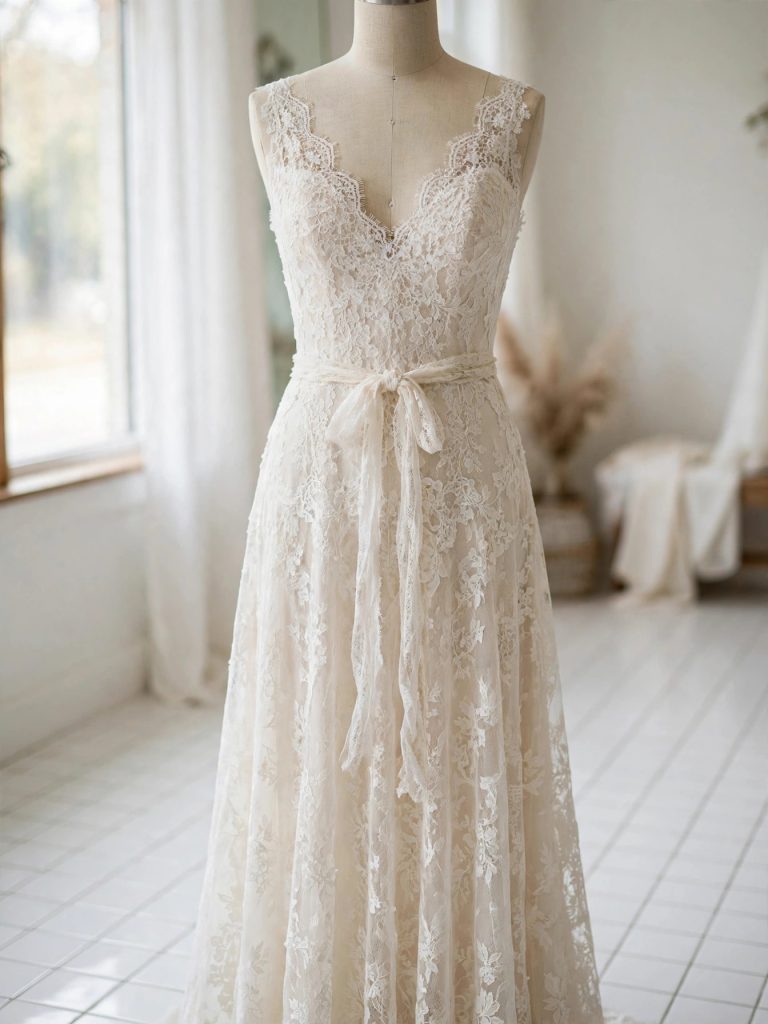
Ten pieces.
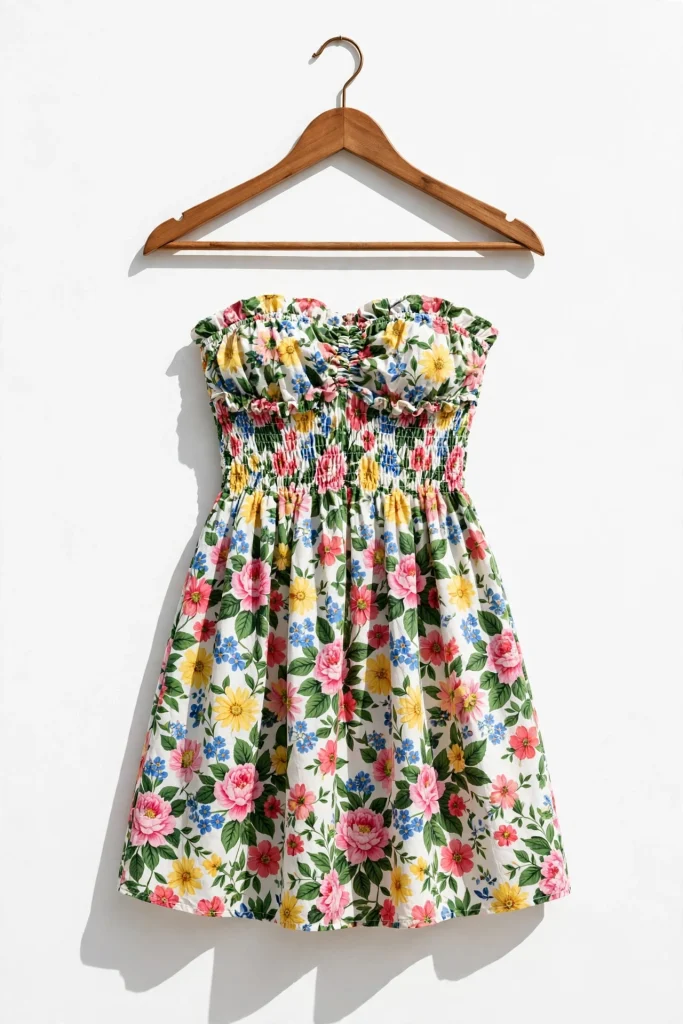
Every conversation about the ZESICA 2026 summer strapless floral dress starts with that number. Ten pieces minimum, mixed sizes. Then the second question, always the same one: will the bulk look like the picture. I have never managed to answer that honestly inside a chat bubble, so this is the long version. It is still missing half the story, but it is the half I can write down.
Forget the print for a minute. The ditsy floral matters, it is what makes a buyer stop scrolling on a strapless floral dress, but it is also the one part of the dress that never varies between batches. Prints do not drift. Everything else does. What varies is everything the photograph skips, and the list is not short. Lining weight thins out by the third batch. Boning migrates whenever the channel runs narrow, which it usually does. The elastic gives up by August. The grading fit the sample size and nothing else, though nobody mentions that part until the returns start coming in. The inside of a strapless floral summer dress decides whether it lives or dies. The rest is just good photography.
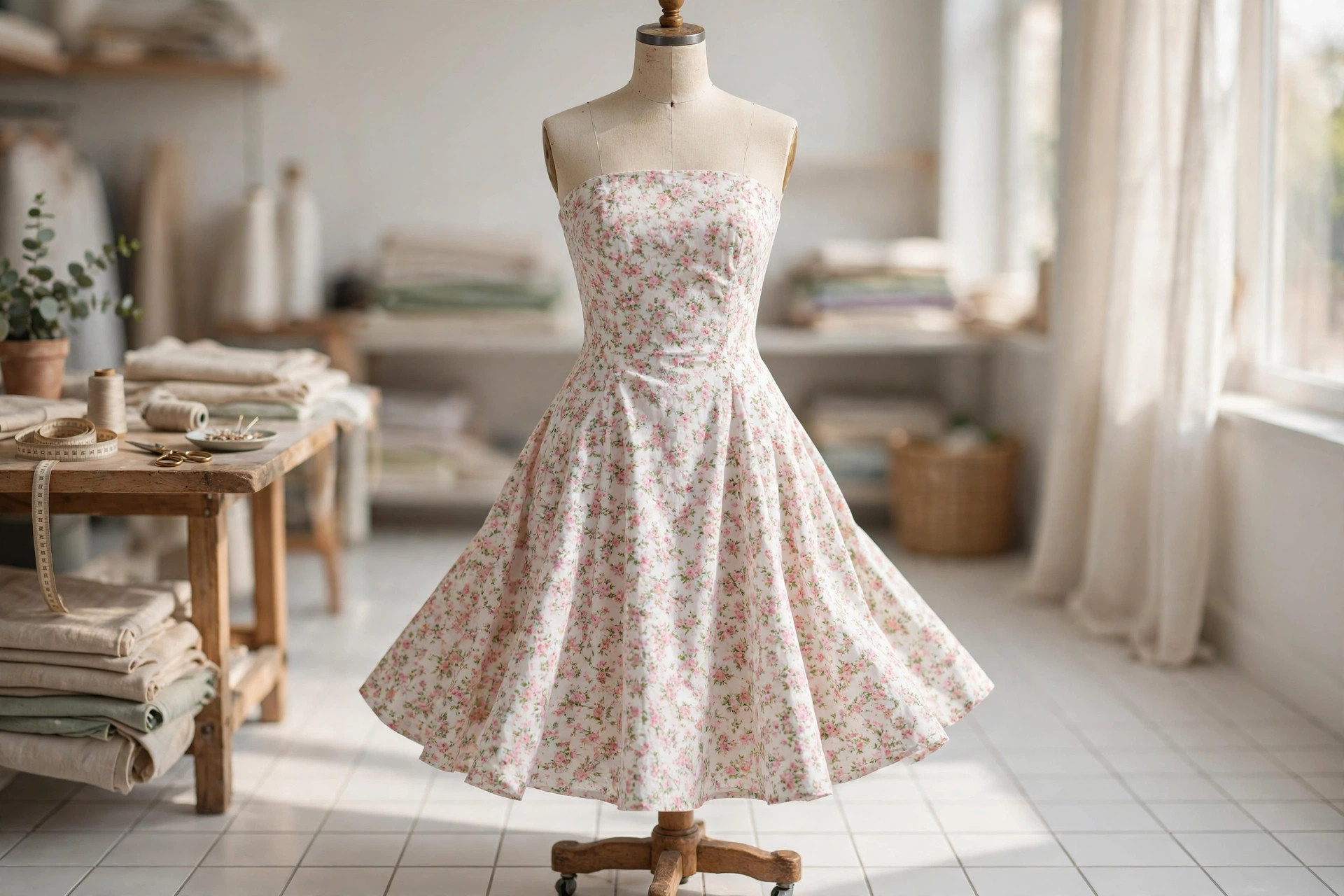
Why Does a Strapless Floral Dress Slide Down After Two Wears?
Usually the boning has migrated. The channel holding it was cut with under 1.5 centimeters of seam allowance, the stays wandered after a few wears, and now the bodice cannot grip, so the wearer tugs through cocktail hour. The failure was decided months earlier, in millimeters, by someone rushing a marker.
The classic accident with this category happens in boxes, not fitting rooms. A boutique owner opens batch three and the strapless floral dresses will not stay up. Batch one of the strapless floral dress was fine. Batch two was fine. The supplier swears nothing changed, and the supplier is telling the truth as far as the supplier knows, because what changed was the lining roll. Fifty-denier on the sample. Whatever the factory could source at the target price in bulk. Assume ten percent thinner, assume the boning went from something with memory to plastic strips that fold like a cheap ruler, and assume nobody mentioned it because the outside still photographs exactly the same. I have seen this dress, this exact category of summer strapless floral cocktail dress, come back with the note “won’t stay up,” and the summer cocktail dress problem was never the fitting room.
Here is the number almost nobody checks, which tells you most of what you need to know about this business. Measure the seam allowance around the boning channel. Under 1.5 centimeters and the boning starts migrating within a few wears, I have watched it happen too many times to call it a coincidence. Over it, the channel holds. Bring a tape measure when you inspect. The buyers who survive summer season are the ones who measure the inside of the bodice before they admire the print, because the print is the same on every batch and the inside is where the batches diverge. A tape measure costs nothing, which is probably why nobody brings one. The box of returns costs the season, and everyone pays it eventually.
As for the print, I cannot dismiss it however much I might want to. The ditsy floral moves the strapless floral dress off the rack, we all know it, and pretending otherwise would just be me showing off. Bare shoulders, small-scale print, under forty dollars retail, the 2026 women’s dress trends all point the same way, and the 2026 dress trend breakdown for boutique buyers lays out exactly why this silhouette keeps selling. A buyer who ignores the print buys a technically perfect wedding guest dress nobody wants. The trick is keeping two facts in your head at the same time. The print sells the dress. The inside is what keeps it sold, months later, when nobody is photographing it anymore. Returns are just delayed unsales.
What Breaks First on a Price-Driven Strapless Dress?
Three seasons ago the zippers went. Then everyone switched to the same two suppliers, the zippers held, and the side seams started popping where the boning ends. Nobody reinforces that spot. One more operation would need room on the costing sheet, and there is none, so the breakage moved on. Three seasons, three different weak points. The zipper era, the seam era, now the elastic era. It never stays where you fixed it. Zipper fixed, seam pops. Seam fixed, elastic dies. The failure never gets fixed. It just finds a new address.
Grading is the multiplier nobody talks about, and on a strapless bodice it multiplies hard. The pattern gets scaled up from a size 4 sample, and every grading error compounds across the bodice, which is why the size 12 of a strapless floral dress like this ZESICA piece can fit like a different garment from the size 4. The computer grades it now. The computer does not wear strapless. Strap dresses forgive grading errors because the straps distribute the load. On a strapless floral dress bodice, a quarter-inch mistake has nowhere to go. One size gapes at the back, another clamps like a vise, same marker, same factory, same afternoon.
If you only fit-test one size, make it the largest one you plan to carry. The smallest wedding guest dress will flatter you, it was cut closest to the original sample, and flattery is exactly what you do not need from a fitting. The largest size is where the grading errors went to hide. The largest is where the money gets lost, because that is where the grading errors land and where the returns come from. A strapless floral dress that only fits the sample size is a dress that only sells to the sample customer. I don’t know what the grading increments are on this particular ZESICA pattern. That is the factory’s spreadsheet, not mine. Test the top of your size run. That is the whole advice.
No wait. I said the computer does not wear strapless, and that came out wrong, like I am blaming the software. I am not. The software grades exactly what some tired patternmaker told it at 11pm. Garbage in, gaping back out. The problem is what it is told: increments copied from strapped blocks, applied to a strapless bodice, by someone who has never watched a size 12 customer tug at a gaping back. The tool is innocent. The inputs are guilty. Three weeks of returns will teach what one fitting would have.
Haggling Eighty Cents Off the Unit Price Saves Nothing
The math that kills boutique buyers of the strapless floral dress is not the unit price. It is the batch variance hiding behind the unit price. A buyer haggles eighty cents off, feels victorious, and then batch three shows up with lining thin enough to read through. Those eighty cents went somewhere. They always go somewhere. The lining roll got cheaper, for one. The boning grade dropped a notch, for another. And packing lost its thirty seconds somewhere between the sample room and the bulk line. Three small thefts, every one of them invisible in the photograph. There is no slack in a sub-forty-dollar retail dress. Every cent squeezed out of the price reappears in the garment. Usually where the photograph cannot see, which is exactly the point.
Veterans order early and pay for the better lining, then stop talking about price. They have done the other math, the one where a return costs not the refund but the customer who never comes back, plus the dead stock squatting on the shelf through August. New buyers squeeze the unit price and then act betrayed by batch three, as if the factory had promised something the price never allowed. Nobody promised anything. I used to read the haggling as greed, and I was wrong about that for years. It is usually fear wearing a negotiation costume. Eighty cents a unit, two hundred units, that is September rent for a single-store owner. Once I understood the arithmetic, the haggling stopped annoying me.
I used to mock the hagglers. Then I started noticing who haggles hardest, and it is not the greedy ones. It is the thin-margin ones, the single-store owners for whom eighty cents a unit across two hundred units is the difference between making rent in September or not. The haggling is not greed. It is fear wearing a negotiation costume. I had the contempt backwards for a while. The buyers I should have worried about were the ones who never asked about price at all, because those were the ones who never intended to reorder.
The Dress Arrives Looking Like It Lost a Fight
Nobody reads the packaging paragraph. Everybody pays for it anyway. A strapless floral dress with boning does not travel well in a flat polybag. I have opened cartons where the boning of a strapless floral dress took a permanent crease over the ocean and the bodice arrived with a ridge across the front. The customer tries the wedding guest dress on, sees a flaw. The flaw was never in the garment. It was in the journey, and the journey was chosen by someone trying to save thirty seconds a piece. Good suppliers roll the bodice around tissue. The cheap ones fold it flat. Ask which one yours is before the carton ships.
The packing question comes before the price question. Always. A supplier who can describe it has thought about the garment arriving. Most only think about it leaving. A supplier with no answer to that question has told you plenty. The carton is the last factory operation and the first boutique impression, and the distance between those two is measured in creases.
Some buyers actually prefer the flat pack, and this is the counterweight I did not expect. Flat packs ship denser. Freight per unit drops, and on a forty-dollar dress that math is not imaginary. I know a buyer who takes the crease risk on purpose and steams every piece on arrival. Her choice, her steamer, her margin, and it works for her. The polybag did nothing wrong. The buyer who never asked how her dresses were packed, she is the one who paid for it in July. The problem was not knowing the polybag was a choice.
Wash One, Wear One, Cut One Open
The most reliable quality control in the strapless floral dress category costs three destroyed samples. Wash one, wear it twice, check the stretch recovery on the smocking and whether the print bleeds. I wear-test one through a full evening. Sit, stand, reach, see if it slides. The third one I cut open, boning channels, seam allowances, lining weight, all of it on the table. Three dollars of destroyed sample taught me more than any review ever did. Reviews describe the sample. Scissors describe the bulk. Different garments, most of the time.
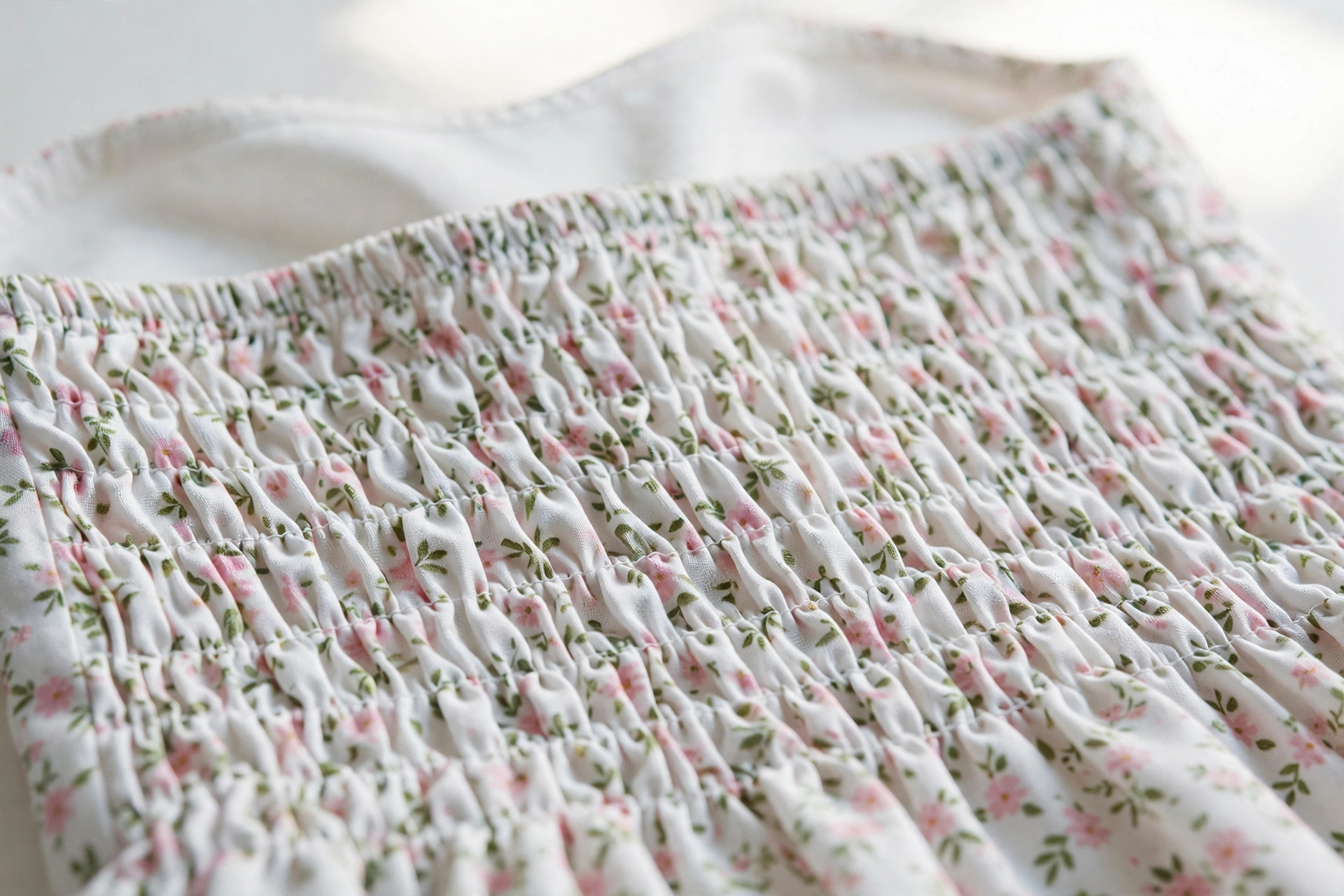
The smocking versus elastic question decides half the fit complaints before they happen. Some versions of this strapless floral dress ship with smocked backs, some with plain elastic, depending on which supplier and which month, and the two behave nothing alike after five washes. Smocking with good recovery springs back. Tired elastic stays stretched, and a strapless summer dress with tired elastic is a tube top with ambitions. The stretch recovery test takes ten seconds: pull, release, watch. If it does not snap back on the sample, it will not snap back in August either.
People ask whether the testing ritual is overkill for a forty-dollar wedding guest dress. It is not, because the ritual scales. Three samples on a ten-piece test order becomes thirty minutes of inspection habit on a fifty-piece reorder, and the jump from ten to fifty is exactly where batch variance lives. The women’s wholesale dress guide covers that jump in detail, because ten pieces from one roll behaves nothing like fifty pieces from three rolls. Start with ten pieces. Learn on the cheap. Scale only what the scissors approved.
A wedding gown has architecture, everyone grants that. The summer strapless floral dress has engineering too, only cheaper, faster, less forgiving. Fewer layers in the bodice. Shell. Interfacing, if you are lucky. Boning channels. Lining. Each layer is a cost decision, and on a price-driven wedding guest dress every layer is negotiable except the print. That is why two batches of the “same” dress can feel like different garments. They are different garments sharing one wedding guest dress photograph.
Bridal fittings take weeks. A summer cocktail dress fitting takes an afternoon, and that speed is the trap. The sample looks right, the order goes in, and nobody finds the grading problem until the size 10s come back. The one fitting worth slowing down for is the largest size, along with the wash test and the scissors. Those three, unhurried, are the cheapest quality control in the building. Everything else about this category rewards speed. Those three reward patience, and patience is the only free quality control in the building.
Do buyers ever get tired of hearing “check the inside”? Probably. But the alternative is another July of returns, and July returns do not get easier with experience. They just get more expensive, because the rent is higher and the patience is thinner. So the advice stays the same, season after season, whether anyone wants to hear it or not.
The navy maxi dress review on this site covers a different silhouette with the same lining disease, and comparing notes across silhouettes is worth the ten minutes. Same factory logic, different neckline. The summer navy maxi review is the companion piece. Read them together and the pattern jumps out: the print changes, the inside stays the same, and the inside is always where the money goes.
Frequently Asked Questions
Ten pieces minimum. So why does batch three look different from batch one?
Ten pieces gets you in the door. The same roll twice is a different negotiation, and nobody mentions it upfront. I have seen batch one and batch three of a strapless floral dress cut from different lining rolls in different months, and the product photos never changed. Not once. The variance lives inside the strapless floral dress. Lining gets thinner, boning gets cheaper, elastic shows up already tired. The outside keeps photographing the same because the outside is the easy part. Assume the sample showed you the best version. It usually did. The sample was cut when someone was paying attention, which is more than you can say for batch three.
The picture shows a perfect fit. What will the picture never tell me?
Photographs flatten three things into nothing on a strapless floral dress. Boning channels, lining weight, grading. Those three decide returns, not the print. A 1.5-centimeter seam allowance lets the boning wander, I have seen the x-rays of it, so to speak. Lining goes sheer by batch three. And the size 12 was graded by computer from a size 4 block, which works right up until a real person puts it on. The picture sells the wedding guest dress. The tape measure, the wash test, the scissors decide whether it stays sold. Trust the tools. Not the pixels.
Under forty dollars retail with a 4x markup. Where does that math actually break?
The math breaks at batch variance. Not the unit price, the variance. Forty dollars retail, 4x markup, no slack for anything to drift. Not the lining roll. Not the boning grade. Not the packing method, and yes, I know that reads like a list. It is a list. The first two batches behave because someone was watching them. Batch three is where the costing sheet collects. The debts come due in the parts the photograph cannot see, every single time. Budget for the price but not the variance and you have budgeted for half a business.
My customers wear sizes 4 to 12. Which size do I fit-test?
Fit-test the 12, honestly. The 4 is a trap, cut closest to the original sample, so it looks right, and looking right is about the least useful thing a fitting can do for you. Every grading error in the run walked uphill and parked itself on the 12, which is where the back starts gaping on real bodies. I would rather find that out in my own fitting room than read about it in a July review of the wedding guest dress.
The dress slides down. Is it the boning or the elastic?
I get this one wrong half the time myself. Usually it is the boning. Press the bodice of the strapless floral dress and feel around with your fingers, if the stays are not sitting where the seams are, the boning has shifted and the seam allowance was probably cut too narrow. The elastic was fine in that case, it just cannot hold up a bodice that has already lost its shape. If the boning is still where it should be, then it is the elastic. Pull it and let go. If it does not snap back, that is the problem. It is a cheap part, at least, easy to spec better on the next order. Tired elastic stays stretched. Either way the fix is not in the fitting room. It was decided at the cutting table, months ago, by someone in a hurry.
So. Ten pieces minimum. Forty dollars retail. A print that sells and an inside that decides. That is the whole business in four numbers, and it has not changed in all the summers this category has been running.
Whether the next buyer will bring a tape measure or just admire the photograph, I am still waiting to find out.