There is a question I get asked in different words every season, and this season it wears a basque waist. A buyer sends over a photograph, usually a screenshot, usually with the waist circled, and asks why the dress in the picture costs what it costs when the same dress with a straight waist seam costs less. Sometimes they ask it the other way around. They ordered the basque version at the straight-waist price, the samples came back, and now they want to know what went wrong. I have been around wedding dress production long enough to have watched this silhouette leave and come back, and I still do not have a clean answer for why one dropped point causes this much trouble. I have pieces of an answer. They do not add up to a whole one.
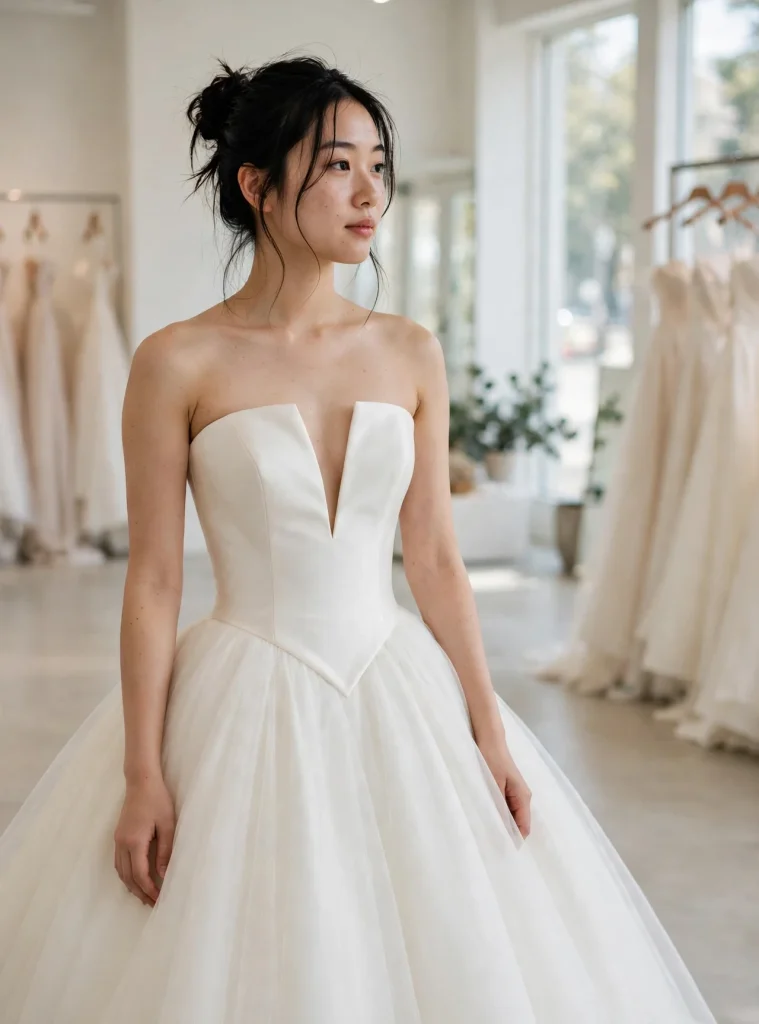
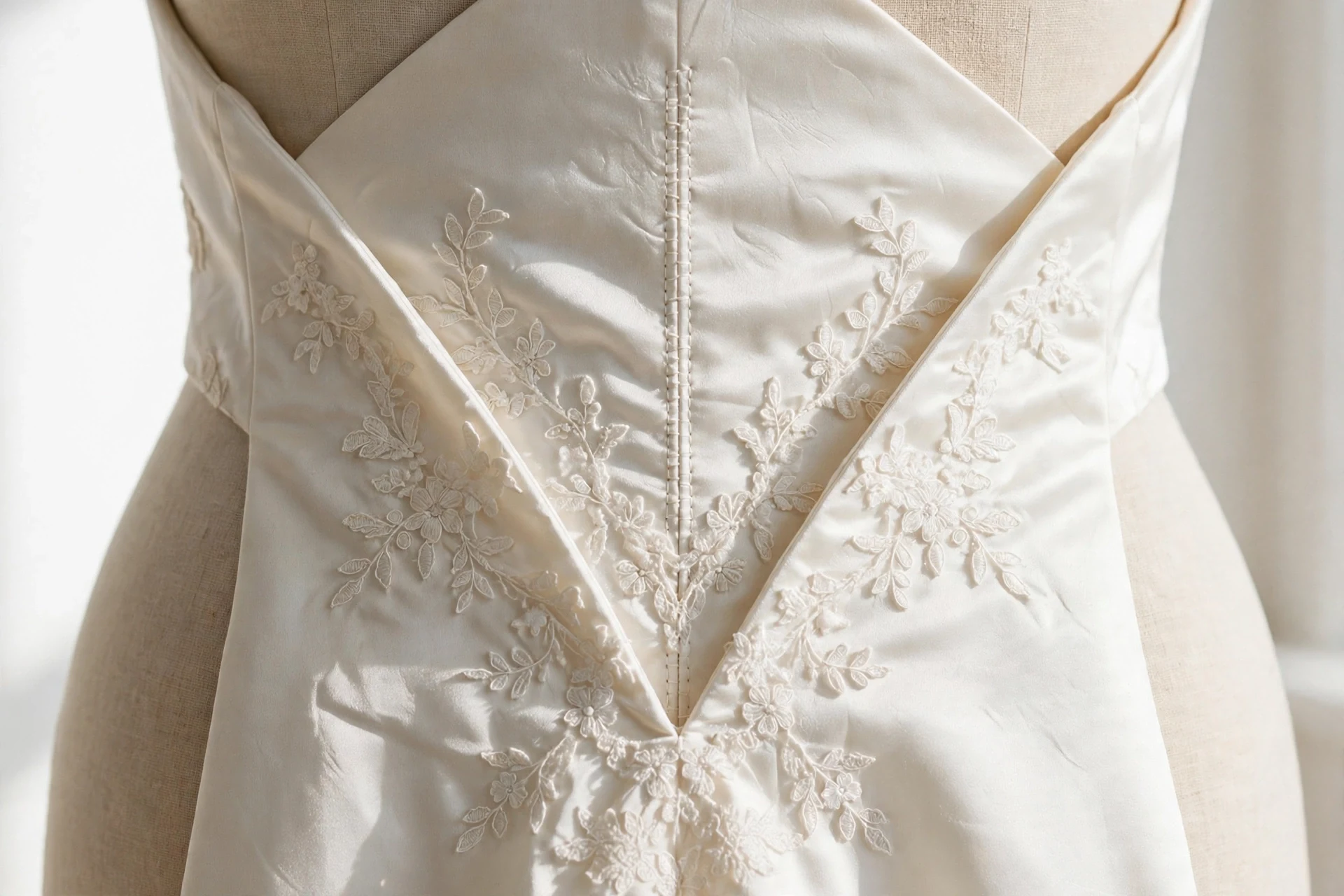
Start with the point itself, because everything else hangs off it. On a natural-waist gown, the bodice ends where the body bends, and the seam that joins bodice to skirt is nearly straight and mostly hidden by the body’s own crease. On a basque waist wedding dress, the bodice keeps going, five to nine centimetres below the natural waist at centre front, and ends in a V. That V is not decoration in the way buyers seem to think. Every step a bride takes pulls on it. Sitting pulls on it harder. It is the single most stressed spot on the whole garment, and it sits exactly where every camera at a wedding is pointed.
So the line treats it differently. The point gets stay-stitching before the skirt is joined, and a small reinforcement patch behind it, and if either of those two steps gets skipped because a line is running late, nothing looks wrong on the hanger. The seam starts to grin open somewhere around the third hour of wear, in photographs the boutique will see before the factory does. I have watched buyers hold a returned gown up and point at that gap as if it were a mystery. It is not a mystery. It is a thirty-second step that somebody traded away.

Three millimetres is a long way at the bottom of a V
The first sample of almost any basque style comes back with the point sitting off centre. Three millimetres, sometimes four. On a straight waist seam, three millimetres is inside the noise; the seam is long, the eye has nothing to compare it against, and the skirt hangs over it anyway. At the bottom of a V there is a single point with two long diagonal lines running up from it, and the human eye is very good at finding the middle of a shape and noticing when a point is not on it. Three millimetres reads as crooked. Not slightly crooked. Drunk.
The fix is boring, which is why it gets skipped in conversation. The pattern carries a drilled notch at the point, and the machinist checks the joined bodice against the centre line of the stand before the skirt goes on, not after. Checking after costs a full unpick. Checking before costs ten seconds. And yet the samples keep arriving off centre, season after season, which tells me the check lives in somebody’s head instead of on the work instruction, and heads change jobs. This is also the part of sampling nobody warns a buyer about when they ask how long a wedding dress sample actually takes — the calendar days are rarely sewing days. They are waiting-for-a-corrected-point days.
Wrong by a little is somehow worse than wrong by a lot. A point that lands a full centimetre off gets caught by anyone walking past the stand. A point that lands three millimetres off gets through the sample room, through the buyer’s fitting, through the bulk run, and then shows up in a bride’s photographs, where it cannot be unseen.
The boning has nowhere polite to go
A dropped bodice is a longer bodice, and a longer bodice means longer boning channels running further down the torso. The centre-front bone is where it gets awkward. Run it all the way into the point and the V kicks outward the moment the bride sits down, because the bone wants to be straight and the point wants to fold. Stop it short and you have to decide where short is, size by size, and that decision is a pattern decision, not a sewing decision. Spiral steel behaves better at that fold than rigid plastic does. It flexes at the seat line instead of fighting it. Buyers squeezing a bodice in a showroom are usually checking whether the boning feels cheap; what they should be checking is where it ends. I wrote about how to tell whether a corset bodice is well made a while back, and the basque version of that same question is mostly about this one channel.
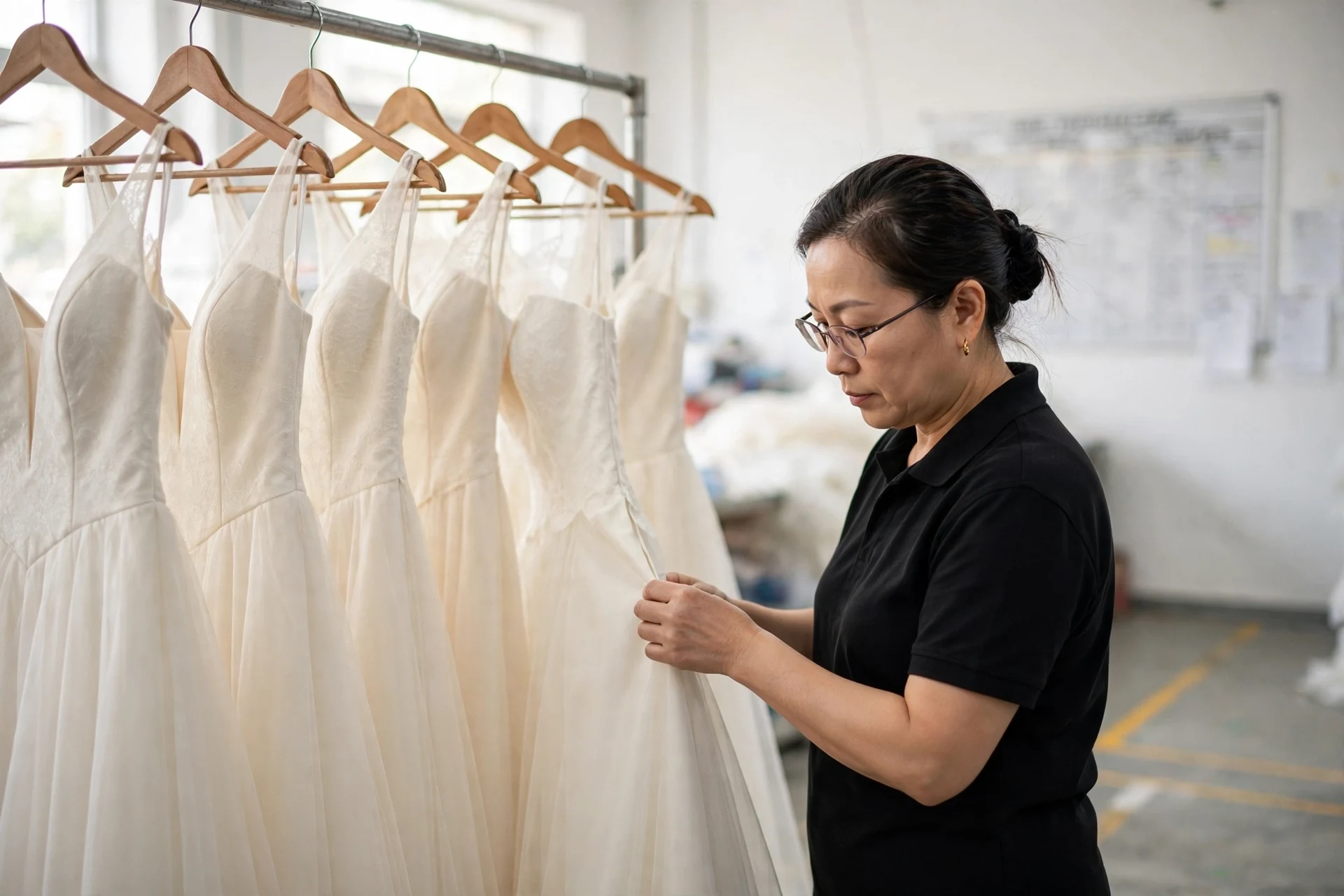
Pressing deserves its own complaint. The seam allowances inside the V have to be clipped almost to the stitch line and pressed flat in two directions, and in satin, one careless pass of the iron leaves a shine mark in the one place nobody can stop looking at. The women who press basque points well are not interchangeable with the women who press straight seams well, and a line that rotates staff without knowing that will produce a run of gowns with a faint bright triangle at the waist. Rework on the point runs visibly higher than rework on a straight join. Nobody puts that in a brochure.
The grade is where the silhouette quietly dies
Here is the piece of the answer I trust least, because I have seen it done three ways and two of them were wrong. A basque point has to be graded, and it cannot be graded like a waist. If the drop length grows at the same rate as the waist circumference, then by the time you reach the larger sizes the point has wandered down toward the hip, the long torso line is gone, and the dress looks like a different dress that happens to share a name. The drop has to grow more slowly than the waist does. How much more slowly is a judgment call each pattern maker makes alone, and I have never seen two of them agree.
Buyers see the result without seeing the cause. A boutique orders a size run, the size 8 photographs beautifully, the size 22 arrives looking matronly in a way nobody can quite name, and the reorder, when it comes, comes back narrower. Fewer plus sizes the second time. The buyer usually blames demand. Sometimes it is demand. Sometimes the size 22 was never really the same dress.
No wait. I should be fair about the narrower reorder. Plus-size bridal sells slower in plenty of boutiques for reasons that have nothing to do with grading, and I have blamed the grade for at least one reorder that was probably just a quiet shop. The grade is a real problem. It is not the only problem wearing that shape.
Your size chart is measuring a waist that is not there
The quietest failure in this whole style is a measurement argument. A spec sheet for a basque gown still carries a line called waist, and on this pattern that seam sits well below the bride’s natural waist, where her body is a different circumference. A bride gets measured at her natural waist, the way every fitting guide on earth tells her to, the dress gets made to the chart, and the bodice feels a size large through the middle even though every number on the sheet is correct. Both sides did their job. The dress still does not fit.
The reviews on the big marketplaces tell the same story from the other end. Read enough one-star reviews of dropped-waist gowns and the complaints cluster in a small area: the point digs in when sitting, the waist lands lower than the listing photograph suggested, the bodice reads long on a shorter torso. Almost none of them mention fabric. Meanwhile the five-star reviews praise the elongated line and the vintage feel, and they lean toward taller buyers. Same construction. The tall bride gets the silhouette the trend pages promised. The petite bride gets a seam sitting where her hip starts and a point pressing into her when she sits at her own wedding breakfast. A platform listing cannot say any of that, so it says nothing, and the returns handler at the boutique end absorbs it.
The quote difference is minutes, and minutes are the whole argument
Put the same sketch in front of a pattern maker twice, once with a natural waist and once with a basque, and the basque comes back as a new block. Buyers hear that as a sales line. It is a geometry fact. Every bodice panel below the bust changes length, the angle where the skirt joins changes, and the grade rules for the point have to be written separately from the grade rules for the waist. The cloth difference is small. A dropped bodice takes slightly more fabric and that is the least of it.
What the higher quote is actually buying is time in specific chairs. Time at the pattern table. Time in the longer boning channels. And the largest chunk sits in a place buyers never think to look: lace placement. A lace motif that sits whole and lovely on a natural-waist bodice gets cut in half by a seam line that descends through it, so on a basque style the motifs get laid after the bodice is joined, by hand, one gown at a time, arranged to flow across the point instead of dying at it. That is slow work done by experienced hands, and it is priced accordingly. Anyone learning how to read a wedding dress factory quotation should know that the line item they are looking for is not labelled lace. It is buried in the labour figure, and the labour figure is where a basque waist lives.
Which brings back the buyer who negotiated the basque quote down to the natural-waist price and felt pleased about it. The factory did not absorb the difference out of kindness. The difference came out of the dress, and it comes out of the invisible places first: the reinforcement behind the point, the slower press, the second check against the centre line. The gown photographs fine. It fails in the third hour, at the sitting, in the size that was graded by habit. Our own starting point for styles already in the range is ten pieces per style, colours and sizes mixed, and the basque does not change that number. What it changes is what has to happen inside those ten pieces for them to be worth shipping.
Bridal trade coverage has run this silhouette as a headline for two seasons now, part of the vintage revival, all long torso lines and old photographs of somebody’s grandmother looking severe and wonderful. The coverage is not wrong about the look. It just never mentions that a dropped waist is a construction change wearing a styling change’s clothes, and that the cost sits in pattern work and hand placement, two things a runway photograph cannot show. Buyers arrive informed about the trend and uninformed about the garment, and honestly, that is the normal state of this business and not only for basque waists.
Questions buyers ask me about this waistline
The point sits three millimetres off centre on the sample. Is that honestly a reject?
Yes, three millimetres off centre at the point is a reject, even though the same three millimetres anywhere else on the dress would pass without comment. The two diagonal seam lines turn the point into the one spot every eye checks against the middle of the body, and a small offset there reads bigger than it measures. What usually happened is simpler than bad sewing. The bodice got joined without anyone checking the notch against the stand’s centre line first, so the error was sewn in early and discovered late, when fixing it means unpicking the whole join. I would rather argue about it at sample stage than read about it under a bride’s photographs, which is where the argument ends up otherwise.
Ten pieces per style is the minimum. Does a basque waist quietly change that?
No, ten pieces per style stays ten pieces, and the minimum is not where this style costs you. The MOQ on existing styles is about the sewing line, and the line does not care much whether the bodice ends at the waist or below it. Where a small order does bite is the pattern work, because a basque block has to be built and graded on its own and that cost lands on the first order whether it is ten pieces or two hundred. Buyers sometimes try to dodge it by asking for the point to be added to an existing natural-waist pattern, which is a bit like asking for a staircase to be added to a finished house and being surprised the carpenter wants to talk about structure first.
My bride measured her natural waist, the chart was followed, and the bodice still feels a size big. Who got it wrong?
Usually nobody got it wrong, which is the annoying part, because the measurement was taken at a waist the dress does not use. On a basque pattern the seam sits five to nine centimetres below the natural waist, and the body is wider down there, so a bodice built to a natural-waist number hangs loose through the middle while matching the spec sheet exactly. The fix lives on paper: the chart has to say where the waist is taken from for this style, in words, next to the number. I get this one wrong half the time myself when I skim a tech pack, so I am slow to blame a bride with a tape measure.
The size 8 sample is beautiful and the size 22 looks like a different dress. Same pattern, supposedly. What happened?
What happened is usually the grade, because the drop of the point was grown at the same rate as the waist and by size 22 it has travelled too far down the torso. The long elegant line depends on the point sitting in a narrow band of territory, and that band does not widen just because the dress does. A pattern maker who grades a basque like a normal waist will produce exactly this result while following every rule he knows, which is why I ask to see the largest size sewn, not just the sample size, before bulk. Whether every factory will agree to sew it is another conversation, and usually a shorter one than I would like.
So the question I started with is still open, and I have stopped expecting to close it. A straight waist seam forgives. It forgives the three millimetres, the rotated pressing staff, the grade done by habit, the measurement taken at the wrong height, because the body’s own crease hides the evidence and the skirt hangs over what is left. The basque forgives none of it, and in exchange it gives a bride a silhouette she cannot get any other way. Buyers keep circling the point in photographs and asking what it costs. It costs everything a straight seam lets you skip. I do not think that is a flaw in the style. I think that is the style, and the shops that sell it well seem to be the ones that figured that out before they placed the order, not after the photographs came back.
Follow our channels for new styles and factory updates: WhatsApp Channel · Telegram Channel