The gown that wins in your fitting room at noon is often the one that comes back in a review at midnight. That sounds backwards if you stock dresses for a living. Most buying advice about how to choose a wedding dress starts with the photograph, the neckline, the feeling in the first twenty seconds on the pedestal. From the production side, that is exactly where the trouble starts, because a bride does not live in the first twenty seconds. She sits through dinner. She walks down stairs she has never practised on. She hugs people, sweats a little, gets pulled sideways for photographs in daylight that is nothing like your shop lighting. A dress can be right in the mirror and wrong by nine in the evening, and the distance between those two moments is made of small factory decisions nobody put in the catalogue.
I work on the side of the table where those decisions get made, so I look at a gown the way a line supervisor looks at it. Where does the zip land. How short did they cut the lining under the train. Did anyone check the ivory of the lace against the ivory of the tulle outside, in plain daylight, or only under the warm tubes in the workshop. Buyers who learn to ask about those three things stop having the season they expected and start having a quieter one. Not a perfect season. Quieter. Fewer dresses coming back with that particular tired complaint, different from picture, which usually has very little to do with the picture.
So this is not a list of pretty shapes. You already know what an A-line is. If you run a boutique, your real question about how to choose a wedding dress is narrower and harder than the bride’s version of it. Hers is, does this look like me. Yours is, will this still look like the sample after ten brides have tried the stock piece, after the bulk run has been pressed by someone in a hurry, after a girl with wider hips than your fit model sits down hard in it at a reception. Answer that second question honestly and the first one mostly takes care of itself.
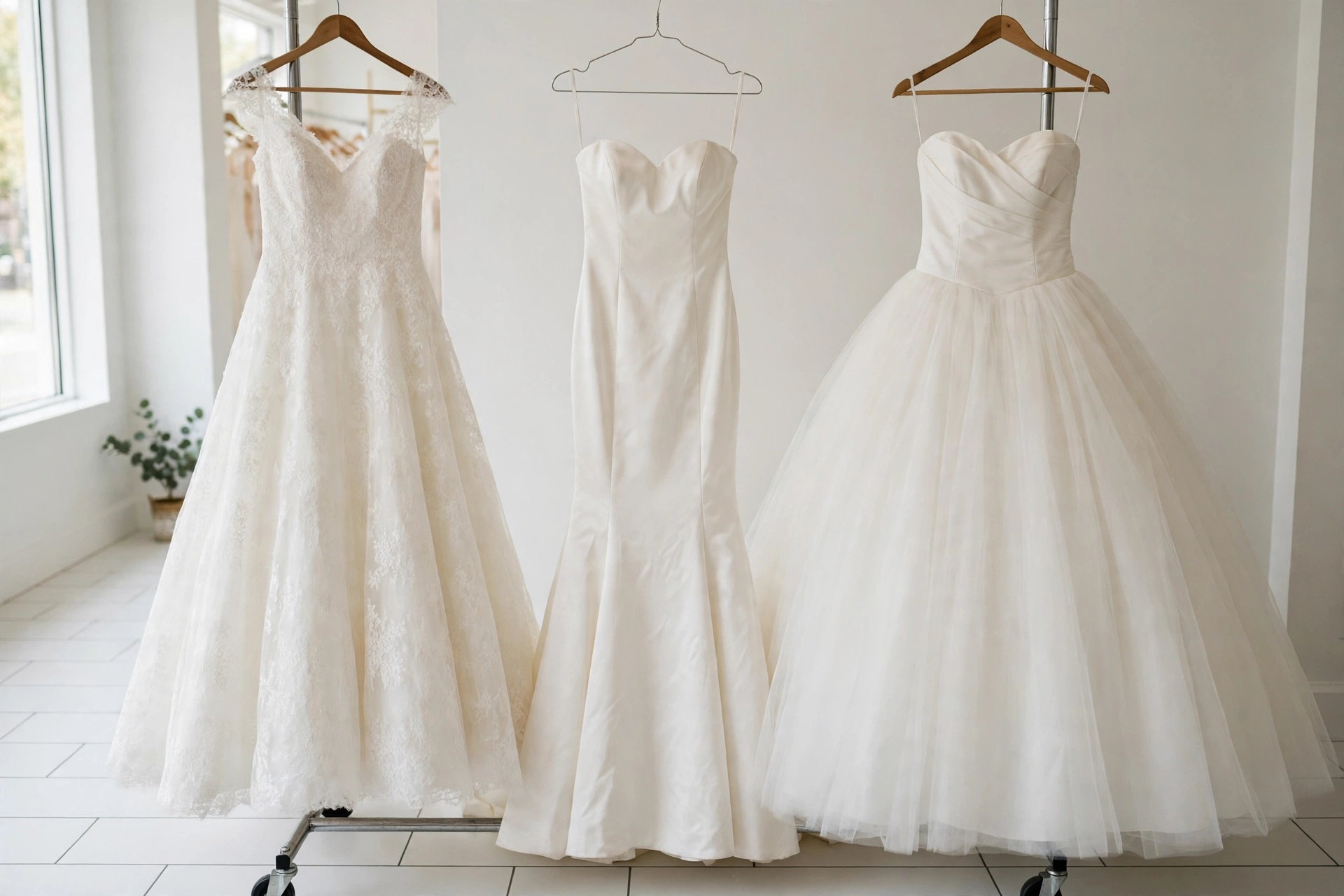
The mirror lies for about twenty minutes
A standing bride is the easiest bride a factory will ever dress. Standing hides almost everything a pattern gets wrong.
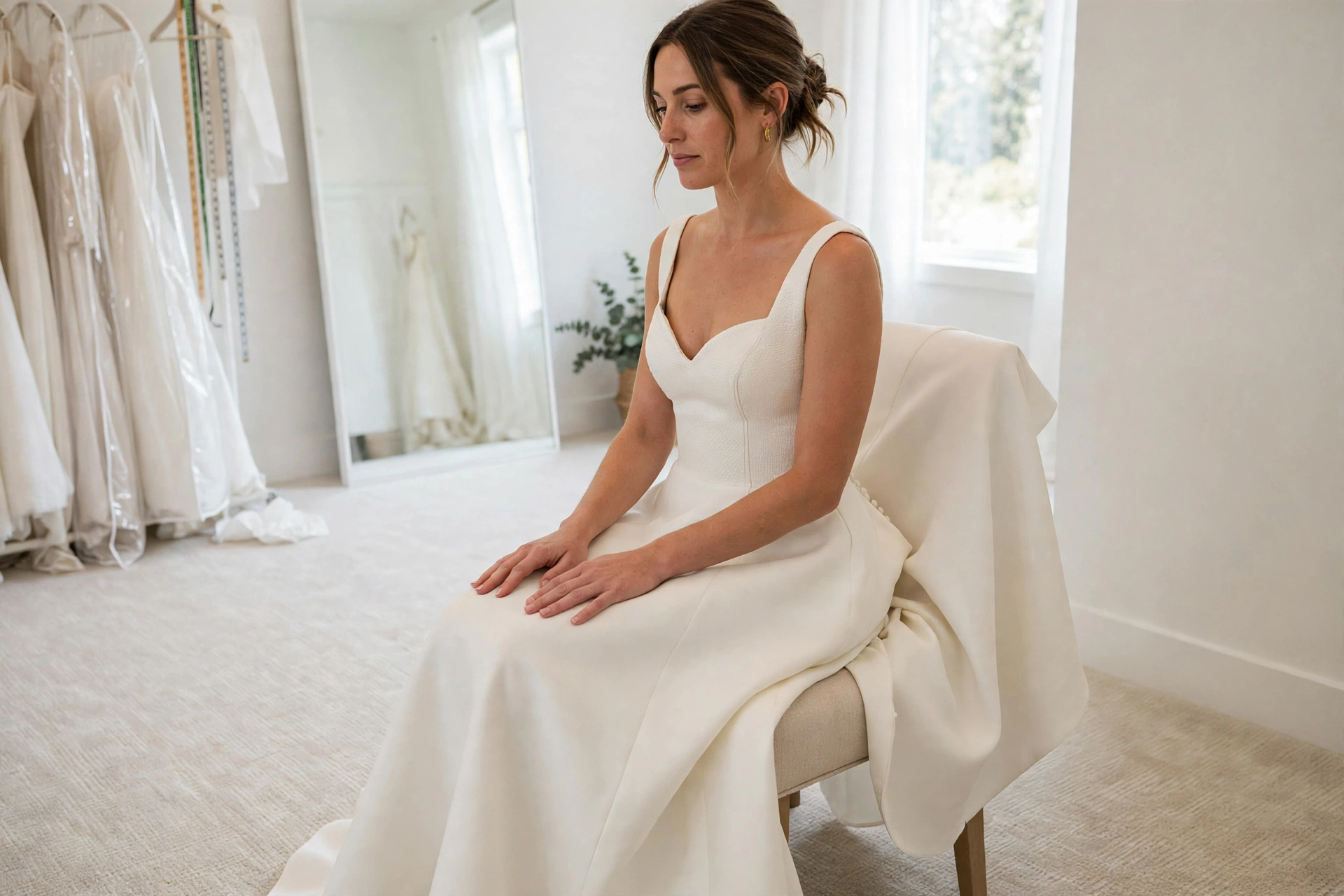
Take the sitting problem, because it is the one I see buyers miss year after year. An A-line skirt gets measured, hemmed and photographed standing up. Then a real person sits, and the front of that skirt lifts something like four to six centimetres while the back pools and drags, and the waist seam that sat so flat in the fitting starts to ride and bite. Nothing broke. The dress was simply never tested in the position a bride spends half her wedding in. In the sample room we know this, which is why the older pattern makers make the girl sit before they sign anything off. Sit, stand, sit again, reach for something on a table. Four small movements. A surprising number of bought-in samples have clearly never been through them, because the moment you sit, the bodice tells on itself.
The same thing happens with a fitted shape, only louder. A mermaid that photographs like a dream can turn into a dress a bride cannot climb two steps in, and she finds that out on the day, not in your shop, because nobody asked her to climb anything. I have watched buyers blame the bride’s body for that, in emails, in those exact words. The body was fine. The sample was tested standing still under good light by a woman who wears samples for a living. That is a different job from wearing a dress for eleven hours.
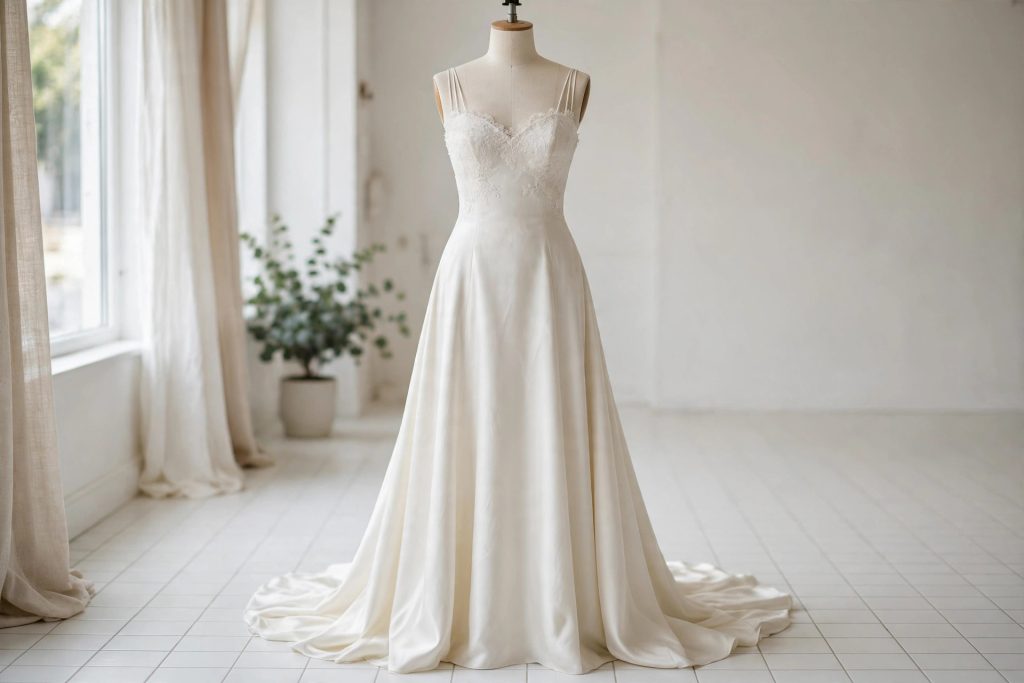
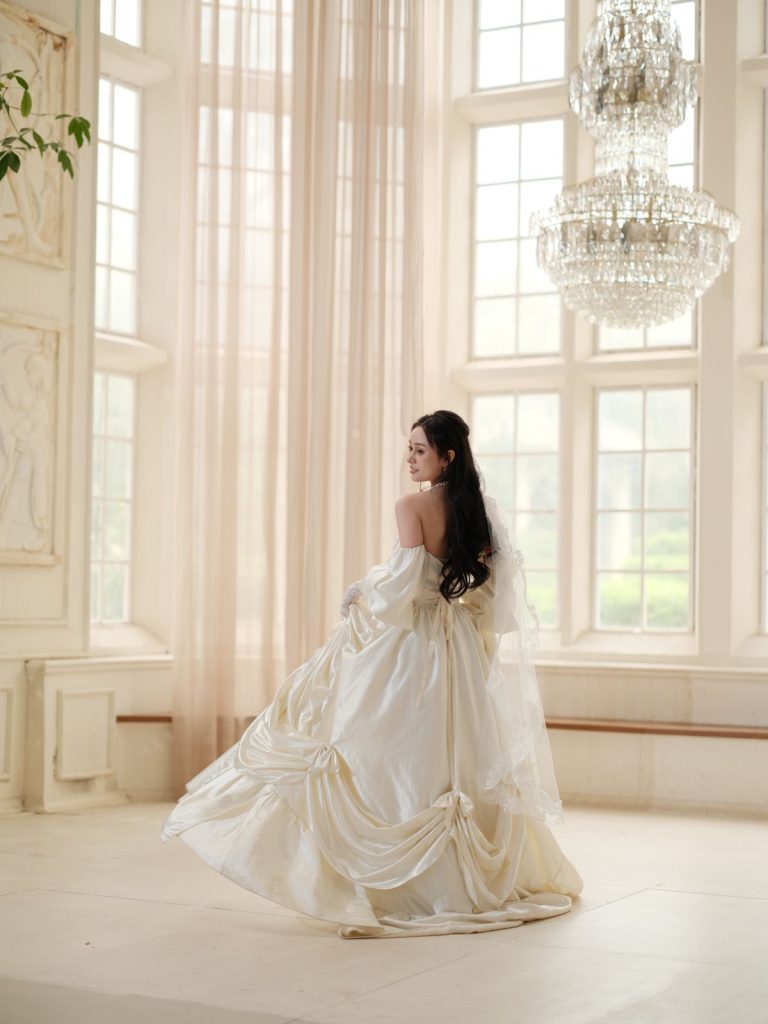
Silhouette choice for a shop is really a bet on bodies you have not met yet. Simple wedding dresses with a clean A-line and a bit of give at the waist forgive the widest range of those bodies, which is why they keep selling long after louder shapes have had their month. A ball gown forgives hips and punishes short torsos. A sheath forgives nobody and photographs like it forgives everybody. When you choose stock, you are not choosing the best dress in the room. You are choosing which complaints you would rather have, because you will have some, and a shape that fails gracefully in alterations is worth more than a shape that is flawless on one girl and unwearable on the next three.
Satin shows everything the sample hid
If a satin gown has a wavy zip, the sewing is probably innocent. The damage was done at the pressing table.
That one took me years to accept, because on the line we blame stitching first. But satin remembers heat. Press it too hot or too long while the zip goes in and the fabric around the seam takes a shine and a ripple that no amount of careful sewing put there, and under shop light it reads as cheap, which is a cruel word for what is really a temperature mistake. Good factories press satin gowns from the inside, with a cloth, at a heat the operator would rather argue about than guess. Bad ones press them the way they press everything else, fast, because the order behind yours is already late. When you look at satin wedding dresses for your shop, run your hand down the back seam in daylight if you can. A wave you can feel with your palm will photograph ten times worse on a phone at a reception, in flash, at an angle nobody chose.
Colour does a similar trick, and this one still catches experienced buyers. Ivory is not a colour. It is a family of warmths that happen to share a name. The lace comes from one supplier, the tulle from another, the lining from a third roll that was already in the building, and under warm workshop light all three of them agree with each other beautifully. Take that same bodice to a north-facing window and the lace sits a touch cream against a skirt that has gone faintly green-white, and the bride sees it before you do because brides look at dresses in the kind of light weddings actually happen in. On our side there is a boring habit that prevents most of this. Somebody carries the whole dress, not a swatch, to the window before the bulk gets cut. Swatches lie by being small. A whole bodice cannot hide.
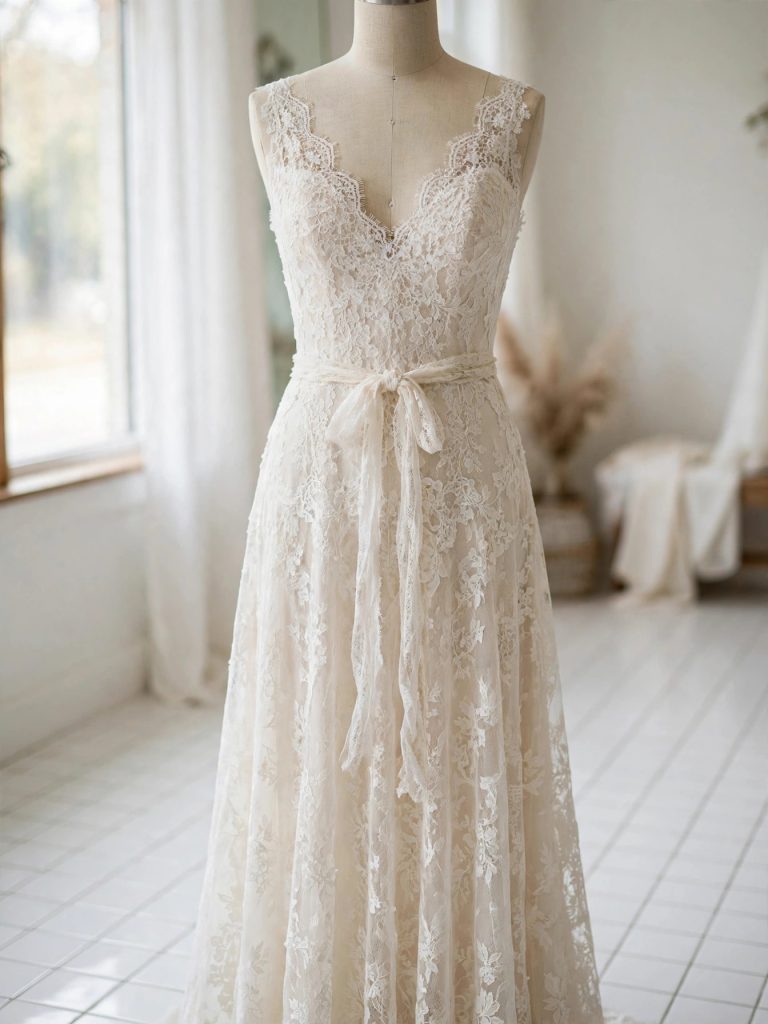
A lace wedding dress asks one more question that buyers rarely think to ask, and it lives right on the back. Where the zip runs, the lace pattern has to be cut apart and placed back over the seam by hand, motif by motif, or the zip line shows through the pattern when lace panels are simply sewn straight over it. No wait. Scar is too neat a word for it. It shows as a hard straight interruption in a pattern that is supposed to wander, and once you have seen it on a dress you cannot unsee it on any dress. That hand work costs something like twenty minutes a gown, give or take, and it is one of the first things to quietly disappear when a price gets squeezed. The sample on your rail will have it. Ask, in writing, whether the bulk will too, and keep the answer.
Boning deserves the same suspicion, handled gently. A well made corset wedding dress holds a bride up without making her aware of it, and the difference between that and a bodice that digs is often a centimetre and a half of nothing. The boning has to stop short of the seam and the tip has to be capped, because a tip that runs right into the waist seam will work its way through the lining and start to poke after a couple of hours of sitting and standing. You cannot see any of that from outside a finished dress. You can feel for it, though, pinching along the channels at the waist of your sample, and you can read what other buyers learned the hard way in our guide to whether a corset wedding dress is well made before you commit to a run of them.
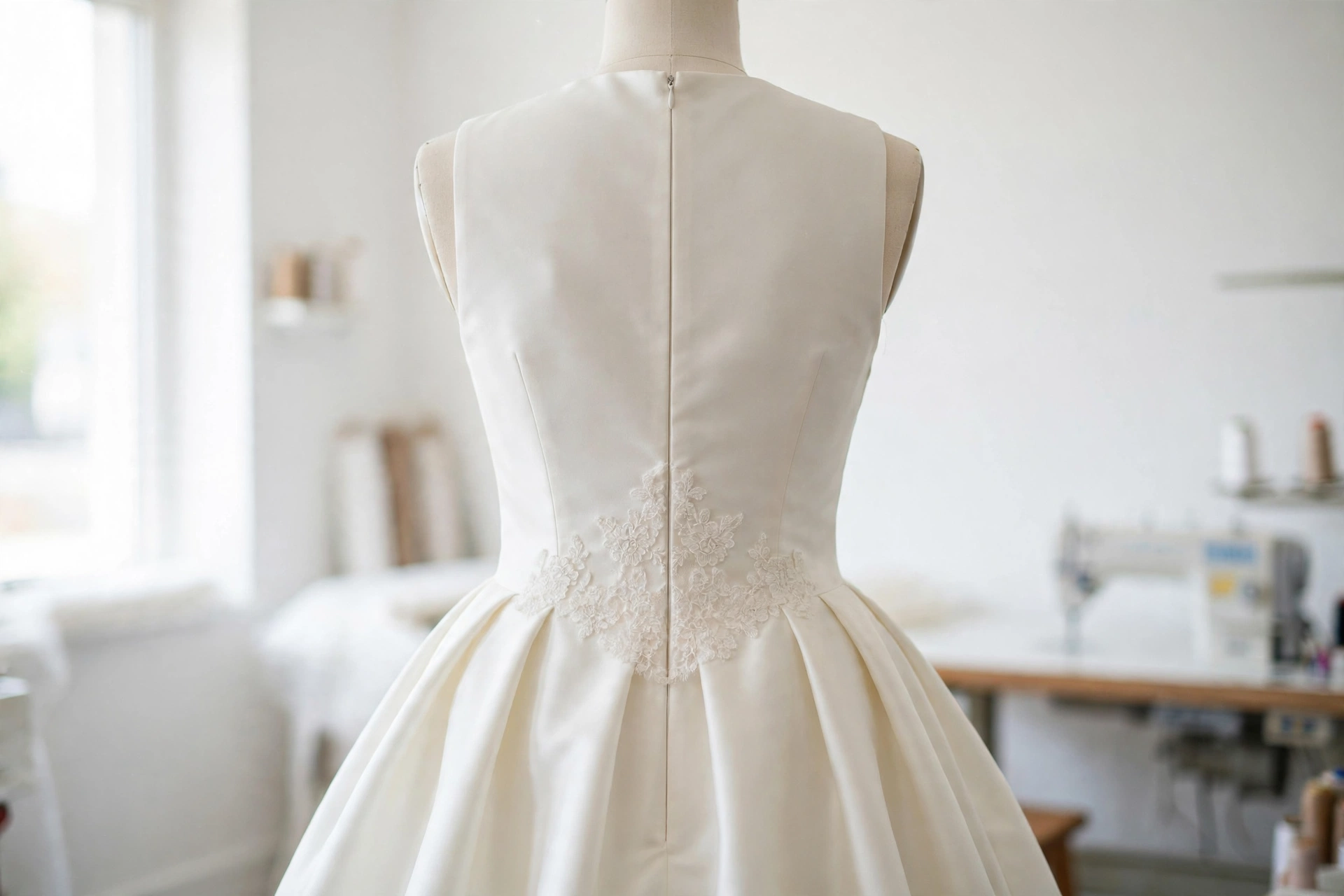
The lining decides whether she can sit
Nobody buys a lining. Brides buy the outside of a dress and live in the inside of it.
Under a train, the lining has to be cut shorter than the shell, two or three centimetres shorter, or the lining starts to peek out from under the hem as the bride walks and the whole back of the dress looks unfinished in every photograph taken from behind her. Which is most of the photographs. Cutting the lining a touch short costs the factory nothing in fabric worth arguing about. It costs attention, which is a scarcer thing on a busy line, and attention is what disappears first when a delivery date moves closer. I would rather a buyer asked me about train lining length than about almost anything on the front of a dress. The front is where factories show off. The underside is where they tell the truth.
Length in general behaves badly once a dress leaves the rail. A hem measured on a form is a hem measured on something that never bends, never wears heels two centimetres higher than planned, never stands on grass. Tea length and chapel length are names, and names drift between suppliers the way shoe sizes drift between countries. One factory’s chapel is another factory’s sweep with ambition. If you order by name alone you will, sooner or later, open a carton and find a train that is nobody’s fault and entirely your problem. Centimetres are dull and they do not drift. Put the number in the order, measured from the waist seam down the centre back, and make the factory confirm that number back to you rather than confirming the pretty name you sent them.
Returns teach the rest of this, if you let them. Spend one evening reading why dresses actually come back and a pattern settles that has very little romance in it. Colour in real light. Weight nobody warned her about. A bodice that fit at eleven in the morning and argued with her by lunch. We wrote up what boutiques keep hearing, season after season, in our piece on satin wedding dresses and the different from picture problem, and honestly I get half of it wrong myself when I try to predict which style will bounce back next spring. What I do trust is the boring end of the data. Dresses that were sat in, walked in and carried to a window before the order was signed come back less. That is not a slogan. It is just what is left when you remove every dress that skipped those ten minutes.
Ten pieces is where the truth shows up
A single sample proves a factory can make a dress once, slowly, with its best people watching. Ten pieces prove what your customers will actually receive.
Our minimum sits at 10 pieces per style for wholesale, colours and sizes mixed, and I know buyers sometimes hear a number like that as a hurdle. From this side of the table it reads differently. A run of ten is the smallest run that behaves like production rather than theatre. The second dress is sewn by someone who did not sew the first. The pressing gets done at production speed instead of sample speed. The lace placement over the zip gets done by the line, not by the sample master whose hands are in every photograph the factory ever sent you. If a style falls apart as a buying decision, ten is usually where it falls, and falling at ten is survivable in a way that falling at sixty is not.
Checking that run is its own craft and it is not the same craft as checking a sample. Lay two sizes side by side, not one dress alone under good light. Measure the train on the largest size, because grading stretches a train in ways the base size never warned you about. Pull the zip on the smallest size with the dress on a person or a form, not hanging empty on a rail, because an empty dress will forgive a tight zip that a body will not. Our working notes on quality control on bulk wedding dress orders go through the rest of that routine in the order we actually do it, including the parts that feel petty until the first time they save an order.
Price fits in here, in the unglamorous middle where it belongs. A very cheap quote on a dress with hand placed lace, a capped boning channel and a properly short train lining is a quote that has quietly removed one of those things, and the removal will not be announced. Factories rarely lie to buyers in words. They lie in omissions, in the twenty minutes that vanish from a process nobody itemised. So when two quotes for the same style land far apart, I no longer ask which factory is greedy. I ask which twenty minutes the cheaper one is not spending, and I ask it out loud, before the deposit, while the question is still cheap to ask.
Questions buyers ask me after the first order goes wrong
The sample fit perfectly in the shop. So why do brides say the bulk dresses run small?
The bulk dresses usually run true to the bulk pattern, and the sample was the one telling the kind lie. Samples get made, adjusted, steamed and made again in a small room where the pattern can be nudged for the girl in front of them, and that nudged version is what you fell for. Then the order goes to the line and gets cut from the graded pattern exactly as written, no nudging, and a half centimetre that a fitter absorbed without mentioning it shows up on three sizes at once. I would rather find that out measuring my own sample against its own spec sheet, tape in hand, than read about it in a review in July.
10 pieces per style is the minimum. Is that real, or does the price change once I commit?
10 pieces per style is real, with colours and sizes mixed inside those ten. What does change, and this is the part nobody budgets for, is everything around the ten. A custom lace the mill has to weave for you can run two to four weeks before the sample room sees it. A second fitting round adds its own days. The ten dresses themselves are the predictable part of the order. The calendar around them is where buyers get hurt, usually because they counted from the day they sent the email rather than the day the cloth was confirmed.
A quote came in 20% under the others for the same lace dress. Where did the money actually go?
Usually it went out of the work you cannot photograph. The lace over the zip seam gets sewn straight through instead of cut and placed back by hand, which saves the twenty minutes I mentioned, and the boning tips stop being capped, and the train lining gets cut the same length as the shell because measuring it short takes a moment somebody stopped taking. None of that shows in the pictures the factory sends you, which is the whole problem. I have opened cheap dresses that looked fine for a full minute. It was the second minute, turning them inside out, that explained the price.
She loved it standing up and hated it by the reception. What did we miss in the fitting?
Usually the chair. A bride in a shop stands, turns, stands some more, maybe walks six steps to the mirror and back, and a dress can pass every one of those tests while still riding at the waist, lifting at the front hem and arguing with her ribs the moment she sits through a meal. Sit her down. Let her reach across a table. Let her stand up without help and without holding her breath. It takes four minutes and it feels slightly awkward in a pretty fitting room, which is probably why shops skip it, and I understand that, and the dresses still come back.
I still keep one sample in the workshop that passed every standing test we gave it and failed, completely, the first time a girl sat down to lace her shoes in it. We never fixed that pattern. We just stopped selling the style, which felt like losing at the time and now feels like the cheapest lesson the building ever taught us, and I think about it every time a new style photographs a little too well.
Follow our channels for new styles and factory updates: WhatsApp Channel · Telegram Channel